


You’ve offered the perks, the flexibility, and maybe even a mental health day or two, but your team still seems off. They’re quiet in meetings, slow to respond, and the energy just isn’t there. Managers often assume that low employee engagement means their team just needs more motivation. But often, the real issue is employee experience, and the two aren’t the same.
Employee experience is everything your people go through at work, like daily interactions, policies, and peer treatment. Employee engagement, on the other hand, is how they respond to that experience. It’s whether they care, contribute, or simply check out.
When the experience is poor, engagement drops. That disconnect is costing businesses a staggering $8.8 trillion in lost productivity, according to Gallup’s ‘State of the Global Workplace: 2023 Report.’
The good news is that when you understand how experience and engagement work together, you can turn things around.
What is employee experience?
Employee experience is the complete journey of an employee with a company. And it starts way before their first day at work. From the moment they come across your job ad to their tenure and how they exit the company, it’s all part of the experience.
Think about it. A job description that makes sense, a smooth onboarding, a workspace that provides resources to grow and managers who listen. That’s the kind of experience you’d want, right?
Understandably, HR and managers play a huge role in making this experience better (or worse). When things are messy or people feel ignored, the experience breaks down and engagement usually follows.
What is employee engagement?
Employee engagement is how motivated, committed and connected employees feel to their work and their workplace. Do your team members care about their goals? Do they take initiative and feel proud of their work?
If the answer is no, it’s a sign your engagement strategy needs attention. But how do you bring better engagement? By improving the employee experience. When employees are truly engaged, they don’t just meet expectations, they go beyond them. Not because they have to, but because they believe their work has purpose.
And just like experience, engagement is shaped by a manager’s support. The way you communicate, give feedback and guide your team plays a huge role. A lack of it can cost you top talent, directly affecting the company’s growth.
Key differences between employee experience and engagement
Both employee engagement and experience are connected, but still different. How does that work?
Let’s understand employee engagement vs employee experience with a table.
| Area | Employee Experience (EX) | Employee Engagement (EE) |
| Scope | Covers the full employee journey, from pre-hire to exit. | Focuses on current commitment, energy and enthusiasm. |
| Input vs output | EX is the input. What the company creates. Systems, culture, tools, environment, etc. | EE is the output. How employees respond to the systems with their commitment, involvement, ownership, etc. |
| Timeframe | Long-term and cumulative. Evolves through every interaction. | Short-term and can change depending on daily experiences. |
| Responsibility | Shared by HR, leadership, IT and others across the company. | Mostly influenced by direct managers and team leads. |
| Measurement | Tracked through lifecycle surveys, exit feedback and culture ratings. | Measured through pulse surveys, performance and goal alignment. |
They are like two sides of the same coin. Understanding the key differences in employee engagement and experience can help you make better decisions.
Why are both essential for business success?
You can’t have sustainable business success without addressing both employee engagement and experience. Here’s why.
- Higher productivity: Engaged employees give their best. And when the overall experience is strong, you see a higher return on sales compared to businesses that overlook this.
- Better retention: People don’t leave jobs where they feel good. If your team feels supported and valued, they’re far more likely to stay. Fewer exits mean you save on rehiring and keep valuable knowledge in-house.
- Improved innovation: When your people feel empowered, they speak up, contribute ideas and solve problems faster. This creates better teamwork, a healthier culture and service delivery because satisfied employees take care of customers better.
- Positive brand image: When happy employees talk about your company in a positive light, it helps attract great talent. That makes hiring easier and smarter.
In short, it’s not really about employee engagement vs employee experience. Good experience drives engagement, which drives performance, which improves culture and so on.
How to improve employee experience and engagement
This is where the real work begins. You know the differences in employee experience vs employee engagement. Now, how do you improve both? Here are some key areas you can focus on.
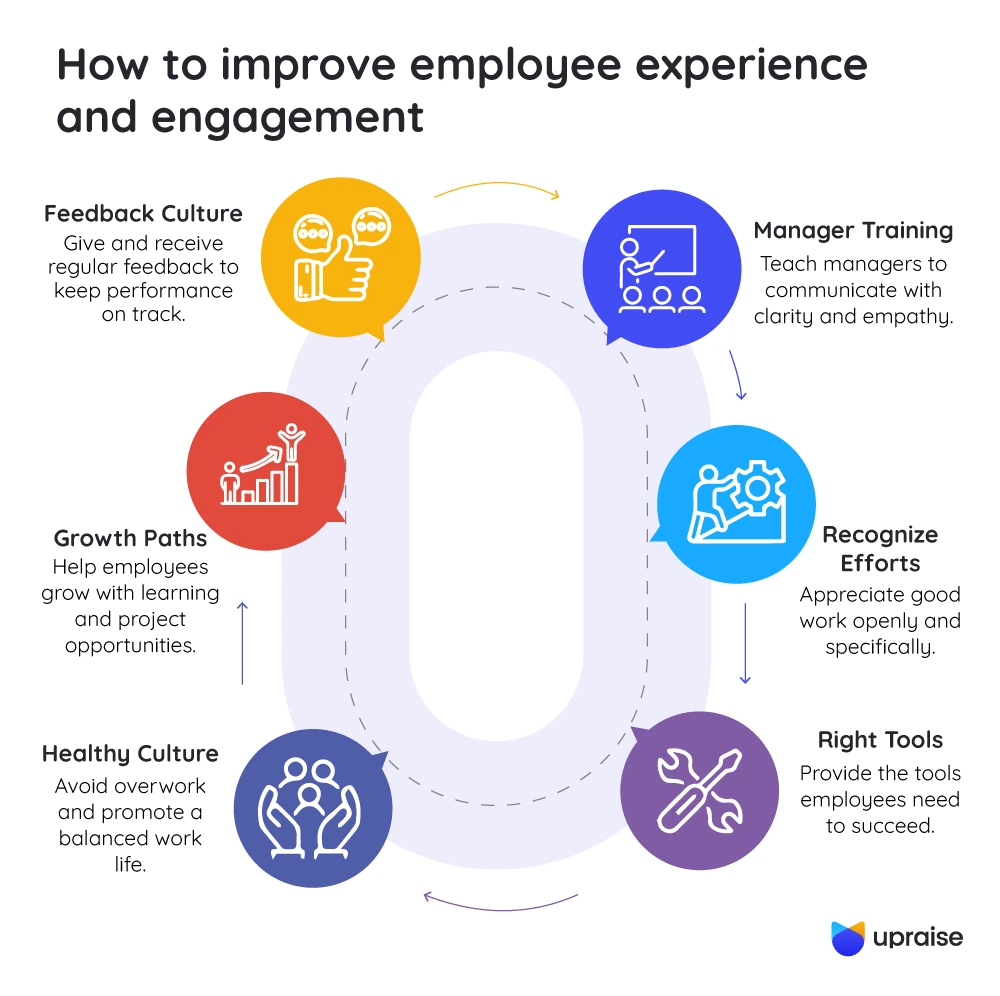
Create a feedback culture
Don’t wait for quarterly reviews to talk about performance. Keep feedback flowing all the time. A quick comment after a task or a weekly check-in can go a long way. Needless to say, it should be honest yet constructive feedback.
But it doesn’t go one way. Create an environment where employees feel comfortable sharing their feedback and experiences. Use this feedback to improve further. This helps employees feel seen and helps you course-correct early.
Train managers in positive communication
A negative performance review does more harm than good. Managers shape the experience more than anyone else. Equip them to speak clearly, kindly and constructively.
Provide them with consistent training about effective communication and team management. Run short role-play sessions or give them feedback templates to guide conversations. A little training goes a long way in building trust.
Reward good performance
Building a recognition culture is the simplest way to boost morale. If someone handles a tough client well, mention it in the next team meeting. If a teammate picks up extra work during crunch time, drop a note of appreciation in your group chat or email.
Don’t stop at a simple “Good job!”. Tell them what they did well and why it’s appreciated. Recognition doesn’t need to be big. It just needs to be timely and genuine.
Give employees access to the right tools
You can’t expect people to do great work without the right support. This includes functional equipment, good software and even a comfortable desk. Your IT team can’t work with computers that heat up enough to boil an egg, right? But it doesn’t end with employees.
You also need to level up by using effective performance tools.
Tools that integrate performance management into your existing workflows can drive alignment and efficiency. A Jira-integrated Agile performance management app like UpRaise for Employee Success turns performance management into something ongoing. It helps you manage goals, feedback and reviews right where you already work.
Look for tools that help tie goals to outcomes using approaches like Objectives & Key Results (OKRs).

Whether you’re a startup or a large company, the right platform can support real-time recognition and performance visibility.
Encourage a healthy work culture
The goal is to encourage employees to do purposeful work. But that shouldn’t mean working around the clock. Don’t let overwork become the norm. But why is it important? Here’s a fact check. Out of 2000 US professionals, 36% reported feeling burnt out at work and 30% said they lack support or recognition from their manager.
This culture can harshly affect the company’s productivity in the long run. It’s a gap you can close simply by being patient and empathetic.
Provide career growth opportunities
Discuss growth goals during one-on-ones, not just in formal reviews. If someone wants to lead projects, let them co-lead the next sprint.
Offer access to online courses or invite them to sit in on strategy meetings. These small steps show that you’re invested in their future and care about their growth.
Performance is built on trust, clarity and support. Start with these steps and you’ll see both experience and engagement rise.
Conclusion
We all work better when treated right. Once you understand the key differences in employee engagement and experience, you can build a team that feels motivated and valued. As a manager, your job is to create that balance. Check in regularly, give credit where it’s due and support their growth.
When you focus on both, you don’t just retain talent, you get their best work. If you want to drive better team productivity, start by making your employees feel valued.
FAQs
Q1: What is the difference between employee experience and employee engagement?
Experience is how an employee is treated on a day-to-day basis in a company. Engagement is how motivated and productive they are as a result. Both are different, but collectively drive growth.
Q2: How can employee experience impact retention?
When people feel respected and supported at work, they’re likely to deliver and stay longer. A poor experience makes even well-paying roles hard to hold on to.
Q3: What strategies can improve both employee experience and engagement?
Employee engagement and experience are closely linked. You can improve growth with strategies like taking care of requirements, practicing empathy, giving regular feedback, rewarding accomplishments and providing growth opportunities.
Q4: Why is employee engagement important for organizational performance?
Engaged employees care more, take ownership and show up creatively motivated. That kind of commitment directly impacts results and team morale.


