
What is strategy implementation, really? It’s that stage where most great ideas start to lose momentum, not because the strategy wasn’t smart, but because execution didn’t follow through.
Think about it. You’ve spent weeks shaping a solid plan. The goals are big, the team’s excited, and the kickoff meeting feels promising. But as time passes, energy dips. Priorities shift. Progress slows. And what once looked like a clear path starts to feel like a moving target.
According to a report by Bridges Business Consultancy, only 5% of organizations consistently hit 90% or more of their strategic goals. That’s not a reflection of poor planning but a sign that the strategy implementation process needs attention.
In this blog, we’ll break down the strategy implementation process into six practical, results-driven steps. You’ll learn how to apply strategy execution best practices using Agile thinking and real-world examples. Along the way, we’ll explore how centralizing goals and performance insights can make the difference between plans that sit in slides and strategies that get the work done.
What is strategy implementation?
Strategy implementation is the process through which an organization translates its defined strategy into actionable initiatives, policies, and activities that achieve specific business goals. It involves allocating resources, establishing timelines, assigning responsibilities, and monitoring performance to ensure alignment with strategic objectives.
It acts as a bridge between what needs to be done and actually doing it.
Understand the strategy implementation plan with an example:
Let’s take Starbucks. Back in 2008, the company faced a sharp decline in sales. Their CEO, Howard Schultz, initiated a new strategy to revitalize the brand, focusing on improving customer experience and store quality. The strategy included closing underperforming stores, retraining baristas, and redesigning store layouts.
But it wasn’t the strategy alone that turned things around—it was how effectively it was implemented. Schultz personally led the charge, restructured leadership, and embedded the new focus into daily store operations. Within a few years, Starbucks not only bounced back but also reported record earnings.
Key steps for successful strategy implementation
Here are six essential steps to move from vision to execution successfully:
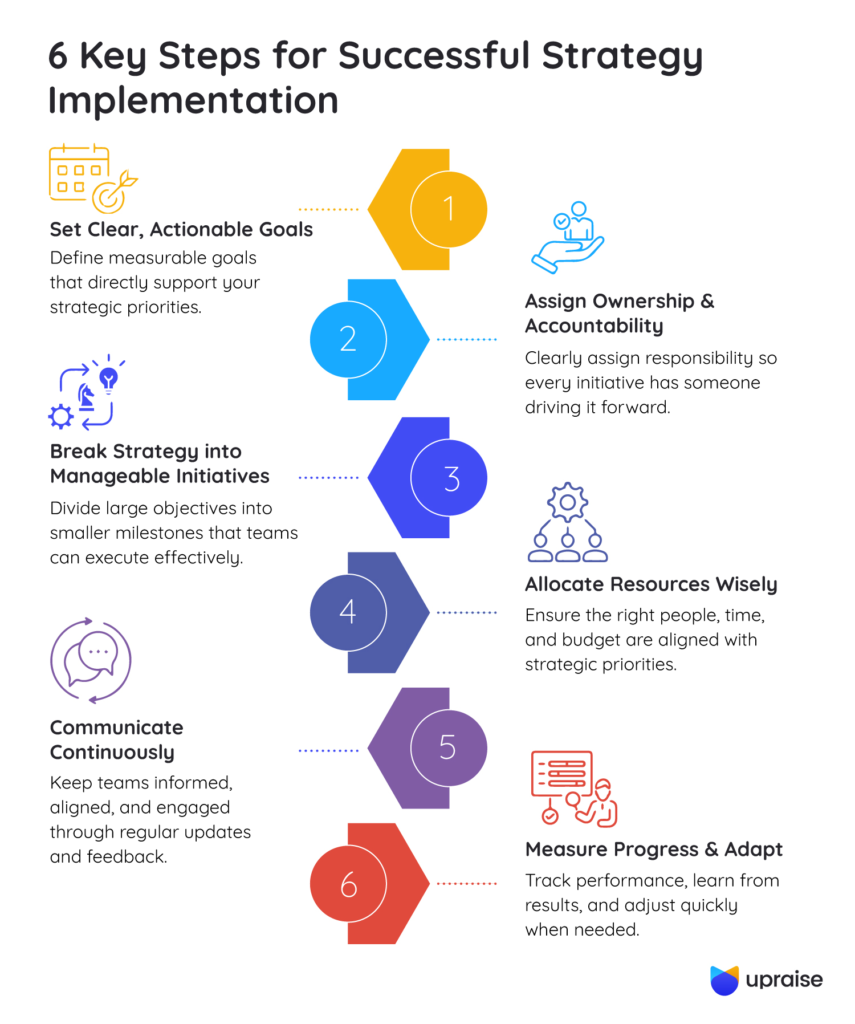
1. Set clear, actionable goals
Your strategy won’t implement itself. Start by translating high-level objectives into specific, measurable goals that teams can own. In Agile terms, think of it like breaking down an epic into smaller, achievable user stories.
Tip: Link every goal directly to a strategic priority so teams understand the bigger picture they’re contributing to.
How UpRaise helps: UpRaise for Employee Success makes it easier to define and manage goals that are rooted in your company’s strategy. You can set OKRs at the organizational, team, or individual level, so everyone has a clear path forward.
The Tree View layout adds a visual layer to that structure. It shows how each OKR connects upward, helping teams see how their day-to-day work ladders up to something bigger. That kind of visibility strengthens focus, ownership, and follow-through.
2. Assign ownership and accountability
Assign clear ownership for each initiative. Someone needs to drive the work forward—not just manage tasks but also remove roadblocks and adjust priorities when needed. This keeps the strategy implementation process dynamic, rather than static.
Tip: Use RACI matrices (Responsible, Accountable, Consulted, Informed) to map out responsibilities transparently.
How UpRaise helps: With UpRaise, each goal, initiative, or key result can be clearly assigned to a specific individual, so there’s no ambiguity about who’s responsible.
Through regular Check-ins, employees can share quick updates, while managers stay in the loop on what’s moving and what’s stuck.
The platform’s Goal Hierarchy and visibility settings also make it easy to see ownership across the board. This reduces overlap and makes sure nothing goes wrong.
3. Break down the strategy into manageable initiatives
Massive strategies can overwhelm teams if not divided properly. Take a lesson from Agile: break initiatives into sprints, create smaller projects, and deliver value in increments.
Tip: Organize initiatives into phases, milestones, or deliverables, just like you would organize tasks into iterations during product development.
How UpRaise helps: UpRaise allows you to use cascading OKRs to break big-picture objectives into smaller, more actionable goals. Teams can work toward long-term outcomes through shorter, time-bound cycles, like quarterly OKRs, without losing strategic direction.
When connected to Jira, strategic goals stay visible at the task level. This ensures that day-to-day work is tied back directly to the larger mission.
4. Allocate resources wisely
Without enough time, budget, or people, even the strategy implementation best practices fall short. Resource planning must be part of the early execution phase, not an afterthought.
Tip: Revisit allocations regularly—priorities change, and your resources should, too.
How UpRaise helps: While UpRaise doesn’t manage financials or hiring plans directly, it gives managers a clear view of goal assignments and progress across the team. That visibility helps spot who’s stretched thin and who might have room to take on more.
Check-ins offer an additional layer of real-time insight, surfacing blockers or resourcing concerns before they become bigger issues. And through the Feedback module, employees can flag when they need support or when a process is slowing them down, helping you course-correct before productivity drops.
5. Communicate the plan, and keep communicating
Communication isn’t a one-time announcement. Teams need continuous updates, feedback loops, and a shared sense of purpose to stay motivated. Strong communication is a hallmark of strategy execution best practices.
Tip: Hold sprint reviews, retrospectives, or check-ins to ensure alignment and tackle challenges early.
How UpRaise helps: UpRaise, Check-ins, and Retrospectives give teams a structured way to share updates, voice concerns, and reflect on what’s working.
Its Jira integration keeps these conversations tied directly to the work being done, so strategic context isn’t lost. Review cycles also create space for regular, focused discussions around progress, challenges, and alignment—turning communication into an ongoing habit, not a reactive fix.
6. Measure progress and adapt quickly
Finally, real-time tracking of progress ensures that the strategy implementation doesn’t drift off course. Set clear KPIS and use dashboards to make performance visible to all stakeholders. And remember: agility is your strength. If something isn’t working, adapt.
Tip: Celebrate quick wins to maintain momentum and foster a culture of continuous improvement.
How UpRaise helps: UpRaise offers real-time progress tracking through Goals and OKRs, so managers and teams always know where things stand. The dashboard view gives a clear snapshot of how individuals and departments are advancing toward strategic initiatives.
Check-ins make it easy to surface blockers and shift direction when needed, without waiting for formal reviews. And when milestones are hit, UpRaise’s Recognition and Feedback modules help you celebrate wins publicly, building a culture that values progress.
Common challenges in strategy implementation
Even with a solid strategy implementation plan in place, it’s not always a smooth ride. But the positive part is that most challenges can be anticipated and tackled early if you’re paying attention.
Here are a few common ones that trip teams up:
- Lack of clear communication – When teams don’t fully understand the strategic objectives, execution suffers. Successful strategy implementation relies on continuous, two-way communication across all levels.
Example: A sales team may focus on boosting lead volume, unaware that the strategic goal is to improve lead quality. Without alignment, their work looks productive but isn’t even moving the needle.
- Unrealistic or vague goals – A strategy implementation process anchored in broad or impractical goals often leads to confusion and wasted effort. Goals must be specific, achievable, and tied to measurable outcomes.
Example: A product team is told to “increase engagement,” but the goal isn’t defined. Without clarity, whether that means more active users or longer session times, they end up working in different directions.
- Poor resource allocation – Without adequate staffing, budget, or time, even the best strategies stall. Revisiting your strategy implementation plan regularly ensures resources are rebalanced when priorities shift.
Example: A marketing team may be tasked with launching a multi-channel campaign, but with only one designer and no additional budget, the output gets delayed—or worse, diluted.
- Resistance to change – People naturally resist new initiatives, especially when they are unclear about the reasons behind them. Embedding strategy execution best practices, like early stakeholder engagement, can reduce friction.
Example: When a company rolls out a new OKR system without explaining the rationale, teams may view it as micromanagement instead of a tool for focus and growth.
- Lack of performance tracking – Without clear metrics, it’s impossible to know whether the strategy is working. A strong strategy implementation process builds in frequent performance checks and adaptation points.
Example: A customer success team may assume satisfaction scores are high because complaints are low. But without tracking NPS or collecting direct feedback, they miss early signs of churn.
Efficient strategy implementation with Upraise
Strategy only works when it moves off the whiteboard and into action. But turning ideas into outcomes takes more than planning — it demands consistency, focus, and the ability to adapt. That’s what makes mastering the strategy implementation process so essential.
A correct strategy can bring structure to the implementation process, and tools like UpRaise for Employee Success will help you in achieving this. It integrates goal setting, OKR tracking, continuous feedback, and real-time performance insights directly into your everyday Jira workflows. This helps teams stay aligned, adapt quickly, and measure progress with clarity. It also brings much-needed transparency and agility to the strategy implementation process, ensuring that execution stays visible and doesn’t get lost in daily operations.
UpRaise also simplifies progress reviews through Check-ins and dashboards, which makes it easier to track momentum and adjust when needed. And with features like Recognition and Feedback, it supports the human side of strategy, keeping teams engaged and motivated along the way.
The best time to rethink your strategy execution best practices is now. Start small, adapt fast, and watch your ideas take flight.
FAQs
What are the main challenges in implementing a business strategy?
Common challenges include vague goals, weak communication, limited resources, resistance to change, and leadership losing focus along the way.
How do you ensure effective communication during strategy implementation?
Keep teams updated regularly, use simple messaging, and create easy ways for people to ask questions or share feedback throughout the process.
What role does leadership play in the successful implementation of a strategy?
Leadership drives commitment, provides direction, removes obstacles, and ensures that the strategy stays prioritized across all teams.
How can you measure the progress of your strategy implementation?
Define clear KPI, track milestones consistently, and use tools that give you real-time insights into how things are moving on the ground.