

Career development should no longer be treated as a “nice-to-have” perk. Today, it’s a growth engine for both your people and your organization. Employees today don’t just work for a paycheck. They work for progress. If your organization doesn’t help them grow, someone else will. And when talented people leave, it’s a business setback that costs time, money, and momentum.
Now imagine two of your best employees growing into new leadership roles within your company. They feel valued, challenged, and supported in their journey. Instead of seeking growth elsewhere, they mentor new hires, take ownership of projects, and contribute to innovation. This is what happens when organizations invest in career development early. They retain top talent and inspire excellence from within.
This article will explain how career development programs can benefit your organization. You will also learn how to implement and measure the success of a career development program with ease.
What is career development and why does it matter?
Do you feel the spark that once drove your team isn’t there anymore? Your top performer still meets targets, yet their energy feels heavy. What you’re seeing is not a case of burnout but the quiet weight of stagnation. Career development is the process that keeps this from happening.
Career development is a way to provide direction, helping your employees envision a future within your company rather than at your competitors. Mentorships, skill-based challenges, and project rotations are simple ways to make employees feel they are growing each day.
According to LinkedIn’s Global Talent Trends report, 94% of employees say they would stay longer at a company that invests in their learning and development. The irony? Most companies wait to act until those same employees resign.
The silent cost of ignoring it
Research shows that replacing a single experienced employee can cost up to twice their annual salary. That number includes the visible expenses like recruitment, onboarding, and training, but the real cost runs deeper.
Every time a seasoned employee leaves, you lose:
- Their unspoken knowledge
- The shortcuts they’ve learned
- The trust they’ve built with clients
- The influence they carry within the team
- And much more
Workplace morale also takes a back seat as others start to wonder if they should do the same. Workflow slows as new hires struggle to match the same rhythm. Projects that once ran smoothly suddenly need more supervision. The organization spends months rebuilding what one departure quietly erased.
When you add it all up, the loss isn’t just about money or productivity. It’s about momentum, something that takes years to build and only moments of neglect to lose.
Today’s workforce doesn’t just want jobs; they want journeys. Don’t think of career development as a retention tactic; it’s a growth strategy for your business.
How career development programs benefit organizations?
Career development programs act as a buffer against this risk by keeping your employees engaged and committed. Research from Gallup shows that companies with strong learning cultures have 21% higher profitability than those that don’t. The reason is simple: when employees grow, your business grows with them. Let’s take a look at some of the benefits:
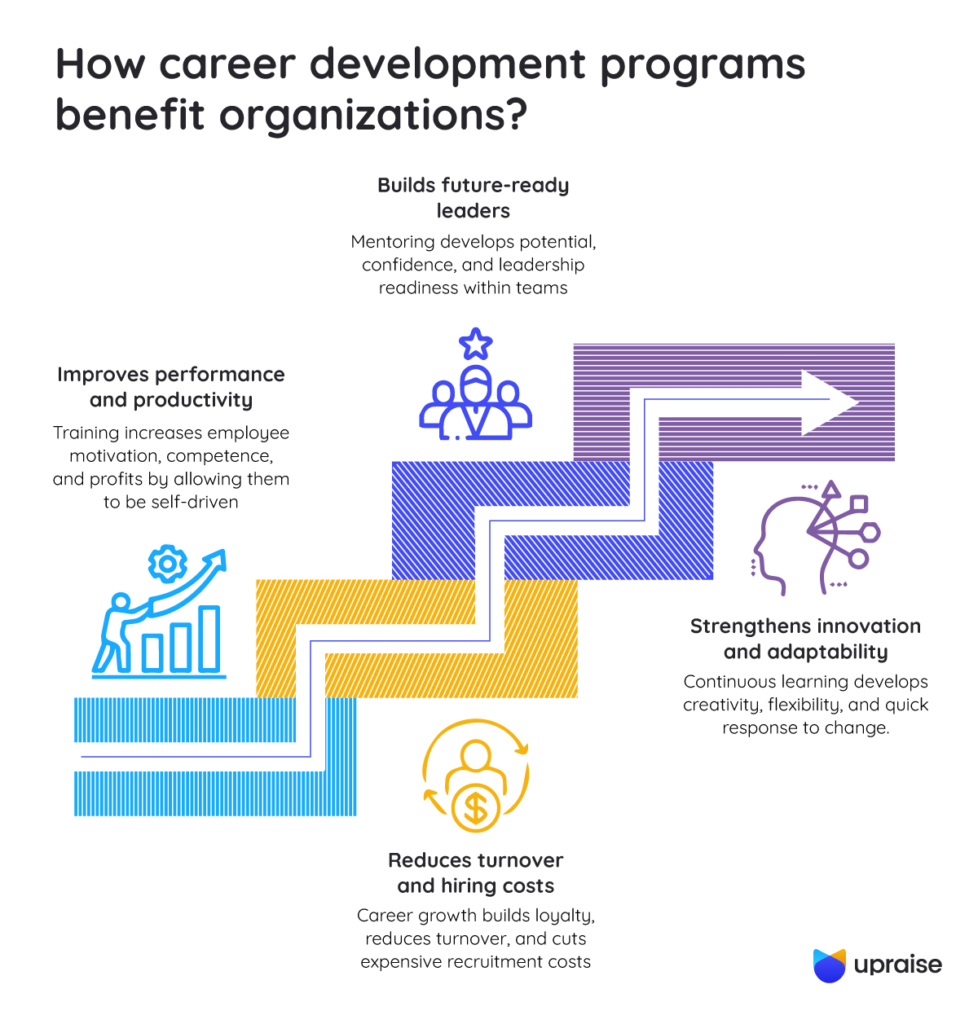
Improves performance and productivity
As per a study by the Association for Talent Development, organizations offering comprehensive training programs enjoy 24% higher profit margins. From the psychological point of view, this works. Employees feel worthy of their skills and competent enough to remain self-motivated (self-determination theory).
Reduces turnover and hiring costs
Data shows that 94% of employees would stay longer if they had access to career development. Career development satisfies the basic human need for progression (Maslow’s hierarchy), anchoring loyalty while saving companies thousands in recruitment and onboarding costs.
Builds future-ready leaders
A mid-sized company struggled with leadership gaps until it started internal mentoring and career mapping. With the right mentorship, any organization can naturally produce high-potential leaders. This aligns with the Pygmalion effect, which says believing in someone’s potential improves their performance.
Strengthens innovation and adaptability
Employees exposed to new skills and challenges are more willing to experiment and solve problems creatively. Cross-training and learning programs trigger cognitive flexibility, a key factor in innovation. Companies that cultivate this adaptability can pivot faster in a changing market, keeping them ahead of competitors.
When career development becomes part of your organizational DNA, the results are tangible. However, it’s equally important to understand how to turn it into action for truly transforming a company.
Steps to implement a career development program
A career development program is a strategic investment. Organizations need a clear framework to best utilize resources for the benefit of employees. Here is a structured plan that you can adapt as per your budget, organizational culture, and goals.
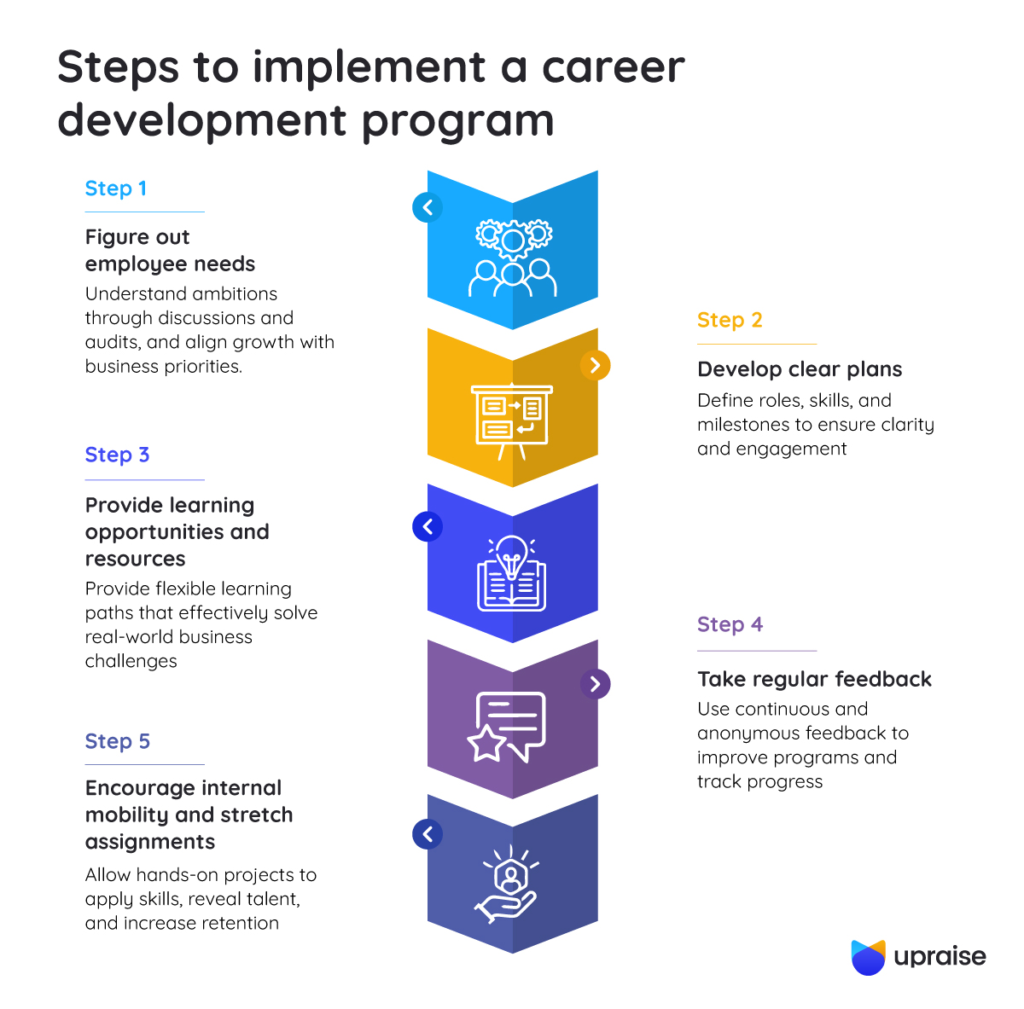
1. Figure out employee needs
When it comes to employee needs, there shouldn’t be any guesswork. Talk to your employees or conduct an internal audit about their needs and ambitions. Not everyone wants the same thing. Those insights form the foundation for the company to develop plans that benefit employees without disconnecting from its core business priorities.
2. Develop clear plans
Most employees have a vague idea about what lies ahead in their desired career planning. It’s the part of the program to educate them on the roles they will switch, the skills they need to develop, and the milestones to be achieved along the way. This is an enlightenment stage for employees. Clarity keeps them engaged and reduces turnover.
3. Provide learning opportunities and resources
Employees need the right resources to develop desired skills by best using their limited time. Allow them to choose their preferred mode of learning. They may like to join workshops or take online courses, depending on the nature of their work. What is important here is to design the curriculum in a way that teaches them how to solve your actual business challenges. It will keep them motivated to fully leverage the resources.
4. Take regular feedback
Continuous feedback sessions are important because they provide insight into your program’s success rate among employees. Even short weekly check-ins are enough to know that they are improving. However, most employees may feel reluctant at first. Allow them to share feedback anonymously to get honest opinions about how to make the program more effective.
5. Encourage internal mobility and stretch assignments
Imagine employees are still looking for opportunities at your competitor’s firm because they don’t have the chance to apply what they’ve learned. The best course of action would be to offer them temporary roles in projects where they can develop practical skills as well. It also helps leaders identify hidden talent and build flexible teams ready for future challenges.
Once your career development program is up and running, the next step is to measure how well it’s working. It will help you understand what’s improving employee growth and what needs more attention.
Measuring the success of career development initiatives
Once you design career development programs, one of the major challenges is to measure their impact to understand the scope of improvement. Ideally, it requires the HR team to focus on a mix of qualitative and quantitative data as follows:
- Employee performance improvement in terms of productivity, project completion rates, and quality of work
- Retention and engagement levels before and after introducing programs (higher scores suggest motivated employees)
- Frequency of new skill utilization in day-to-day work and project assignments
To collect the data, conduct periodic manager feedback and peer reviews with smart tools, like the UpRaise for People. It runs inside Jira to:
- Automate reminders for reviews or feedback cycles
- Link OKRs directly to Jira issues for real-time progress visibility
- Manage leave, calendars, and compliance records effortlessly with built-in automation
- Generate actionable reports to see exactly how development initiatives drive performance and engagement
That means the HR can not only track the program’s success, but also continuously improve it.
Conclusion: Prioritizing career development for success
Career planning helps both employees and organizations succeed. When employees learn new skills, they perform better and stay longer. So, HR managers must plan growth programs that match company goals. It is also important to keep scopes for ample training, mentoring, and feedback to make teams stronger. To measure the success of these programs, track the right KPIs that show what is working and what is not.
Use UpRaise to complete relevant tasks such as keeping employee records, goals, and reviews in one place inside Jira. The app sends reminders, tracks OKRs, and shows real results to help HR teams see how growth supports business success.
Book a free demo and start building a smarter workforce.
FAQs
What is career development, and why is it important for employees?
Career development is a process of helping your employees upskill and grow to better aid in long-term organizational goals. From an organizational perspective, the process is also vital for creating a pool of happy employees who will confidently take on higher responsibilities.
How can organizations create a successful career development program?
While designing career development programs, envision how the output will impact your long-term business goals. Ideally, employees completing the program should be able to significantly contribute to meeting broader organizational goals. To make programs at this level effective, encourage continuous learning at every stage and involve senior leaders for mentorship.
What are the long-term benefits of prioritizing career development for employees?
When employees see a clear path for growth, they are more likely to stay for professional benefits. Once they start to feel invested in the process due to the program, it leads to more productivity at the workplace. That positions you as a stronger workforce in the market and helps you attract more top talent with ease.
How do career development programs contribute to employee retention?
When employees receive free resources and development opportunities to enhance their skills, they tend to stay with the organization for a long time. If their enhanced skills are utilized in the right way and appreciated frequently, it leads to brand loyalty and reduced turnover.


