

You’re an HR manager trying to track performance across a fast-growing team. There are endless spreadsheets to review, you have already missed deadlines and feedback seems biased. Traditional performance measurement methods can hardly produce error-free real-time progress cards when you need them the most.
This is where utilizing AI in performance management becomes imperative. It automates mundane processes, adds real-time feedback to personalizing growth plans for each employee, and restores staff faith in the appraisal system. However, using AI to achieve that perfection is a real challenge for many organizations.
In this article, you’ll learn why AI is transforming performance management in 2025, how it works, what benefits it brings and how you can use it in your organization meaningfully. Before we dive into how AI is changing things, let’s first understand what it means in the context of performance management.
What is AI in performance management?
AI-driven performance management automates the way you track, measure and improve employee performance. It monitors real-time performance data of employees, like productivity patterns, goal progress or engagement metrics. This real-time data helps you gauge individual performance at any time without having to wait until the next performance appraisal.
Sophisticated AI performance management tools also help you make sense of the collected data. Powered by data intelligence and predictive analysis, AI can spot patterns, suggest improvements and even predict issues before they show up.
For example, AI can alert you when an employee is at risk of burnout based on workload and behavior. Such real-time alerts can help HR to step in early before it gets too late. In short, AI in performance management is all about moving from gut feelings to data-backed decisions to offer your team more clarity and control.
Now that you know what AI in performance management means, let’s look at how its specific features are reshaping employee evaluations and why that matters for you.
How AI is changing employee evaluations
A performance management AI tool comes equipped with numerous features to make evaluations more accurate, fair and useful. Some of the most popular features are described below:
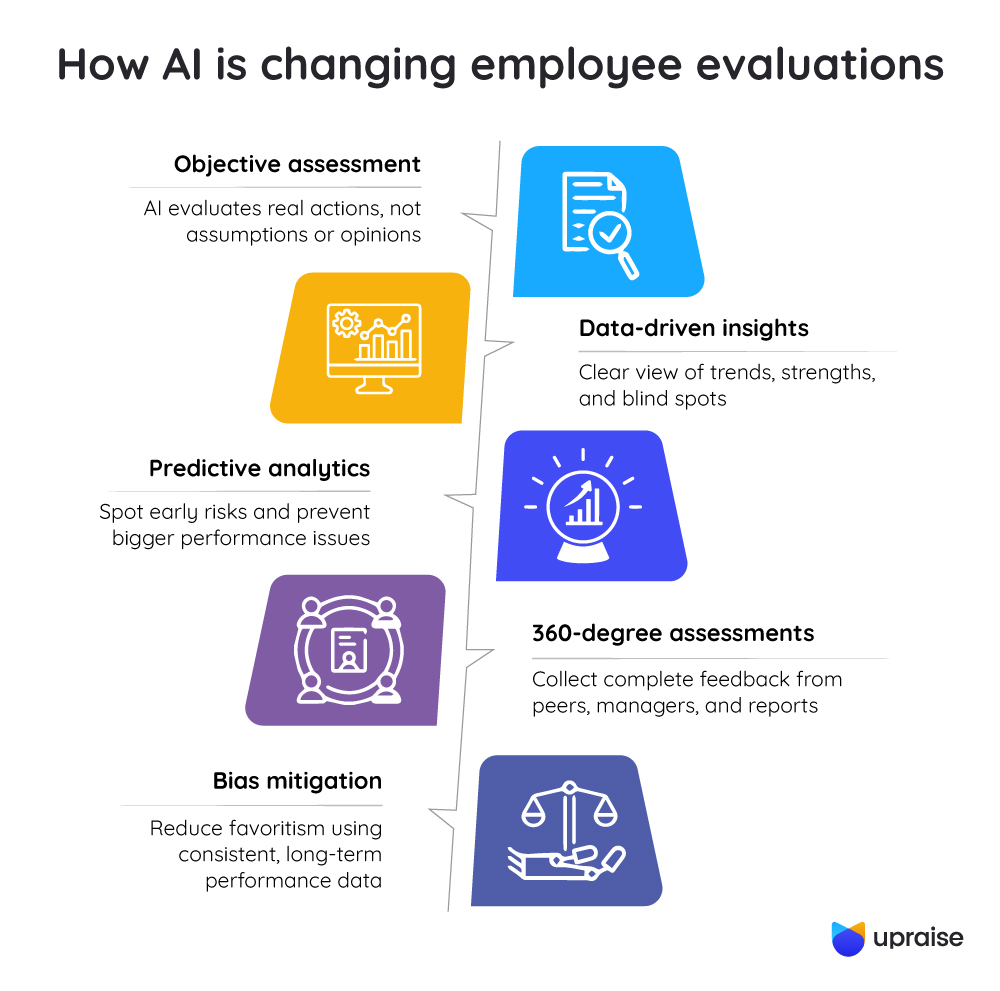
Objective assessment
Instead of relying on memory or personal opinions, AI pulls data from actual work patterns, like goal tracking, project milestones and team collaboration. This means your evaluations are based on actions, not assumptions.
Data-driven insights
AI brings all your performance data together to show trends, strengths and blind spots. For example, if someone is regularly missing deadlines or consistently exceeding goals, you’ll see that clearly without needing to dig through spreadsheets.
Predictive analytics
AI can also flag potential issues before they happen. Predictive analytics helps you catch a drop in an employee’s engagement or output early. You can then take proactive steps, like offering support or training, before it turns into a bigger problem.
360-degree assessments
With AI, collecting and organizing feedback from peers, managers and direct reports becomes easier and faster. It helps you look at performance from multiple angles, giving you a more complete picture of each employee’s contributions. This is also known as 360-degree feedback.
Bias mitigation
Because AI works with long-term performance data, it helps reduce common psychological biases, like favoring recent work, personal relationships or first impressions. This makes evaluations feel fairer to your team and more consistent overall.
All these features become more valuable as you get them in real time. Let’s see
how real-time evaluations are more balanced, faster to conduct and helpful for everyone involved.
The role of AI in real-time feedback
Thanks to AI-powered real-time insights, feedback processes are becoming faster, regular and reliable. Here is how it works:
- Instant insights after key tasks: AI systems can generate instant snapshots of an individual’s performance on a specific project or task. For instance, a manager can see employees about to miss today’s deadline for a task from the dashboard to step in with support, right when it matters.
- Supports continuous improvement: When employees receive instant feedback to make smaller progress more often, it adds up to major success over time.
- Improves manager-employee conversations: Smart AI performance management tools enable real-time 360-degree surveys that alert managers when team morale drops, allowing timely and meaningful check-ins.
Despite such benefits, most organizations choose to pass on AI tools, assuming less scope for personalization.
AI’s impact on personalization in performance reviews
Employees today expect to receive timely and relevant feedback customized to match their roles and responsibilities. Here is how AI can make performance reviews more personal and relevant for your teams:
- Creates unique growth paths for each employee: If someone in sales is great at closing but struggles with follow-ups, AI might recommend a quick workshop or micro-course on client nurturing. That’s far more useful than general “improve communication” advice.
- Understands different work styles: If AI spots that an employee does better when given autonomy, you can give them more independent projects. If they thrive on teamwork, you can involve them in more collaborative initiatives.
- Sets meaningful and realistic goals: AI recommends goals based on an employee’s performance history and natural growth pace. For instance, AI can auto-suggest short-term goals to employees during quarterly reviews based on their progress metrics.
There are many benefits to incorporating AI in performance management.
Benefits of AI-driven performance management
Performance management AI is not just about making things faster. It’s about making them smarter, more accurate and more impactful. Here are some key benefits:
- Saves time: AI automates a lot of repetitive tasks, like collecting performance data and creating first-draft evaluation summaries so HR can focus on meaningful conversations.
- Helps in making faster decisions: AI continuously monitors performance from project boards or collaboration apps so that HR can step in with support or training before bigger issues develop.
- Removes guesswork from evaluations: AI pulls from different data sources, like task completion rates, peer feedback, client ratings and manager notes, to build a full and fair view of an employee’s performance.
- Helps boost employee engagement: AI can prompt you to celebrate small wins more often, like a project delivered ahead of schedule, boosting morale in real-time. That leads to stronger engagement and motivation.
- Spots skill gaps and training needs early: An AI-driven performance management tool can quickly spot employees who need skill support before it affects performance.
- Improves fairness and reduces bias: A study by PwC shows that AI-powered reviews can lower bias-related complaints by up to 35% caused by personal opinions, favoritism, or recent events.
Now that you understand the benefits of modern tools, let’s learn how to implement an AI-driven performance management system.
How to implement AI in performance management
The idea may sound overwhelming, but when broken into simple steps, the process becomes easier to follow and far more achievable.
Here’s how you can get started:
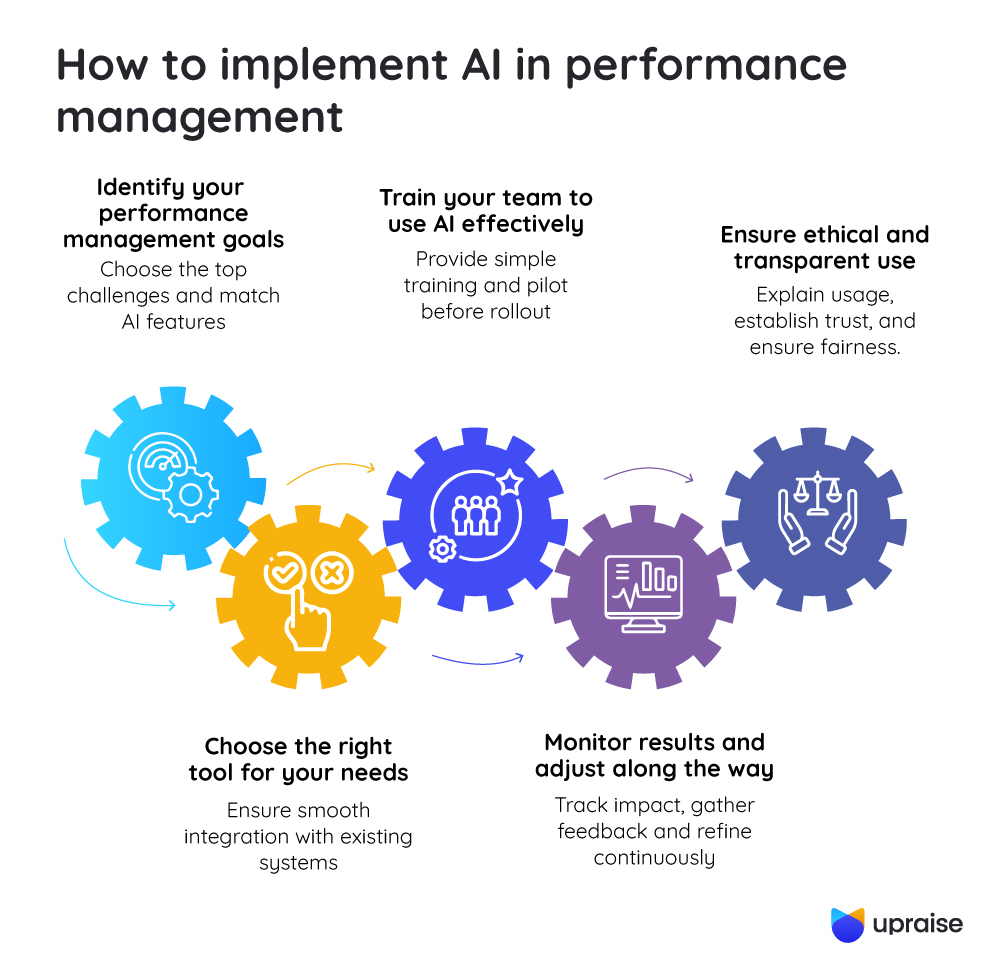
Identify your performance management goals
First, start figuring out the targeted areas of improvement. Do you want to give feedback more often, reduce bias, or make review processes smoother? If your biggest problem is managers forgetting employee wins during reviews, your goal might be “real-time performance tracking.” Write down your top three challenges and match them with the kind of AI features you’ll need, like bias detection or continuous feedback loops.
Choose the right tool for your needs
An ideal performance management AI tool should sync with your current HR systems for better feedback, goal setting, or performance tracking. For instance, if you use Slack or Microsoft Teams daily, consider using tools that can plug into those systems and send performance alerts or feedback prompts.
Train your team to use AI effectively
Even the best performance management AI tool won’t help if people don’t know how to use it. Before rolling out an AI performance management tool, run a pilot with one department and gather their feedback on what features were most helpful or confusing.
Offer clear, simple training to show your team how to read AI reports, spot patterns and turn insights into action.
Monitor results and adjust along the way
Track how the system is working and how people are responding. Are managers saving time? Do employees find the process fairer? Use this feedback to improve your setup. If employees find AI feedback too robotic, tweak the settings to focus more on qualitative insights or add a human note before sharing.
Ensure ethical and transparent use
Let your team know exactly how AI is being used, what kind of data is collected and how it’s interpreted. Transparency builds trust and reduces fear. You might say, “This tool tracks progress toward goals, not things like mouse clicks or time spent online.” Share a simple FAQ or one-pager about how AI supports, not replaces, human judgment in reviews.
You will probably face a unique set of challenges while incorporating performance management AI tools into your workflow. Don’t be afraid to experiment with different setups and products until you find the right combination of apps and products for your brand.
Challenges in integrating AI into performance systems
While AI in performance management sounds promising, it’s not all smooth sailing. Before you start to apply the theories, you need to prepare well for what might stand in your way. Let’s take a look at some common challenges below:
Lack of understanding or awareness
If managers start to see AI as their replacement instead of a performance booster, they can hardly motivate others to use it. So, before launching any tool, host short training sessions or share a simple one-pager that explains what the AI will and won’t do.
Data quality and availability
AI works well when you feed it with clean, structured and up-to-date data. If your systems are outdated, inconsistent, or missing key information, the insights won’t be reliable. For instance, if your performance data is only updated once a year, AI can’t give real-time feedback or track ongoing trends.
Concerns around privacy and transparency
People want to know how their data is being used and whether it’s being used fairly. If they feel AI is “watching” them or making decisions behind closed doors, trust can break down. So, let employees know what the AI tracks (e.g., goal progress, feedback data) and what it doesn’t (e.g., personal messages, idle time).
High implementation costs
Some AI tools require expensive custom setups and integrations for companies with complex HR tech stacks. Instead of overhauling everything, begin with one pain point, like performance tracking. Use a cloud-based tool that scales as you grow.
Conclusion
An AI-driven performance management system empowers HR with real-time feedback to make data-backed decisions. When utilized properly, it can support continuous improvement and build a strong communication channel between the management and employees. However, there are also real challenges, like a lack of understanding about AI or resistance to change from your team, that you’ll need to plan for.
But with the right approach you can move away from outdated methods and build a performance system that truly works.
FAQs
Q. How does AI improve employee performance management?
With AI, you can easily track, measure and understand employee performance in real-time. As the entire process runs on automation, it reduces bias, highlights growth opportunities and makes feedback more accurate.
Q. What are the key advantages of using AI in performance evaluations?
AI-driven performance management offers data-backed insights, removes guesswork and helps you spot trends early. It makes evaluations more fair, fast and focused so that both you and your employees grow together.
Q. Can AI be used for real-time employee feedback?
Yes, AI tools can give instant feedback based on tasks, goals and performance data. This helps employees course-correct quickly, stay aligned and feel more supported every day.
Q. What challenges do companies face when implementing AI in performance management?
Some common challenges include unclear goals, lack of training, data privacy concerns and resistance to change. It’s important to choose the right tools and bring your team along at every step.


