


If you have ever sat in a meeting and felt everyone was agreeing just to keep the peace, you’ve seen groupthink in action. It’s what happens when teams choose comfort over conflict, and real opinions get buried. 86% of employees feel they’re not heard fairly at work. And when people stop speaking up, teams start making safe, often flawed decisions.
For HR professionals and team leads, this silent agreement can quietly kill innovation and lead to decisions no one stands behind. The good news? Groupthink is fixable. With the right strategies, you can prevent groupthink in teams and create a space where honest input and better decision-making come naturally. Let’s break it down.
What is groupthink and why does it happen?
Groupthink is when decisions are made by prioritizing consensus without adequate debate or discussion. This creates an illusion of agreement where everyone appears to be on the same page, but critical thinking gets pushed aside. You might think it’s just peer pressure, but the psychology behind groupthink runs much deeper than that.
Teams develop their own culture and identity over time. When members become too invested in maintaining this unity, they start filtering out information that challenges their shared beliefs. But over time, this suppression of diverse opinions steers decisions off course.
Here are some factors that might cause groupthink.
- High-stress situations: This often triggers people to seek comfort in agreement.
- Strongly opinionated leaders: Employees might feel intimidated and hesitate to challenge authority.
- Tight deadlines: This can lead groups toward quick consensus rather than thorough analysis.
- Isolated teams: Teams that never get external input often get trapped in a bubble or endless loop.
Even the best teams can slip into groupthink when they get a little too confident in their teamwork. The key is noticing it early, before it quietly shuts down fresh ideas and honest conversations.
Key signs of groupthink in teams
Groupthink might sometimes go unnoticed. Many teams believe they’re working in sync when stuck in an echo chamber. Here are a few red flags to watch out for:
Unanimous agreement without debate
When everyone agrees instantly, that’s not alignment, it’s avoidance. Real decisions need some debate. If your meetings always end in smooth consensus without a single question, it’s worth pausing to ask why.
Dismissing outside criticism
If the team shrugs off feedback from other departments, customers, or external advisors, that’s a problem. Dismissing those views as “it’s not their department” can block meaningful improvements.
Self-censorship
If your team stays quiet during discussions, it might be because they are conscious about sharing their opinions. That silence can prevent better decision-making in teams.
Stereotyping outsiders
When a team brushes off external players as incompetent or irrelevant, they stop learning from them. This can blind them to real competition or important changes happening around them.
Mindguards
Mindguards are team members who filter or block feedback before it reaches the group. They might say things like, “Let me handle that,” or “This will just confuse everyone.” It usually comes from a place of harmless protection, but it ends up shielding the team from necessary reality checks.
These are subtle signs that show up slowly. If you notice them in your team, pause and rethink your team decision-making strategies.
Strategies to prevent groupthink
Avoiding groupthink requires an environment where real thinking is welcomed. That includes encouraging feedback, slowing down when required, and giving people more access to speak.
Here are a few groupthink prevention strategies you should consider.
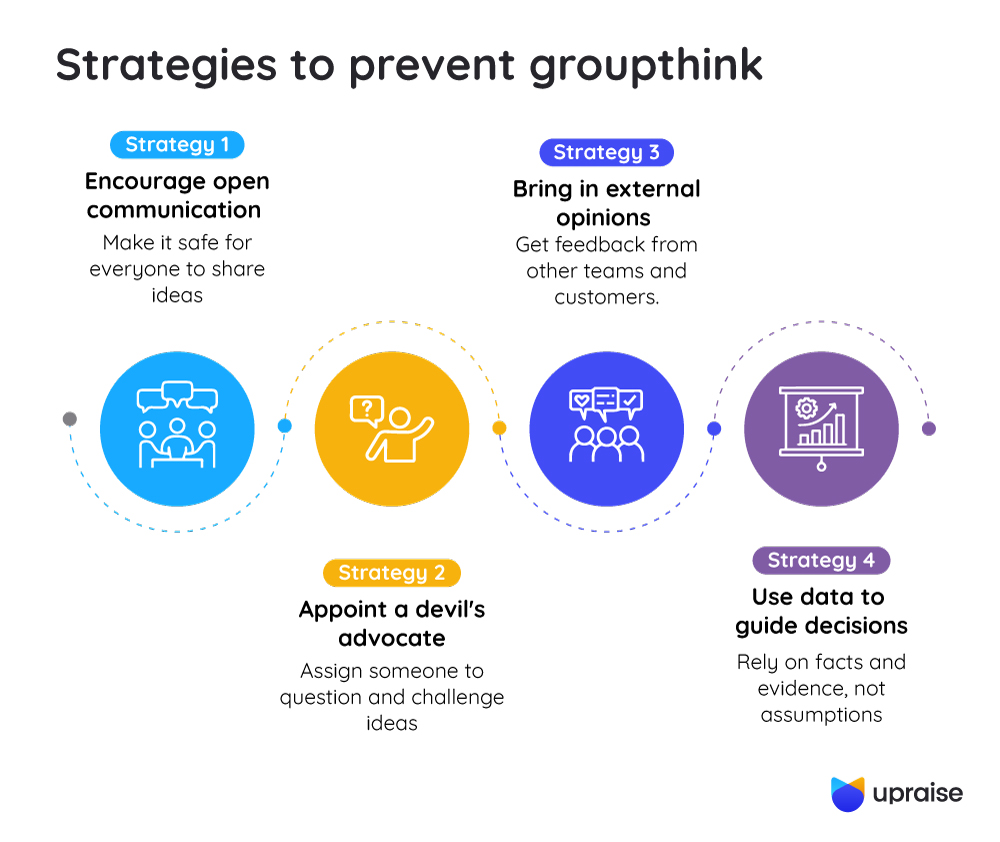
Strategy 1: Encourage open communication
You should encourage your people to feel secure enough to offer suggestions and feedback openly. Stifling communication might cost you some excellent ideas. You can fix that by:
- Creating a comfortable space for every voice.
- Sending agendas in advance and encouraging ideas.
- Giving your team enough time to understand the discussion and what input you expect.
Measures like these help the smart introverts of your team build their opinions instead of being put on the spot.
One way to prevent groupthink in teams is to go around the room and ask each person to share their views before a group discussion. Let everyone know they’re just sharing ideas, not trying to come up with ‘perfect’ ones. This makes the conversation easier and helps you run effective business meetings.
Call on people directly
Some team members may never jump in unless asked. Once the conversation starts, respectfully invite quieter employees to share. You could try something like, “Hey Jeff, what’s your take on this?” It’s a simple way to show that you value their opinion and encourage them to speak confidently in the future.
Allow contributions outside the meeting
Not everyone processes ideas best in real time. Give people the option to email ideas afterward, drop thoughts in Slack, or schedule one-on-ones. A good idea is too valuable to miss just because someone didn’t say it out loud.
Strategy 2: Appoint a devil’s advocate
Most teams avoid conflict. But when every idea is met with nods, that’s when you need someone to disagree on purpose. Here’s how to implement this.
Designate a rotating devil’s advocate
Assign someone the role of challenging the idea on the table, regardless of their personal opinion. This permits them to ask tough questions, which often bring blind spots to light. Keep rotating this role to a new member.
Make this a normal team behavior
Don’t reserve this for big projects only. Normalize constructive criticism. Let your team know that debate isn’t personal and it’s how strong decisions are made.
Practice switching sides
When you notice strong agreement too quickly, ask something like, “Let’s all pretend that we are against the entire idea. What would our points of criticism be?” It forces a re-evaluation of assumptions and often uncovers missing context.
Strategy 3: Bring in external opinions
When teams stay in a bubble, they miss what matters. Here’s how to invite outside input that brings fresh clarity and better decision-making in teams.
Seek feedback from other teams
Don’t wait until after something is launched to get input. Loop in sales, customer support, or even someone from finance. Different departments see things from different angles.
Check with your users
For example, before locking in a social media plan, ask how actual customers are responding to previous campaigns. What sounds good on paper might not work out as well as expected with customers.
Use internal surveys or quick polls
Sometimes, even anonymous team-wide polls can surface ideas or concerns that haven’t been discussed yet. It’s not a substitute for conversation, but it’s helpful.
By encouraging open communication and tracking progress transparently, relevant tools can help you build a foundation where groupthink has less room to grow.
Strategy 4: Use data to guide decisions
Data provides a grounding force that helps teams make choices based on facts, not just feelings. Here’s how to use it.
Back every proposal with data
Make it a norm to ask, “What evidence supports this idea?” Whether it’s customer trends, product usage, or performance metrics, data adds weight to the discussion.
Share numbers in advance
Give people time to digest reports before decisions are made. This reduces decision fatigue and helps team members prepare important questions after a thorough inspection.
Combine these groupthink prevention strategies, and you create a culture where innovation thrives and the agreement comes from critical thinking, not convenience.
Conclusion
Groupthink doesn’t mean your team is broken. Sometimes it just means that people want to belong.
You can change that by simply building a space for open discussions. Encourage healthy disagreements and let your team know that no idea is bad. When your team feels welcomed, they speak their minds, helping you make better decisions.
This helps you successfully eliminate groupthink while ensuring your team relies on active participation instead of passive agreement.
FAQ
Q1: What is groupthink, and how does it affect decision-making?
Groupthink is when teams agree with ideas just to keep things smooth and avoid disagreement. It might feel efficient, but it usually means people aren’t raising concerns or exploring other (often better) options.
Q2: How can managers prevent groupthink in teams?
Groupthink can be prevented by welcoming open conversations, accepting constructive feedback, letting people share thoughts anonymously, or rotating someone to play devil’s advocate.
Q3: What are the signs of groupthink in group decisions?
Quiet meetings where decisions are made too fast, and no one ever disagrees, are signs of groupthink. It’s often because people don’t feel comfortable sharing their thoughts.
Q4: Why is a devil’s advocate useful in team decision-making strategies?
A devil’s advocate is meant to criticize the team’s ideas. They’re not trying to be difficult but are helping the group see what they might be missing. This helps teams make smarter, more thoughtful choices.


