


For a business to be successful and grow constantly, it’s critical to set clear and measurable goals. However, it can get exhausting to keep track. Objectives and Key Results (OKRs) scoring provides a structured approach to setting goals and quantifying results.
OKRs were first introduced by Intel and later popularized by Google, where they played a crucial role in the company’s rapid growth and innovation. Since then, many companies have adopted OKRs to ensure goal alignment, accountability, and continuous performance improvement.
However, merely defining OKRs isn’t enough. Scoring and grading OKRs accurately is essential to measure success and drive informed decision-making. Companies like Google use a standardized 0.0-1.0 grading scale to evaluate progress, ensuring that teams stay focused and adaptable while striving for ambitious goals. An effective OKR scoring system provides:
- Clarity: Everyone understands how success is measured.
- Accountability: Teams take ownership of their objectives.
- Data-driven insights: Leadership can make informed adjustments.
- Continuous improvement: Teams can refine their strategies based on real performance data.
In this article, we’ll break down the importance of OKR grading, explore different scoring methods, highlight best practices for tracking progress, and uncover common mistakes to avoid – helping you implement a more structured and results-driven approach to goal-setting.
What is OKR scoring?
OKR scoring is a structured method used to quantify how well teams or individuals have achieved their set objectives and corresponding key results. Unlike traditional goal-setting methods, which often focus on binary outcomes (goal met or not), OKRs emphasize measurable progress and encourage continuous improvement. This evaluation usually takes place at the end of an OKR cycle — typically quarterly or annually — and helps organizations assess how aligned and effective their efforts have been in driving toward broader strategic goals.
By implementing a clear and data-driven approach to OKR evaluation, businesses can identify what’s working, what needs improvement, and how to optimize goal-setting strategies for future cycles.
Now, let’s explore why OKR grading is a critical aspect of performance management.
Why is OKR grading important?
Grading OKRs is more than just a performance-tracking mechanism – it is a strategic tool that drives alignment, accountability, and continuous growth within an organization. Without a structured grading system, companies risk setting ambitious goals without a clear way to measure progress, leading to inefficiencies, misalignment, and a lack of motivation among teams.
Grading OKRs serves multiple essential functions within an organization, including:
- Performance Evaluation: It offers a clear metric to determine how well objectives have been met, facilitating data-driven performance assessments.
- Strategic Alignment: Regular grading ensures that all team members remain focused on the company’s strategic goals, promoting cohesive progress.
- Continuous Improvement: Grading fosters reflection and iterative enhancement by identifying successes and shortcomings.
- Transparency and Accountability: Publicly sharing OKR grades cultivates an environment of openness, where responsibilities and achievements are visible across the organization.
Next, let’s dive into the various OKR measurement techniques that help quantify success.
Different OKR measurement methods
Various methods exist to measure and grade OKRs, each offering unique advantages. Choosing the right method depends on the organization’s goals, culture, and need for precision in tracking progress.
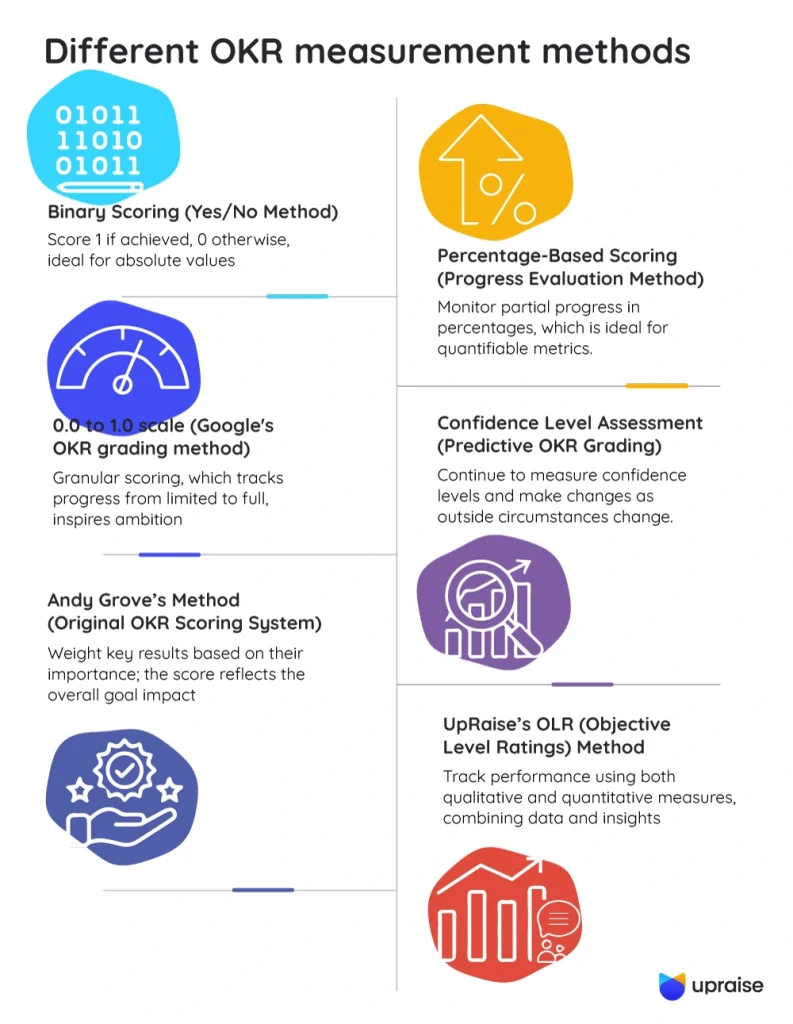
- Binary scoring (yes/no method)
This straightforward approach assigns a score of 1 for complete achievement and 0 for non-achievement, making it ideal for absolute, outcome-based key results.
Example: A company sets a goal to launch a new website by the end of Q2. If the website is live, the key result is scored 1; if not, it’s 0.
Best For: Clear-cut objectives like product launches, compliance certifications, or feature releases.
- Percentage-based scoring (progress evaluation method)
This method assigns a percentage score based on how much of a key result has been achieved. It provides a more detailed view of progress, even when full completion isn’t possible.
Example: If a sales team aims to acquire 200 new customers and has onboarded 150, the completion score would be 75%.
Best For: Metrics that can be incrementally tracked, such as revenue targets, customer acquisition, or user engagement goals.
- 0.0 to 1.0 scale (Google’s OKR grading method)
Google popularized this granular scoring system to encourage ambitious goal-setting. Instead of a simple pass/fail approach, this scale provides a more nuanced measurement:
- 1.0 = Full achievement
- 0.7-0.9 = Strong progress
- 0.4-0.6 = Moderate progress
- 0.0-0.3 = Limited progress
Example: A marketing team aims to increase website traffic from 10K to 15K visitors. If they reach 13K, they might score 0.6 or 0.7, indicating solid progress.
Best For: Stretch goals where full achievement is challenging but progress still delivers value.
- Confidence level assessment (predictive OKR grading)
Instead of measuring progress after completion, this approach involves ongoing evaluations where teams update their confidence levels in achieving the key result throughout the OKR cycle.
Example: A company setting a goal to expand into the Asian market may start with a 50% confidence level. If deals progress successfully, confidence might increase to 80%, or drop if roadblocks arise.
Best For: OKRs with external dependencies or evolving priorities, such as partnerships, market expansions, or product development cycles.
- Andy Grove’s method (original OKR scoring system)
Andy Grove, the Intel executive who pioneered OKRs, introduced a yes/no binary approach with a weighted scoring system. Each key result is assigned a numerical weight based on importance, ensuring that more critical results contribute more to the final OKR score.
Example: If a company has two key results –
- “Increase revenue by 10%” (Weight: 60%)
- “Launch two new products” (Weight: 40%)
If revenue grows 8% (80% completion) and two products are launched (100% completion), the final OKR score would be:
(0.8 × 0.6) + (1.0 × 0.4) = 0.88 (88% completion)
Best For: Companies that prioritize some key results over others instead of treating all goals equally.
- UpRaise’s OLR (objective level ratings) method
UpRaise introduces OLRs (Objective Level Ratings), a structured way to measure OKRs by integrating qualitative insights along with numerical grading. This method encourages:
- Real-time tracking of progress rather than a single retrospective score.
- Qualitative assessments such as feedback from stakeholders.
- Weighted scoring models based on priority.
Example: If a customer service team sets an OKR to improve response time by 20%, UpRaise’s OLR system might include:
- Data-driven performance tracking (response time metrics).
- Customer feedback analysis to assess satisfaction levels.
Best For: Organizations that value both quantitative and qualitative evaluations in performance tracking.
Recommended Infographic sample
Selecting the right OKR measurement method is just the first step. To ensure objectives stay on track and deliver meaningful results, organizations need a structured approach to monitoring progress. Let’s explore how to track OKRs effectively and maximize their impact.
How to track OKRs effectively
Effective tracking of OKRs is vital for ensuring that objectives remain on course and are achieved within the designated timeframe. The following strategies can enhance OKR tracking:
- Regular Check-Ins: Conduct frequent meetings to review progress, address challenges, and realign efforts as necessary.
- Utilize OKR software: Implement specialized tools designed to monitor OKR progress, provide real-time updates, and facilitate collaboration.
- Mid-Cycle reviews: Schedule evaluations at the midpoint of the OKR cycle to assess progress and make necessary adjustments.
- Transparent dashboards: Maintain visible progress indicators accessible to all team members, fostering a sense of shared responsibility and awareness.
Infographic recommendation: Depict a timeline of an OKR cycle, incorporating key tracking activities such as initial planning, regular check-ins, mid-cycle reviews, and final evaluations.
Best practices for OKR grading and tracking
To maximize the efficacy of OKR implementation and drive meaningful outcomes, organizations should adopt the following best practices:

1. Set ambitious yet achievable goals
OKRs should push teams beyond their comfort zones while remaining within reach. This balance fosters innovation and continuous improvement.
Example: Instead of setting a vague objective like “Improve customer engagement,” a more ambitious yet attainable goal would be “Increase monthly active users by 30% within six months.”
Best Practice: Encourage teams to set stretch goals that challenge them but avoid setting unrealistic expectations that lead to frustration.
2. Maintain objectivity in scoring
OKR grading should rely on clear, predefined criteria to prevent bias and ensure consistency across teams.
Example: When measuring customer satisfaction, use tangible data like Net Promoter Score (NPS) instead of subjective opinions.
Best Practice: Align scoring criteria with data-driven metrics, ensuring transparency in how progress is assessed.
3. Separate OKRs from performance reviews
OKRs should focus on team and organizational growth rather than individual performance evaluations. This distinction encourages employees to take risks and innovate without fear of penalties.
Example: A product development team aiming to launch a new feature may fall short of their stretch goal. Instead of penalizing them, the discussion should focus on learnings and process improvements.
Best Practice: Use OKRs as a tool for strategic alignment and continuous improvement rather than a measure of personal performance.
4. Encourage reflective practices
Once OKRs are graded, teams should analyze results, identify challenges, and extract lessons for the next cycle.
Example: After grading, a sales team might find that despite missing their revenue target, they successfully expanded into new markets. This insight can shape future OKRs.
Best Practice: Conduct post-OKR reflections to understand what worked, what didn’t, and how to refine the process for better outcomes.
Common mistakes in OKR scoring and how to avoid them
Awareness of common pitfalls in OKR scoring can aid in their prevention:
- Setting vague objectives: Ensure that all objectives are specific, measurable, achievable, relevant, and time-bound (SMART) to provide clear direction.
- Neglecting regular updates: Avoid the mistake of setting OKRs and failing to revisit them; consistent tracking and updates are essential for sustained progress.
- Overloading with too many OKRs: Focus on a limited number of high-impact objectives to prevent dilution of efforts and maintain clarity.
- Misaligning OKRs with company goals: Ensure that all OKRs are directly linked to the organization’s strategic objectives to maintain coherence and relevance.
Conclusion
Efficient scoring and grading of OKRs is instrumental in driving organizational success. By adopting structured measurement methods, implementing effective tracking practices, and adhering to established best practices, organizations can harness the full potential of the OKR framework. This approach promotes alignment and transparency while promoting a culture of continuous improvement and strategic focus.
It’s important to utilize OKRs that are compatible with your organization’s goals and policies. Tools like UpRaise will help you manage your OKR strategy effectively. Book a free demo to learn more.


