


According to Gallup, replacing an employee can cost up to twice their annual salary. That’s time, energy and money lost. When you focus on keeping your best people, you’re saving on hiring costs and more. Employee retention is a cornerstone of organizational success, ensuring that the time, resources and energy invested in building high-performing teams translate into lasting value.
Picture this: After months of training and mentorship, your team of developers is highly motivated and ready to make a real impact. If you’ve included employee retention policies, instead of worrying about departures, you’ll see them thriving, growing, and contributing to the company. When done right, retention can be a strategic advantage rather than a challenge to overcome.
In this article, you’ll understand what employee retention means, why it matters and how you can improve it to strengthen your business from the inside out.
What is employee retention?
Employee retention refers to your company’s ability to hold on to employees over time. Staff retention means fewer disruptions and a reliable team. With a strong workforce, you save the constant costs and delays of rehiring and retraining.
Working on employee retention means working on your retention policies, efforts and strategies to keep your team engaged and motivated, so they don’t feel the need to look elsewhere. That might mean improving work culture, offering learning opportunities or even just making sure people feel heard. In short, it’s about creating an environment where employees want to stay and actively contribute towards your company’s long-term success.
Next, let’s see how good employee retention can benefit your company from different aspects.
Benefits of employee retention
When happy employees stick around, the benefits have ripple effects across your entire organization. Here are some notable benefits of employee retention that are hard to ignore:
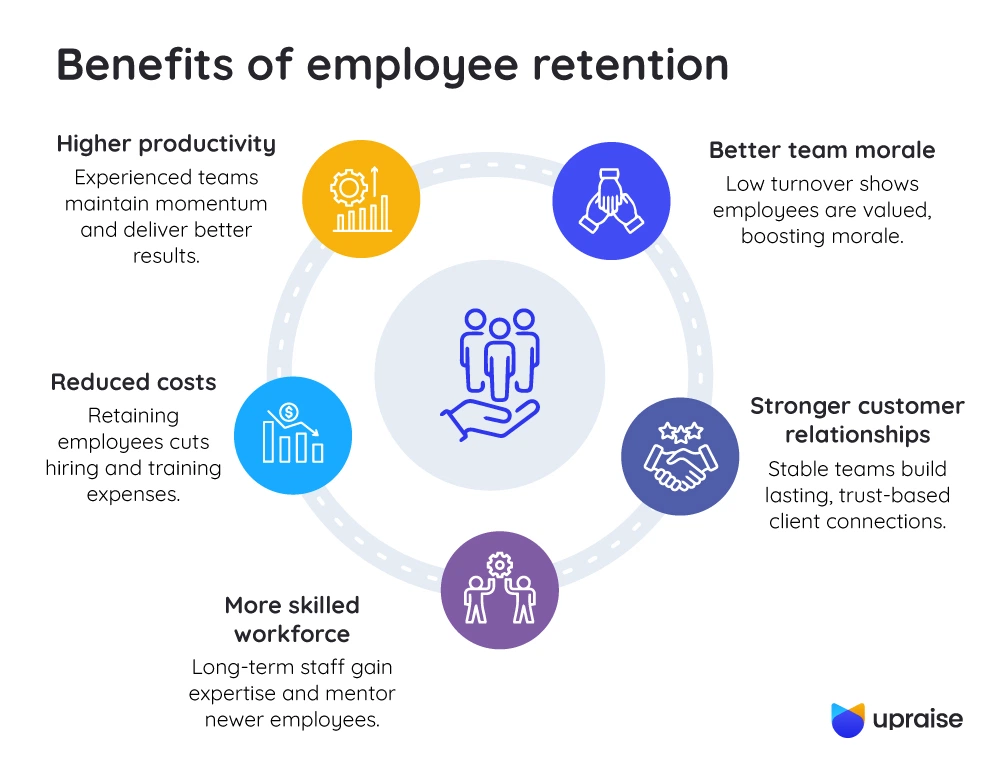
Reduced costs
Did you know each lost employee costs the company one-third of their annual salary? Every time someone leaves, you spend time and money finding a replacement. By retaining employees, you reduce these recurring costs and get a much better return on your training efforts.
Higher productivity
When new employees join to pick up the slack for ex-high-performers, it results in delays, mistakes, or burnout. The time they take to get up to speed hampers productivity. But when you have a strong staff retention, there is a consistency that helps you maintain momentum and deliver better results.
Better team morale
Employees leaving your company soon may prompt other people to wonder, “Am I next?” or “What’s wrong with this place?” On the flip side, when that number is very low, it shows that you value your employees and are willing to invest in them. That boosts team morale and creates a positive loop.
More skilled and experienced employees
When employees stay longer, they naturally become better at their jobs. They understand your business inside out, know your customers well and can handle challenges more smoothly. Their understanding and experience often lead to them becoming mentors and go-to experts for new team members.
Stronger customer relationships
Would you continue working with a vendor if the dedicated account manager who understood your complex requirements had to be constantly replaced? High employee turnover leads to inefficiency and time loss, which in turn enhances customer frustration. Long-term employees build relationships with clients by understanding their preferences, concerns and how they like to receive support.
Now that you understand why employee retention matters, it’s important to look at the other side of the coin: Why employees leave in the first place.
Why do employees leave?
Though people leave jobs for various personal and professional reasons, here are the most common ones that you should be concerned about:
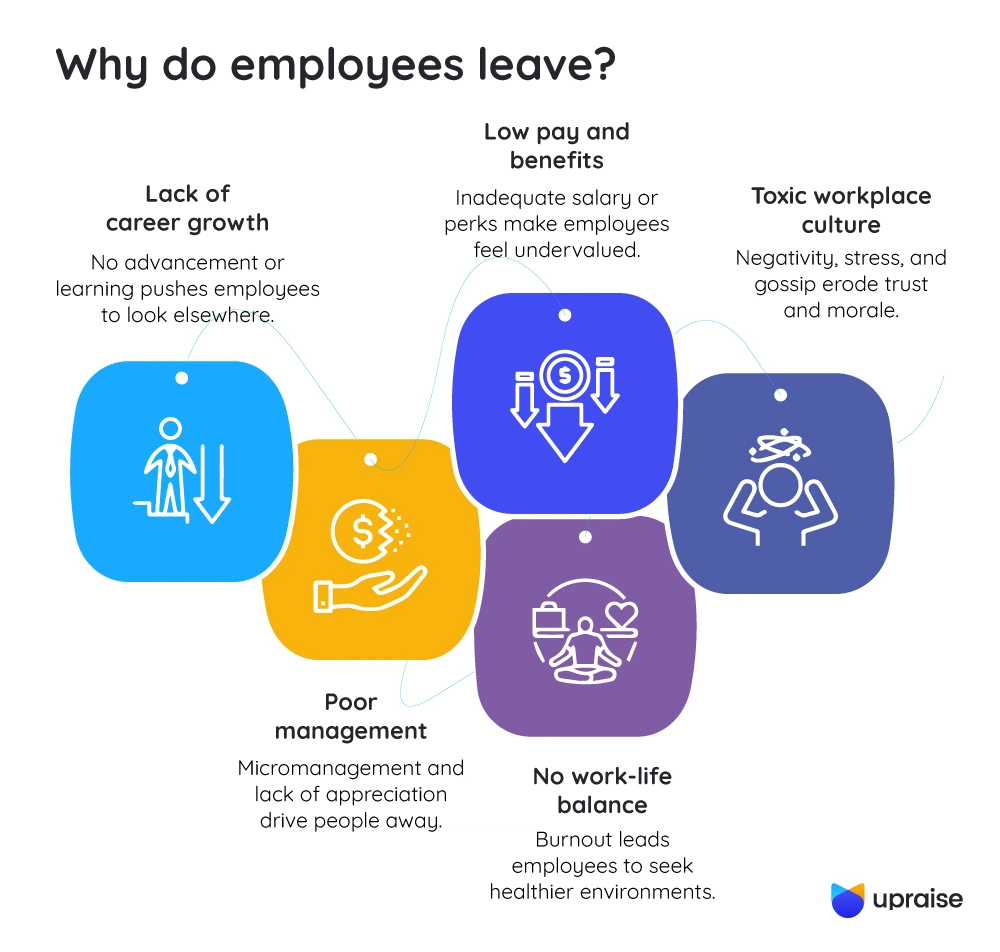
1. Lack of career growth opportunities
According to a McKinsey report, a lack of career development and advancement is the number one reason people quit their jobs, even ahead of pay and flexibility. When employees don’t see any career advancement in your organization, they may start looking elsewhere. A constant learning loop keeps them hooked to a workspace.
2. Poor management or leadership
No one likes to work in an environment where managers have a knack for micromanaging employees or unappreciating their good work. Such an environment always pushes employees to look for an alternative where they feel respected and heard.
3. Inadequate compensation and benefits
A recent US report by ADP Research Institute states that 29% of people leave their job within a month of being promoted. They still quit after promotion because either it came late or only after they voiced their intention to join a new company. Besides salary, other perks like health benefits, leave policies, bonuses and flexibility also matter. People want to feel that their efforts are being fairly rewarded.
4. Lack of work-life balance
A new study finds that 70% of burnout employees leave their current jobs because of it. In 2021, big organizations like LinkedIn, Hootsuite and Bumble shut down for a week to battle employee burnout. Employee burnout is real. So, if your workplace doesn’t support a healthy balance, even your most loyal employees may leave for a company that does.
5. Poor workplace culture
According to the SRHM report, 32.4% of employees left their jobs in 2024, citing toxic work culture as the primary reason.
The five biggest signs of a toxic environment are:
- Lack of trust
- Excessive stress
- High turnover rates
- Low morale and negativity
- Harmful office gossip
It is worth noting that toxic cultures don’t emerge overnight. They build up over time when your organization lacks healthy cultural norms.
If you want to understand employee engagement and loyalty, certain frameworks always work. Let’s discuss them next.
Employee retention models
Let’s discuss the three most widely used employee retention models and learn how they apply to your workplace.
1. Maslow’s hierarchy of needs
According to psychologist Abraham Maslow, human needs can be prioritized in a pyramid structure with five levels as follows:
- Physiological: Basic needs like salary, food and rest.
- Safety: Job security, stable income and a safe work environment.
- Belonging: Feeling part of a team, having strong relationships at work.
- Esteem: Being recognized, respected and trusted.
- Self-actualization: Opportunities to grow, innovate and reach one’s full potential.

As an employer, if you’re not meeting the needs at the bottom of this pyramid, it’s hard for employees to care about what’s at the top. For example, if someone’s worried about job security, they’re less likely to engage in innovation or long-term planning.
2. Herzberg’s motivation-hygiene theory
Psychologist Frederick Herzberg breaks job satisfaction into two categories:
- Motivators: Factors that motivate employees to stay in an organization, such as:
- Meaningful work
- Recognition
- Personal growth
- Achievement
- Hygiene factors: Factors that, if missing, cause dissatisfaction, such as:
- Salary
- Benefits
- Work conditions
- Job security
That’s why it is also known as the two-factor theory.
However, both factors should be independently taken care of by the company. Just fixing hygiene issues (like increasing pay) won’t motivate employees. It will just prevent them from becoming unhappy.
3. McClelland’s human motivation theory
Psychologist David McClelland proposed that all employees are driven by one (or a mix) of three key needs:
- Achievement: The drive to accomplish goals, improve and take on challenges.
- Affiliation: The desire to feel connected, part of a group and liked by others.
- Power: The need to influence others and have control or authority.
Each person is motivated differently. One employee may love setting ambitious goals, while another may thrive on collaboration and team bonding.
All these retention models are not hard to implement. However, you need to continuously monitor your employee retention and fix bumps before they surface.
Measuring and monitoring employee retention
The simplest way to measure retention is to look at two important factors:
- Retention rate: shows the percentage of employees who stayed during a specific period
- Turnover rate: shows the percentage of employees who left during a specific period
These numbers give you a starting point, a general pulse check. But to understand what’s going on, you need to collect a broader set of data through:
- Employee satisfaction surveys: to spot early signs of dissatisfaction
- Exit interviews: to learn honest feedback about why someone is leaving
- Stay interviews: to learn what motivates happy employees to stay in your company
By layering this information, you’ll have a much clearer picture of what’s working and what needs attention.
However, collecting data is only useful if you do something with it. Once you’ve identified trends, take action:
- Train managers where turnover is high.
- Improve onboarding if new hires are quitting early.
- Revisit job design or workload if burnout is leading to absenteeism.
All this is fine, but how to collect so much data and monitor at such a granular level? That’s where the need for HR software becomes imperative.
Improving employee retention with HR software
Modern HR tools give you a clear picture of your workforce performance in real time. You can check everything from top performers and their engagement rate to unsatisfied employees and their core reason for dissatisfaction in one place. Instead of looking at isolated numbers, you get a full view of what’s working and where the cracks are.
What does an ideal HR software do for you?
- Track employee OKRs: helps you spot where people might be struggling so that you can step in and support them before they feel disconnected
- Collect 360-degree feedback: employees receive timely and clear feedback from managers and peers to grow with constructive insight
- Highlights red flags early: shows you early red flags of employee dissatisfaction, such as declining morale, absenteeism spikes and performance dips, long before someone hands in their resignation
- Run automatic surveys: Collects feedback for each employee from key people through ready-to-go templates and centralizes data for transparency
- Make evaluations fair and flexible: employees receive a fair performance review based on objective key results (OKRs), ongoing feedback and engagement data
Conclusion
While employee retention may seem like preventing people from leaving, it’s actually about creating an environment where they want to stay. First, you have to understand the core reasons for your employee dissatisfaction before working on retention policies. One of the best ways to do that is by continuously tracking OKRs with HR software. If you’re using an advanced one, you can also collect continuous feedback with pre-defined templates to save time. Use the insights to generate fair performance reviews that highlight pain points and happy reasons of employees at the same time. Combine these insights, build a stronger, more motivated team and turn them into a long-term strength for your company.
FAQs
1. What is the meaning of employee retention?
Employee retention shows your organization’s ability to create a positive work environment where employees feel motivated to stay for a long time. That happens when people feel valued and supported with fair performance evaluations and constructive criticism.
2. How do you increase staff retention?
Try to understand the core reasons for employee dissatisfaction through anonymous reviews and exit interviews. Work on those pain points while simultaneously focusing on clear communication, fair compensation, growth opportunities and a supportive culture. Track your efforts through regular feedback through HR software and celebrate even small wins of your team to help your people feel engaged, appreciated and committed to staying.
3. What are the four pillars of employee retention?
The four pillars of employee retention are: culture, compensation, career development and communication. They serve as guides to ensure your retention policies are effective.
4. What are the 3 R’s of employee retention?
The three R’s of employee retention are:
- Recruit: hire the right people
- Recognize: acknowledge their efforts consistently
- Retain: Create an environment where they want to grow and stay long-term.


