


Imagine your fast-growing SaaS startup has seen a sudden rise in absenteeism, even though it’s not a holiday season. Also, clients have been constantly complaining about poor deliveries. To address the exact reason, HR decided to conduct an anonymous survey. A list of employee survey questions, tailored to understand workplace engagement, was presented to each team. Surprisingly, the results were eye-opening.
A majority of the staff reported feeling overwhelmed and disconnected from leadership. Within weeks, the company adjusted workloads and improved communication. The following monthly survey reported a marked decrease in absenteeism and few to no quality complaints.
That’s the power of the right employee survey questions. They can help you discover unexplored truths about your culture, performance, and retention. However, many organizations lack clarity about how to draft the right questions that can yield valuable insights to guide action in the right direction.
In this article, get inspiration from 50 simple yet powerful employee survey questions to build your own. Learn how to create questions to measure engagement, satisfaction, and overall workplace happiness, and act on what truly matters.
Why employee feedback is crucial for engagement and satisfaction
According to a Zippia study, 85% of employees take more initiative when they receive feedback in the workplace. However, that’s not the only reason why collecting and acting on employee insights is a good HR practice.
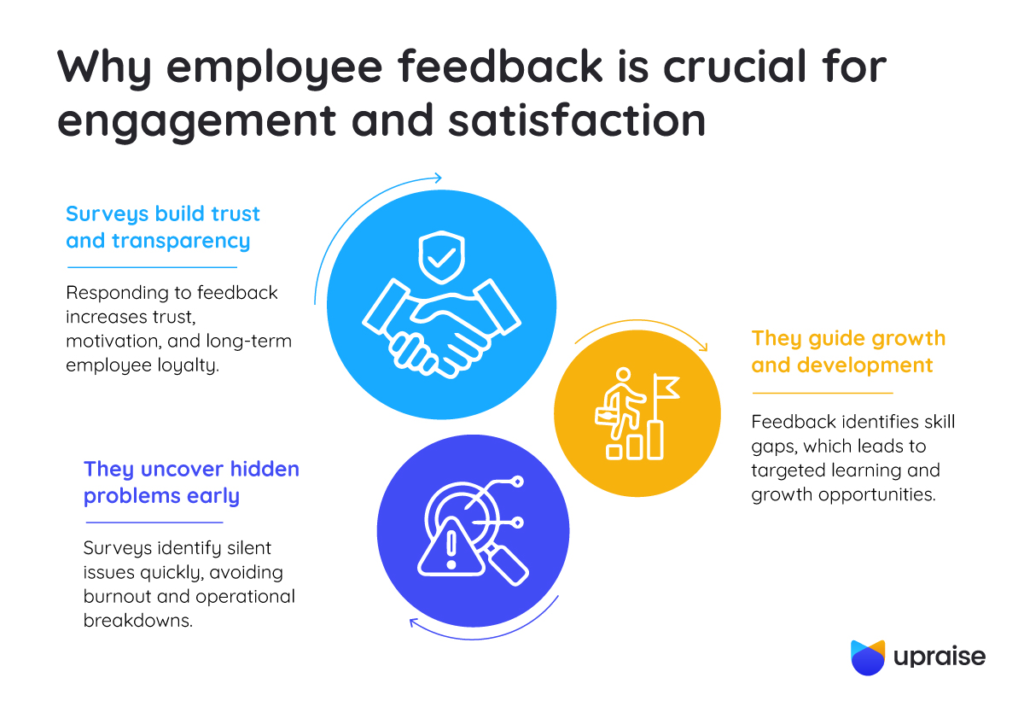
Surveys build trust and transparency
When employees feel heard, they begin to trust the company more. For example, if a product developer shares that release deadlines are too tight and the team lead actually adjusts the timeline, it shows that the company values their input. That trust keeps people motivated and loyal.
They uncover hidden problems early
Surveys surface the hidden pain points teams might not share in meetings. For example, in a SaaS startup, support staff might report through a pulse survey that ticket volume is overwhelming after each product release. With that insight, leaders can add temporary help or adjust processes before burnout sets in.
They guide growth and development
Technical or task-related employee surveys can help team leads identify skill gaps and learning requirements. If the survey reveals that teams struggle to explain new product integrations, it indicates a need for short internal workshops or demo training. When employees see their feedback turn into growth opportunities, they feel valued and engaged.
50 essential employee survey questions
Consider the employee survey questions as the source of inspiration. Use them as a reference to customize your employee feedback survey and get the answers you’ve been looking for.
Job satisfaction and motivation
The following employee satisfaction survey questions will help you discover what they feel about their work. Try to get them to explain in detail to collect more insights.
- How often do you feel excited to work here?
- When was the last time you felt you were not sure what was expected from your role?
- Do you feel your skills are better utilized here than in your previous organization?
- What clear purpose do you see in the work you do?
- How confident are you that your contribution is making a difference to the organization?
- Do you feel fairly recognized for your efforts?
- If you could change one thing about your role, what would it be?
Communication and collaboration
Consider asking the following questions to discover how information flows across your company and how well employees feel supported by their peers.
- How often do you share feedback with your manager?
- When was the last time you worked with cross-team members on a common goal?
- How soon do you receive information regarding any new company updates?
- Do you feel your opinions are taken seriously during meetings?
- How quickly do you receive support from other teams when needed?
- Does your team handle criticism from your team lead constructively?
- Do you feel your team lead should be working more on transparent communication?
Leadership and management
The following set of employee survey questions helps understand how staff perceive leaders in terms of trust and empathy.
- Do you feel your team lead is good at providing a clear direction for the team?
- How often do you find the advice coming from your leader valuable?
- Does your manager inspire you to become a better leader?
- How often do you think of handling the team better than your manager?
- What could your manager do differently to support your growth?
- Is it easy to approach senior leaders for any help with your work?
- Do you feel leadership communicates the company vision effectively?
Career growth and development
Growth is one of the strongest motivators for retention. If you want to know how employees see the company for their career growth, ask the following questions.
- Where do you see yourself in this company after five years?
- Do you feel your career goals are supported in this organization?
- How often do you receive constructive feedback on your work?
- Have you received any opportunities to upgrade your skills lately?
- Have you ever received career development suggestions from your manager?
- Do you feel supported in taking on new challenges in your role?
- What new skills would you like to develop in the next six months?
Work environment and culture
Consider including the following employee survey questions to discover if the workplace feels safe, inclusive, and motivating to them.
- Do you feel respected by your colleagues and managers?
- How balanced is your personal life with your professional life?
- Do you believe your company genuinely values diversity and inclusion?
- Do you feel supported by your team members and manager during stressful situations?
- How likely are you to recommend our organization as a workplace to others?
- When was the last time your team celebrated small wins together?
- Would you like to recommend anything to improve your work environment?
Recognition and rewards
If you want to check how often employees feel recognized for their efforts, consider asking the following questions.
- How satisfied are you with your current salary?
- Do you feel well compensated for your efforts?
- How often do you receive appreciation from your managers?
- What types of recognition motivate you the most?
- Do you think promotion policies here are fair and transparent?
- How could the company better reward sincere employees?
- Would you like to recommend any particular perk to be added to the base salary?
Employee engagement and overall well-being
The following set of employee satisfaction survey questions can identify early signs of burnout, disengagement, or emotional fatigue.
- How often do you feel stressed by your workload?
- Do you feel your company genuinely cares about your well-being?
- Do you take pride in the work you and your team create in this company?
- How often do you watch motivational videos or read something similar?
- How do you see yourself connected to the company’s mission and values?
- What is your daily source of inspiration to come to the office every day?
- Do you feel the company supports your mental health?
- If you could change one thing to make work more engaging, what would it be?
After completing the survey, the next immediate step is to analyze it to draw insights and take actions to show employees that their opinions matter.
How to analyze employee survey responses effectively
The primary purpose of employee surveys is to understand what drives satisfaction or frustration across teams. Consider analyzing the findings in the following manner:
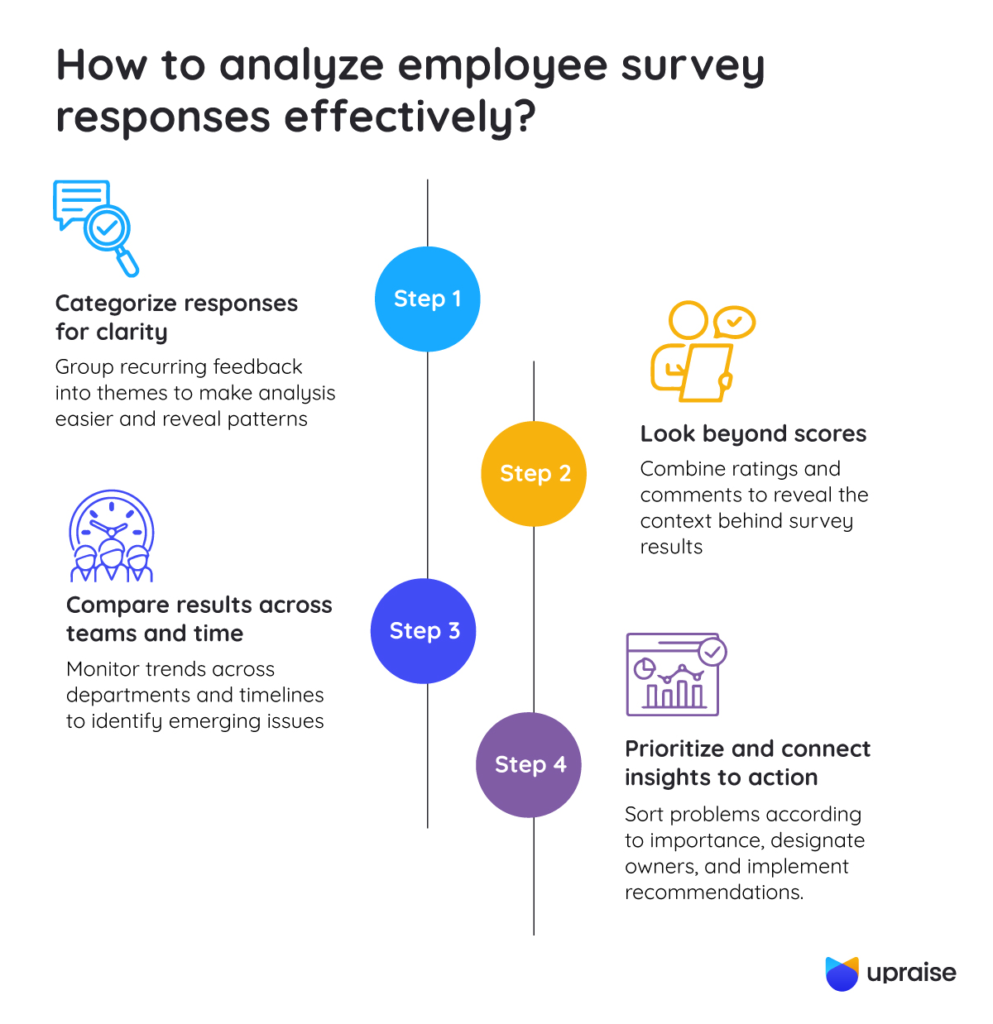
Step 1: Categorize responses for clarity
Most of the time, leaders spend too much time going through individual comments. Instead, consider focusing on recurring issues. Analysis would be easier if you could group responses into categories such as leadership, workload, communication, etc. For example, any mention of a lack of visibility in decision-making can be clubbed into the group reserved for communication.
Step 2: Look beyond scores
A high or low score doesn’t always tell the whole story. Instead, add quantitative data (such as engagement ratings) alongside qualitative scores collected through open-ended questions. For example, a score of seven out of ten on the employee engagement score (quantitative data) might seem fine on paper. However, comments could reveal burnout during a recent product release. Context is everything.
Step 3: Compare results across teams and time
Track how results change over time or differ between departments. A drop in developer satisfaction after introducing a new sprint cycle may signal issues with workload or unclear expectations. Comparing helps identify what’s working and what needs to change.
Step 4: Prioritize and connect insights to action
Not every issue needs immediate fixing. Rank concerns based on their impact on performance and retention. For instance, addressing poor manager communication can have a bigger effect than adding new perks. Create an action list and assign owners to ensure accountability.
Post analyzing the survey, the next step is to take meaningful action for lasting change.
How to act on employee feedback to improve engagement
Collecting feedback is only half the job; what you do with those insights is what really matters. If you want employees to know that their opinions matter, take the following actions.
1. Communicate what you’ve learned
Share key takeaways from the survey on a central dashboard. A simple note like, “You asked for better clarity in OKRs and flexible leave options, and we’re working on it,” builds transparency and accountability.
2. Involve employees in the solution
Encourage teams to be a part of the change. Request that they suggest changes or vote for the option that best fixes their problem. For instance, invite product teams to help design a shared sprint review format to resolve their request for poor cross-team visibility.
3. Prioritize quick wins and long-term changes
Address issues where your 20% of the effort can bring about 80% of the change. Minor issues, like improving the communication channel, can be fixed in a very short time. However, your prompt actions will keep employee momentum high while larger problems are resolved.
4. Track progress and adjust continuously
Regularly review the impact of your actions using engagement metrics or follow-up surveys. If employee satisfaction doesn’t improve, revisit your approach. Engagement isn’t a one-time campaign. It’s a cycle of listening, acting, and refining.
Bring it all together with the right tool
Manually managing feedback loops can get time-consuming and inconsistent. Tools like UpRaise for People help simplify the process by keeping everything connected inside Jira:
- Automate feedback requests and reminders
- Link OKRs with engagement insights
- Track action items and progress in one place
- Keep communication transparent across teams
UpRaise makes it easier to turn employee feedback into measurable engagement results, all without leaving your workflow.
Conclusion
Employee surveys can help you understand your workforce’s pulse at present. However, to derive valuable insights that aid informed decision-making, employees should be asked the right questions. The first few sessions may seem overwhelming. Try to customize surveys to include the right mix of questions to gather both qualitative and quantitative data. Promptly act on low-effort fixes to show employees that their opinions matter. Moreover, involve them in the solution design process. It will make them realize how crucial their opinions are to your organization.
To automate the entire process for a smooth flow, consider leveraging the UpRaise suite of apps with confidence.
FAQs
1. What are the key employee survey questions to measure engagement?
The impact of a question can change, depending on the scenario. So, it is better to draft questions specific to the problem. After all, an employee feedback survey aims to discover what drives engagement in your staff. So, ask questions that will help you extract the qualitative and quantitative data simultaneously.
2. How can employee surveys help improve workplace satisfaction?
Employee surveys give you a bird’s eye view of what is working for and against the organization. It reveals secret challenges that have been blocking the organization and its employees from performing at their peak. So, when you act on feedback, it builds trust and shows employees their opinions matter. Gradually, it leads to a culture where the organization’s success feels personal to employees.
3. How often should organizations conduct employee engagement surveys?
Ideally, employee feedback surveys should be conducted at least once every quarter. Alternatively, you can conduct pulse surveys every quarter and long surveys once or twice a year. This frequency works best for spotting problems and fixing them before they escalate further.
4. What should companies do with the feedback from employee surveys?
First, it is essential to analyze insights for patterns to identify common areas for improvement. Next, share the findings with employees and invite them to be part of the process to bring necessary changes. This will build trust and keep employees engaged.


