


Think about the last time a project hit a wall. Was it due to the team or the person leading it? More often than not, the turning point lies in how a manager shows up.
The real eye-opener is this: 85% of employees say they disengage at work because of an unfair appraisal system. That makes manager evaluations more than a checkbox exercise. They reveal how leadership shapes performance, communication, and team morale.
The challenge is that most performance reviews fall short in evaluating managers’ performance. They focus on outcomes without looking at leadership behaviors. They flag problems but offer no path to improvement. That gap is where potential gets lost.
This guide cuts through the noise. You will receive practical steps to run meaningful manager evaluations, relatable examples of manager evaluations, and actionable strategies for long-term manager development. Whether you are an HR lead, a team head, or a manager yourself, this is the playbook for building leadership that works.
What is a manager’s evaluation?
Manager evaluation is a process for assessing a leader’s effectiveness. It is not about micromanaging performance. It is about zooming out to understand how a manager supports their team, handles challenges, and contributes to your organization’s broader objectives.
A good performance evaluation for managers goes beyond hitting KPIs. It looks at how a manager motivates people, resolves conflicts, manages priorities, and responds to feedback. Some of the best signals come from those they work with every day — direct reports, peers, and department heads.
Think of it like tuning an engine. You are not just checking if it runs, but how smoothly and efficiently it works under pressure.
The role of manager development in organizations
Manager development is what keeps that engine improving. It is a long-term investment in building better leaders, not just better task managers.
This matters because managers shape everything from morale to delivery timelines. They guide sprints, balance workloads, and translate strategy into action. In Agile environments, that influence multiplies. When organizations prioritize manager development, they see stronger collaboration, faster decision-making, and better employee retention. People want to work for leaders who grow and evolve.
Steps in evaluating managerial performance
Running a strong manager evaluation process is like building a reliable map. You need markers to track someone’s location and their destination. Here is how to lay that out:
- Define clear goals: What should the manager be driving? More efficient sprints? Higher engagement? Outline those goals up front.
- Gather 360-degree feedback: Go beyond top-down reviews. Peer and team insights add critical context. For example, a report may value their manager’s mentorship but flag confusion around task priorities.
- Measure outcomes: Look at results, not time spent. Did the team hit delivery targets? Was a team conflict resolved efficiently?
- Review regularly: Skip annual reviews. Monthly or quarterly check-ins provide more relevant data.
- Deliver actionable feedback: Do not just point out flaws. Recommend next steps, like clarifying sprint priorities during daily stand-ups to create focus.
Manager evaluation examples
- A manager who notices burnout and redistributes tasks to avoid delays shows proactive leadership
- A leader who dominates meetings but ignores feedback may need development in listening and team collaboration
- A manager who pushes for sprint goals without clarifying expectations may improve with coaching around communication
These are not just red flags or pats on the back to move past. They’re teachable moments that actually shape a manager’s growth.
How to develop managers for better performance?
When a manager improves, the whole team benefits. According to a 2024 SHRM study, teams led by skilled managers are 2X more likely to be satisfied with their jobs. That’s not just about faster delivery. It’s also about fewer misunderstandings, better morale, and more initiative.
And here’s the kicker. Strong leadership also helps with hiring and retention. Candidates are significantly more likely to accept offers from and thrive in companies known for outstanding managers and a positive leadership culture.
So it’s not just about improving internal culture. It’s a talent magnet and a long-term business win.
You don’t need a massive HR budget to see these benefits. Here are some practical steps to build better managers.
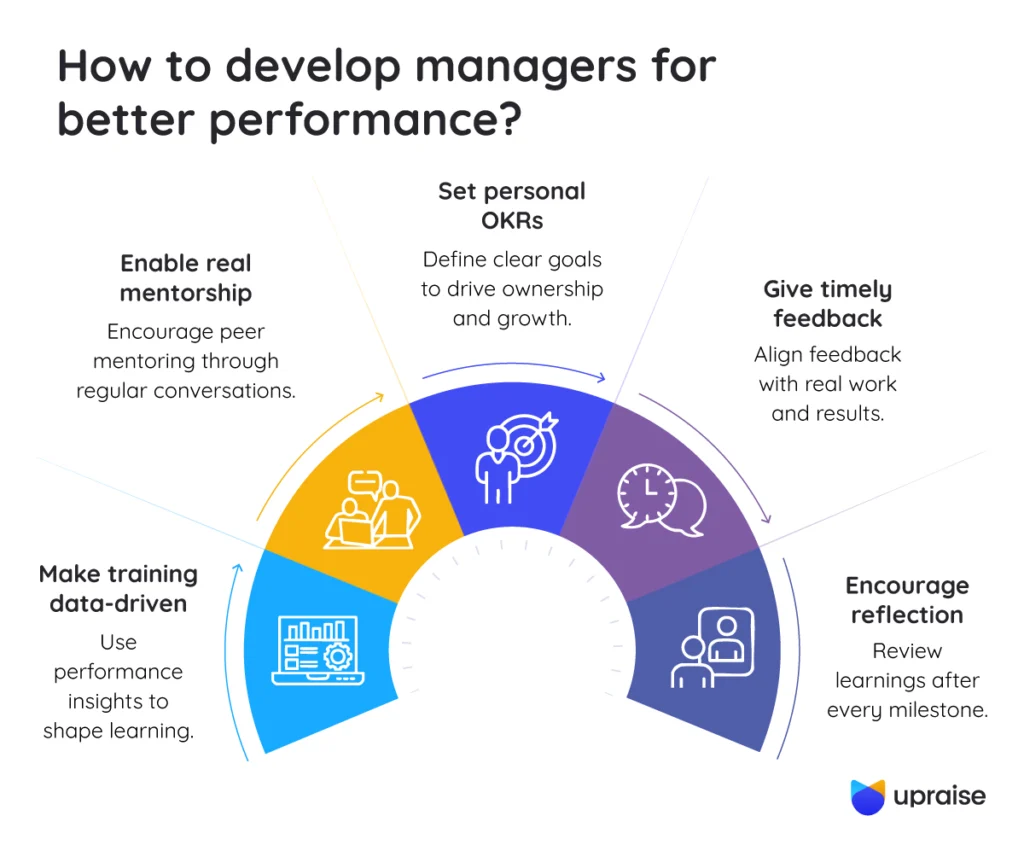
- Let evaluations guide the training
Start with actual data. Use 360-degree feedback, OKR progress, and peer reviews to identify patterns. Is a manager struggling with delegation or prioritization? That’s your cue. Tools like UpRaise for Employee Success help HR teams centralize these insights and create targeted learning paths that directly tie to real performance data. The goal is to keep training short, relevant, and closely linked to everyday work, so improvements show up where they matter most.
- Set up mentorship with real conversations
The best lessons don’t always come from slides. Pair managers with senior leaders for monthly check-ins. These informal chats help unpack sticky situations like handling tough feedback or resolving a team conflict.
For example, a manager learning active listening through peer mentorship may shift from leading top-down meetings to facilitating open discussions. That one shift can boost engagement and clarity across the team.
- Create personal OKRs for accountability
Set clear, measurable goals. Instead of vague improvements, aim for something like boosting one-on-one meeting quality scores by 20 percent in three months.
- Give feedback when it actually counts
Don’t wait for quarterly reviews to point out what’s working or what’s not. Share feedback right after a sprint ends or a project wraps.
For example, you handled the resource crunch last week by reshuffling tasks early. That kept the project on track and avoided burnout. Great job.
- Encourage reflection after every milestone
After a big presentation or sprint, ask managers to reflect on what worked, what didn’t, and what they’d try differently. This simple journaling habit often uncovers patterns that formal training can’t, like unclear instructions or decision-making delays.
Now let’s look at the common roadblocks that slow down manager development and how to move past them.
Common challenges in manager development
Manager development can hit snags, but solving them boosts employee engagement and team success. Here’s the thing: clear strategies turn challenges into growth opportunities. Below are common hurdles and simple ways to tackle them
- No time for training:
- Use 15-minute microlearning videos to fit busy schedules.
- Focus on one skill per quarter, like delegation, for manageable learning.
- Defensiveness to feedback:
- Frame feedback positively: “Your team values your drive — clearer goals can amplify it.”
- Pair managers with mentors for private, constructive discussions.
- Inconsistent evaluations:
- Set shared metrics: goal completion, team sentiment, soft skills.
- Train evaluators to align on standards, improving fairness by 20% (SHRM, 2024).
- Limited resources:
- Host peer-learning sessions with senior managers to share expertise.
- Integrate development into existing Jira workflows to avoid new costs.
These problems, once addressed, can impact team engagement by as much as 70%.
In one real-world case, an Estonian transportation provider used UpRaise to streamline performance management and saved over $25,000 annually. With centralized feedback, clearly defined OKRs, and timely check-ins, they turned scattered evaluations into a process that delivered measurable cost savings and improved manager accountability.
Tools and techniques for manager evaluation
Effective manager evaluation drives better leadership, boosts employee engagement, and aligns teams with broader business goals. The key is using proven methods that keep evaluations fair, timely, and actionable. When combined with tools like UpRaise, these techniques go beyond just tracking performance; they improve it.
Here’s a closer look at what works and why.
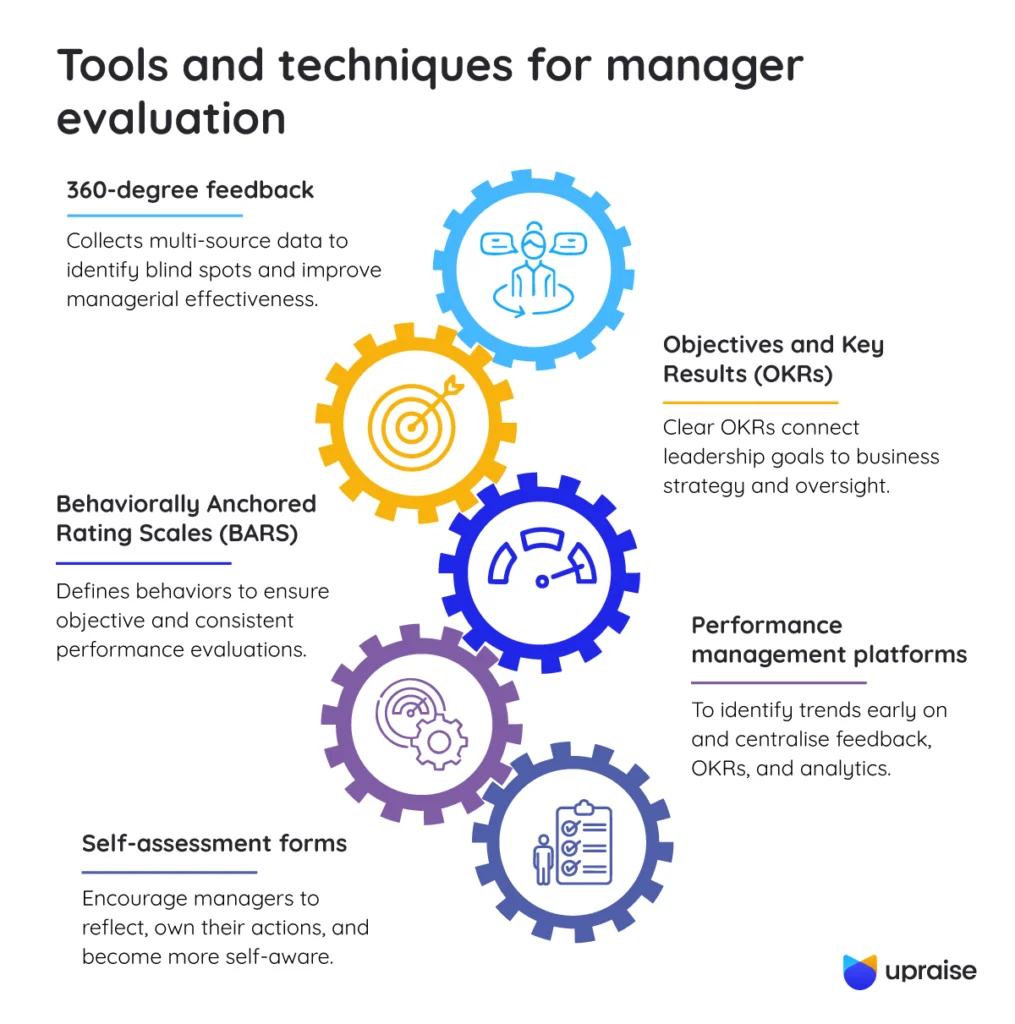
- 360-degree feedback: This method collects confidential input from direct reports, peers, and supervisors to provide a comprehensive understanding of how a manager is perceived. It helps spot blind spots like unclear communication or inconsistent decision-making. An SHRM study shows that people managers believe using structured feedback systems leads to more effective job performances.
- Objectives and Key Results (OKRs): Setting clear OKRs like “increase team productivity by 15 percent” gives managers direction and accountability. This approach of settling clear expectations not only aligns individual leadership goals with company strategy but also boosts manager effectiveness.
- Behaviorally Anchored Rating Scales (BARS): BARS use specific behavioral examples to rate performance on a scale. For instance, a skill like conflict resolution might be rated from 1 to 5 with detailed descriptors at each level. This makes evaluations less subjective and more consistent across teams.
It also makes development conversations easier, since the feedback is based on observed behaviors, not vague impressions.
- Performance management platforms
Modern software tools combine feedback, OKR tracking, and reporting into one place. This saves HR teams time and makes it easier to identify patterns early, like a sudden dip in engagement or frequent missed deadlines.
UpRaise for Employee Garrison integrates these capabilities into Jira, providing real-time dashboards and tailored analytics that support strategic decision-making at scale and can help enhance managerial effectiveness.
- Self-assessment forms
Asking managers to reflect on their own performance encourages ownership and self-awareness. Questions like How well did I delegate tasks this quarter help them think critically about their leadership style.
Organizations that include structured self-reflection in their evaluations can expect an improvement in their performance, as managers become more mindful and responsive.
Conclusion
Strong managers do not just appear. They are built through honest feedback, clear goals, and steady support. That is why manager evaluation is more than just a yearly checkbox. It is your way of understanding how leadership manifests itself day to day and how it can evolve. With thoughtful performance evaluation for managers, you start spotting real patterns. A manager who consistently miscommunicates goals. Another who lifts team morale in tough sprints. These manager evaluation examples are not just observations. They are launchpads for improvement.
Manager development is what turns those insights into progress. When done right, it builds leaders who coach, not just direct. It builds trust, not just compliance. If you are ready to move past vague reviews and into real leadership growth, start here. Your managers are not just part of the team. They set the tone. Equip your managers with the right tools, guide them with clarity, and watch your teams rise higher because of it.
FAQs
Q1: How do you evaluate a manager’s performance?
Set clear goals, collect 360-degree feedback, and focus on outcomes like team productivity. Use the UpRaise People App for Jira for real-time tracking and actionable insights.
Q2: What are the best practices for manager development?
Provide targeted training, set OKRs, and offer mentorship. Tools like UpRaise for Employee Garrison support growth with centralized feedback and HR data.
Q3: Why is manager evaluation crucial for business growth?
Managers drive team success. Effective manager evaluation identifies gaps and aligns leadership with goals, boosting engagement and results.
Q4: How can manager development programs be implemented successfully?
Use clear metrics, ongoing coaching, and tools like UpRaise for Employee Success. Ensure manager buy-in and open communication for lasting impact.


