


It’s Monday morning at a growing SaaS startup. The product team gathers for a quick stand-up. The goal is to generate new design ideas for the upcoming product. On behalf of the team, the lead designer shares a bold suggestion that has never been tried out before. Instead of opposing, the manager says, “Let’s test it.” The team feels heard, trusted, and motivated.
Culture and values make all the difference. When both fall out of sync, engagement fades fast. Teams lose focus. Growth slows. That’s why understanding how culture and values drive engagement is so critical. However, it’s a challenge for organizations to align their values and culture with their broader goals. This article will help you understand how that alignment fuels lasting success.
What are organizational culture and values?
Organizational culture and values are two moral guidelines that shape the future of everyone working in the company.
Understanding organizational culture
In simple terms, organizational culture represents the personality of your company. It is reflected in the everyday behavior and work ethics of employees.
For example, agility and experimentation are very common in the SaaS industry. You will not find this culture written anywhere in their policy manuals. Instead, it reflects how they approach every part of the sprint, from ideation to delivery.
What does a strong company culture appear like from the outside?
- Encourages open communication
- Necessitates continuous feedback
- Teaches how to learn from mistakes
- Aligns everyone towards a shared mission
Understanding organizational values
Values are nothing but the guiding principles that influence every decision. From an organizational point of view, it represents what the company stands for, besides profit.
For example, if a SaaS startup values “customer obsession,” it will prioritize user feedback in every sprint or product update.
Any responsible service provider follows these core values:
- Integrity: doing the right thing, even when no one is watching
- Innovation: Constantly seeking better solutions
- Collaboration: Building together rather than alone
- Accountability: Taking ownership of outcomes
It takes time to consistently follow such strong core values to create a positive work culture. When your company culture and values start to take a strong shape, they directly influence employee engagement and drive exponential growth.
How culture and values influence employee engagement
Employee engagement is not job satisfaction. If employees find purpose in their work, they tend to stay with the organization. That’s where organizational culture and values play important roles.
How culture shapes engagement
A strong company culture gives every employee a purpose to connect with the work. They realize why they belong here, what they are supposed to do, and how they can achieve it by supporting each other.
How does a healthy culture boost engagement? Let’s understand through these two mini workplace culture examples:
- Managers support open communication —> Employees feel psychologically safe at work —> Team no longer works in silos.
- Management recognizes good works —> Employees receive growth opportunities —> Employees feel valued.
In a forward-moving company, you can find many examples of workplace culture that positively influence organizational growth from the root level.
How values deepen engagement
Values are what guide decisions when no one’s watching. They connect daily actions to a shared purpose. Atlassian’s “Don’t #@!% the customer” value, for instance, ensures every employee focuses on user success — not just product delivery.
Values drive engagement by:
- Encouraging initiative aligned with the company vision
- Building stronger collaboration across teams
- Creating pride and ownership in outcomes
To make this impact sustainable, organizations must align their culture and values with their business goals.
Aligning company culture and values with business goals
Tuning the entire workforce together with the same corporate culture and values is not an easy task.
Why is alignment essential?
If there is no alignment between your goals and beliefs, the work often seems forced and overwhelming.
On the other hand, when done right, the alignment brings:
- Clear focus on priorities across teams
- Faster, value-driven decision-making
- Greater accountability and collaboration
- Stronger sense of purpose and ownership
For example, when every team in a SaaS company considers “customer success” as one of their core values as well as business goals:
- UX team focuses on improving user retention
- Developers prioritize working on valuable features
- Customer support teams proactively work on user resolution
- Marketing team educates leads rather than forcing them into sales
As a result, every department pulls in the same direction — not because they’re told to, but because it aligns with what they believe in.
How to align?
Alignment is a continuous design process. You must weave values into every business layer, from strategy to daily standups. Here are some tips for doing it with minimum friction.
1. Translate values into measurable actions
Turn abstract values into visible outcomes. If “innovation” is a core value, link it to a specific target, such as reducing product rollout time by 25% or achieving faster release cycles. This makes values operational, not ornamental.
2. Let leadership live the message
People follow what they see. When leaders share sprint learnings transparently or admit mistakes during retros, they set the tone for an authentic culture that supports company goals.
3. Connect every role to the mission
Every developer, marketer, or support executive should know how their work drives the company’s vision — say, improving customer retention or lowering churn. Clear links boost engagement and accountability.
4. Celebrate alignment in action
Recognize teams that turn culture into performance. Whether through “Customer Hero” awards or internal demos, celebrating behavior aligned with business outcomes keeps values alive.
With alignment in place, the next step is understanding how to measure the impact of culture on employee engagement and business growth.
Measuring the impact of culture on employee engagement and growth
What can’t be measured can’t be improved. Organizations must apply the same analytical mindset to cultural metrics that they apply to product metrics for reflection and development.
Cultural outcomes are tied to four main business metrics:
- Employee retention: Shows employee churn rate
- eNPS (Employee Net Promoter Score): Measures advocacy and satisfaction
- Time-to-ship: Reflects how culture supports agility and collaboration
- Internal promotions: Indicates talent growth within the company
Here are some valuable methods for measuring the cultural impact on employee engagement and growth.
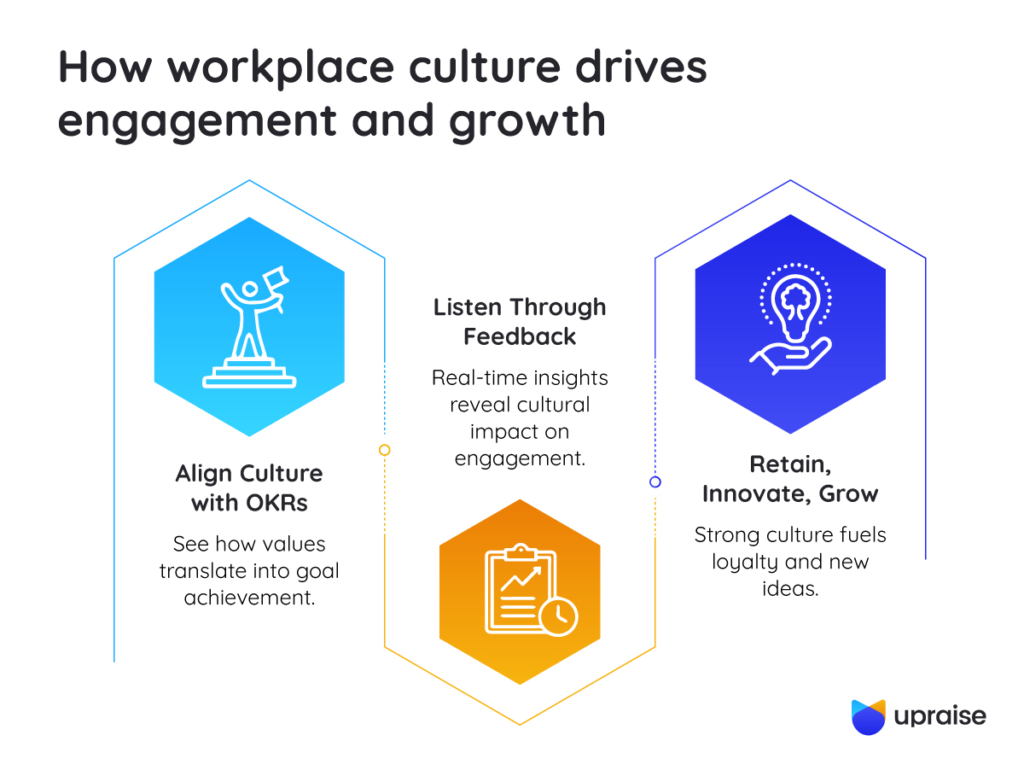
Measure performance alignment with the company’s OKRs
Performance data of employees indicates how closely they align with the business goals in terms of culture. One of the best ways to do this is to convert business goals into objective key results (OKRs) and constantly track them to see how culture influences outcomes.
For instance, let’s say a SaaS company values collaboration. Then, it should set an OKR around improving cross-team project delivery time. Tracking that goal will reveal whether the corporate culture is truly integrated into every aspect of the sprint delivery.
Track engagement through employee feedback loops
Employee feedback is essential to understanding how staff members feel about the company culture. However, there should be continuous feedback loops to analyze the impact in real-time.
HR can conduct one-on-one check-ins or administer anonymous surveys. What if the process feels overwhelming to both HR and employees?
Consider leveraging tools like UpRaise for Employee Success. It enables management and employees to exchange feedback with peers and within the hierarchy on a continuous basis. Surprisingly, all of this can be accomplished within Jira.
Analyze retention and innovation
Just like productivity, retention, and innovation, these metrics also show how engaged employees are in the workplace. Employees tend to prefer working in a healthy work culture for an extended period. Additionally, such an environment serves as the perfect catalyst for innovation. Teams come up with breakthrough ideas for faster development cycles, quicker ticket resolutions, or better feature updates. So, try to measure these factors as well.
Conclusion: Strengthening culture and values for sustainable growth
Organizational culture is an invisible framework that shapes how employees think, collaborate, and grow together. Every sprint planning, customer call, or release review reflects what a company truly values. A culture rooted in trust, ownership, and learning enables teams to move faster without compromising clarity. It keeps developers focused on quality, product managers connected to user value, and leaders aligned around purpose. When corporate culture and values are tightly woven into business goals, engagement naturally follows.
But sustaining that alignment requires visibility. You can’t improve what you don’t measure. That’s where the UpRaise suite of apps can help you turn culture into measurable action. Book a free demo to see how you can connect people, purpose, and performance right inside Jira.
FAQs
How does organizational culture impact employee engagement?
Organizational culture significantly impacts the performance of employees in the workplace. If the culture is supportive of employees, they work in a collaborative environment. Work feels meaningful instead of a tedious process. As a result, employee engagement improves.
What role do company values play in employee satisfaction?
Values act as a moral compass for an organization and its employees. They influence every decision, from product design to customer communication. When employees fully understand these values, they recognize their place within the organization. It prompts them to act proactively to meet the expectations. This clarity in work brings satisfaction.
Can strong culture and values directly contribute to business growth?
Absolutely. A strong culture reduces friction, improves collaboration, and accelerates decision-making — all of which are essential for scaling SaaS businesses. When employees share common values, they move faster toward shared goals. The result? Higher retention, better product quality, and happier customers.
How can organizations align culture and values to enhance employee engagement?
First, clearly define your organizational culture and values on paper. Then, connect those values to measurable business outcomes. Now, inspire leaders to model these values daily. When culture and goals move together, engagement becomes your company’s natural state.

