


Imagine a work environment where teams from different departments have a clear vision of the SaaS product to be launched in the next quarter. Developers know what level of clean code to push ahead of schedule, and marketers know the exact pain points to focus on for maximum conversions. However, midway through the workflow, the project leaders switch to a task-based engagement strategy, given the dynamic work environment, tight sprints, and constant pressure to roll out new features. This flexibility in implementing team engagement strategies is necessary to achieve productive team synchronism.
In this article, we will learn how to take a structured approach to employee engagement strategies that actually work. You will also discover practical engagement strategies with clear steps to implement them effectively.
What are team engagement strategies and why do they matter?
Team engagement strategies are nothing but structured efforts by organizations to inspire, motivate, and connect employees with the company’s vision. These strategies should be designed so that employees will love to stretch themselves into deep work. The aim is to drive engagement from within, not by any fear, pressure, or anxiety.
Why is team engagement important?
According to the APA’s 2023 Work in America™ Survey, 94% of employees feel they should be engaged at work to produce better results. However, 20% of them feel disconnected. Interestingly, this situation often leads to absenteeism, resulting in a $154 million annual loss for businesses.
Moreover, an engaged workforce means:
- Higher productivity and quality output powered by deep work
- Low turnover and absenteeism as employees feel valued
- Lower risk of burnout at the workplace as employees love what they do
It’s not just about following mundane employee engagement rituals in the workplace. Perks, bonuses, and gift vouchers are no longer attractive for elite performers.
For employees, your organization’s efforts should feel organic and genuine in support of their professional development.
Key strategies to boost team engagement and performance
The following four strategies will help you get started on the right foot. It will also be easier to track them through the metrics discussed in the next section.
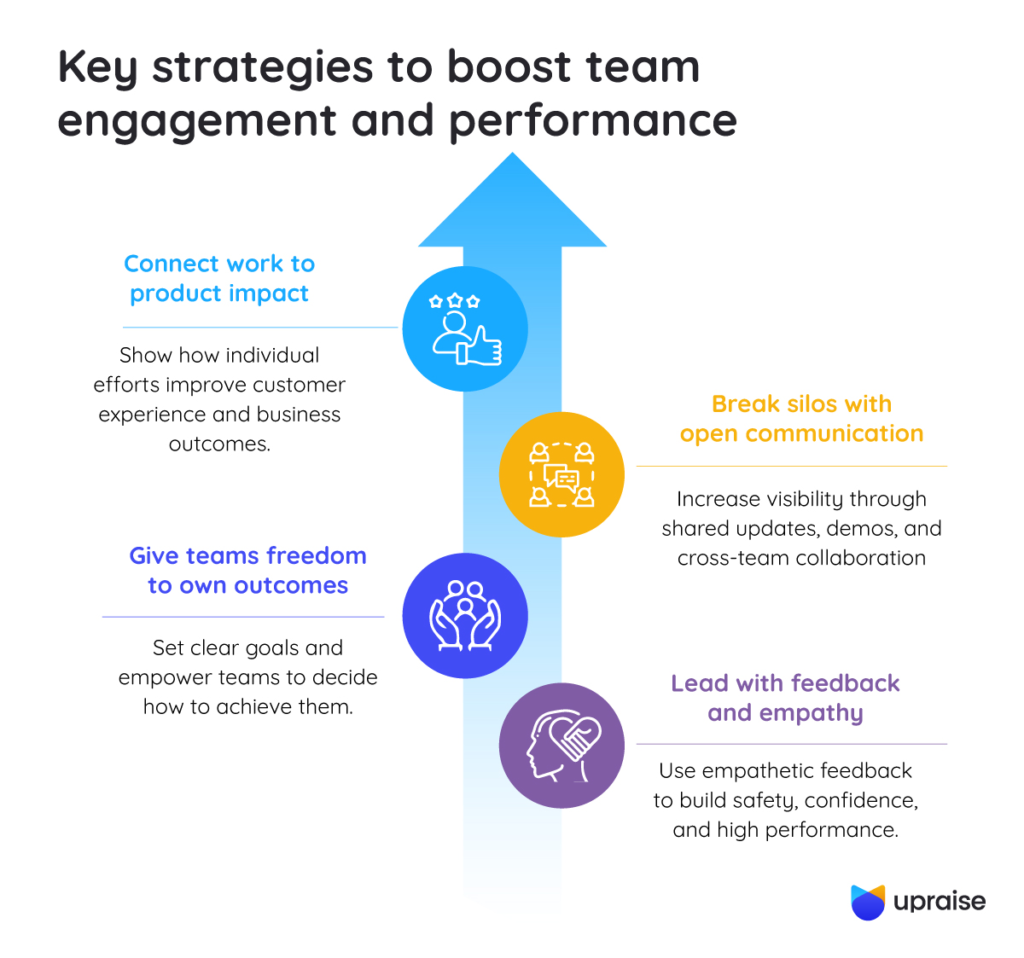
Connect work to product impact
Most employees lose visibility into how their work translates into real-world value. As a result, they feel disconnected from their work. So, try to show each member of your team how their individual effort shapes customer experience. They will feel a deeper sense of purpose. For example, let your SaaS backend engineer know how optimizing API speed directly boosts user retention. Regularly share such insights in team meetings. It will not only motivate them but also inculcate a shared mission.
Break silos with open communication
In a fast-moving SaaS environment, as teams scale, information tends to get trapped between departments. As a result, miscommunications rise and teams eventually prefer to work in silos. That’s why it is important to create a culture of radical transparency.
To make that happen, consider:
- Hosting weekly cross-functional meetings where teams celebrate progress together
- Centralizing all communication using tools, like UpRaise for Employee Success, for clarity regarding progress
- Introducing weekly demo sessions for teams to show how their work connects to the company roadmap
The idea is to create a transparent, bidirectional communication channel where the information gap no longer exists.
Give teams freedom to own outcomes
Like innovation drives growth, autonomy fuels engagement. When teams feel they have the creative freedom to make decisions, they feel more invested in the work. Unfortunately, in many cases, managers hesitate to delegate control. They fear it may lead to misalignment or delay in delivery.
However, the ideal strategy is to set clear outcome-based goals (OKRs) for teams and let them decide how to achieve them. For example, allow your product squads to set their sprint priorities within a shared objective, such as improving user activation by 20%. Once they realize they own the outcome, it will naturally fuel deep engagement inside.
Lead with feedback and empathy
In a SaaS environment, teams always work under high pressure to deliver on time. Working on tight deadlines creates a sense of fear. The fear of committing mistakes that can compromise the team effort. So, all they need is constructive feedback from time to time, delivered with empathy.
A simple question like, “Is there something you need help with?” is enough to open them up about blockers they might be facing in the task. Such periodic check-ins with empathy make teams feel safe to experiment and perform at their best.
Building effective team engagement strategies is one thing, but the art of their implementation makes all the difference. Let’s see how it requires structure, communication, and consistency.
How to implement effective team engagement plans
If you are putting a lot of effort into creating a solid team engagement plan, ensure employees consistently follow through. Here is a simple step-by-step process to put your employee engagement strategies into real action.
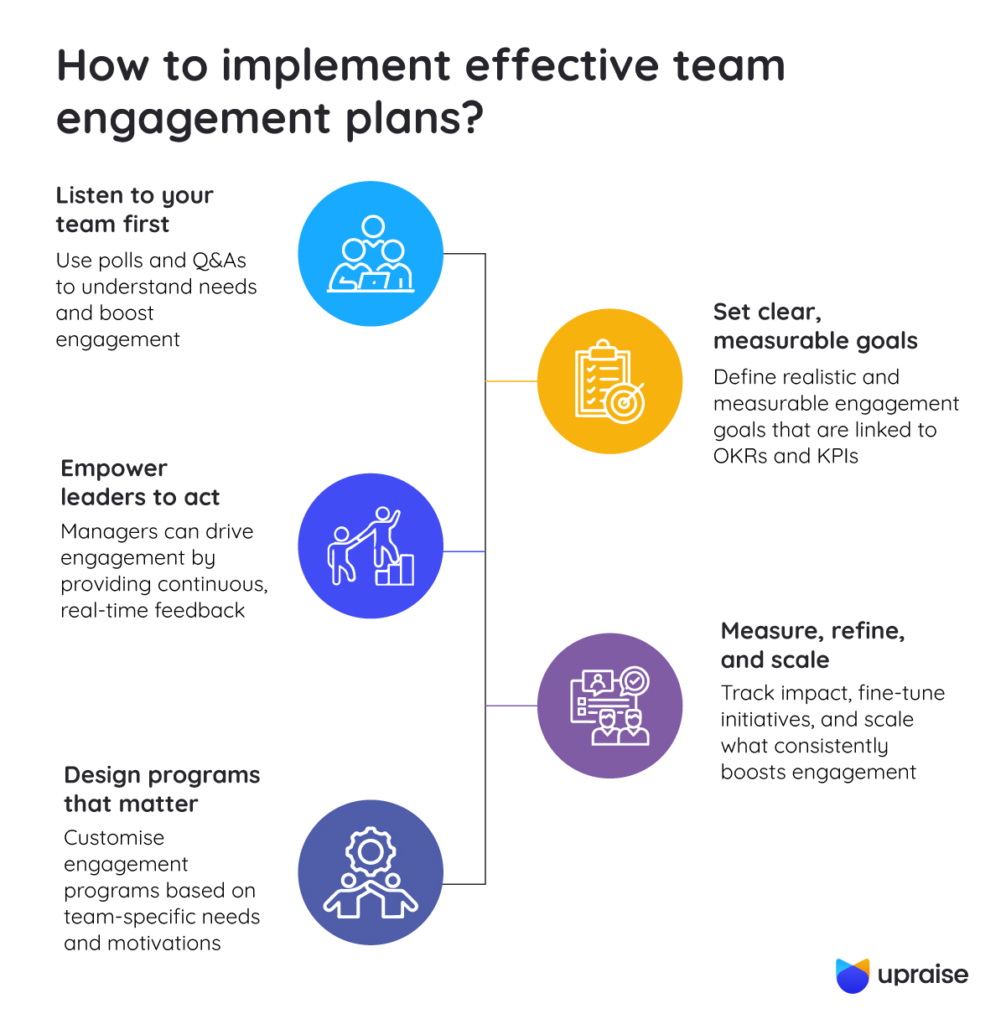
Listen to your team first
Run anonymous polls or hold open Q&A sessions to understand what your employees truly want to remain engaged at the workplace. For example, if your development team wants to be heard during sprint planning, all you need to do is add a team representative to grow engagement.
Set clear, measurable goals
The team engagement strategy should not feel like another task to employees. For that, set realistic goals that are easy to achieve for constant motivation. Instead of deciding to improve team communication, focus on reducing cross-team project delays by 20%. Tie any OKR or KPI to engagement, like participation rates, to easily monitor the progress.
Empower leaders to act
Managers shape how engagement feels on the ground. That’s why employees can better connect with your engagement plans when leaders foster open communication through a real-time feedback loop. Engagement fails when leaders stay passive.
Design programs that matter
It is nearly impossible to design a team engagement plan that applies to everyone. The reasons for disengagement may vary by individual, team, or department. Design programs that the team will find useful. A marketing team may value creative hackathons, while backend engineers may prefer tech upskilling.
Measure, refine, and scale
Employee engagement is a continuous process. Once you have successfully designed and implemented the program, track its effectiveness periodically. The insights will help you decide how to further customize the program. For instance, if feedback shows the mentorship program has helped developers improve performance, consider expanding it company-wide. Treat your engagement plan like your SaaS product. Build, test, learn, and iterate.
However, you need to know the right metrics to measure the success of team engagement plans.
Measuring the success of team engagement strategies
There are four to five key metrics that can tell you how your team engagement strategies are working. Let’s understand what they mean and how to make use of those insights.
Employee satisfaction score
Track how happy employees feel about their work. Moreover, understand how they feel about the management and the work culture in general. These insights help you customize strategies for maximum impact. For example, if an anonymous review of the design team after a rushed sprint reports a low satisfaction score, it could mean either that they need better workload planning or creative freedom.
Employee turnover rate
This shows how often employees leave within a specific period. Let’s say you are experiencing higher turnover in your customer onboarding team during peak product releases. In the process of figuring out the reason, you may realize employees are under much stress in this department, and they should be taken care of to improve the score.
Unplanned absences
If your employees often take unplanned leaves, they are either experiencing work fatigue or feeling disengaged. For example, if your QA team goes through excessive pressure during pre-release testing, some members may deliberately use health excuses to remain absent. It also means they don’t feel their work pressure is balanced compared to other teams.
Employee net promoter score
This metric shows how likely employees are to recommend your company as a workplace. A low score indicates they don’t feel excited about working at the company. On the other hand, a positive score indicates they are proud to be a part of the organization. That means the employee engagement strategies implemented are working in your favor.
Training participation and completion rates
When employees actively participate in team engagement plans, it reflects their willingness to grow. This is the first sign that your strategies are working. You have successfully motivated them to take the first step. However, it is also important to check how many of them complete the sessions. High completion rates indicate they are ready to upgrade themselves to support the company’s broader vision.
To collect data, conduct periodic manager feedback and peer reviews using innovative tools like UpRaise for People.
With this powerful tool, you can:
- Send automated surveys and reminders
- Compare engagement data across departments to spot patterns
- Track OKRs linked to employee retention goals
- Keep complete employee histories and performance records in one secure space
- Discuss survey findings in team meetings to promote open communication
The tool neatly presents all these actionable insights on the dashboard, enabling you to quickly gauge the impact of your engagement efforts on employee performance. No need to waste hours juggling through peer reviews.
Conclusion: Build an effective team engagement plan
Employee engagement represents the relationship between an organization and its employees. Higher staff engagement ensures the organization will perform better. However, to increase your staff’s commitment, dedication, and productivity, you need to implement effective employee engagement strategies. To get started, connect their work to a bigger purpose, allow them to take ownership of their work, help them overcome obstacles with open communication, and lead them with empathy.
After implementing the team engagement plan, track its progress using key metrics, such as employee turnover rate, employee satisfaction score, and employee net promoter score. To bypass the tedious process of anonymous reviews and data analysis, leverage the UpRaise suite of apps.
Start your free trial of UpRaise and build a happier, high-performing team.
FAQs
What are the key elements of an effective team engagement strategy?
Every employee looks forward to achieving work-life balance and getting recognized for their efforts. So, your team engagement strategy should definitely have those two elements. Also, ensure there is a transparent communication channel so employees can share their opinions and make strategies more effective for them. Lastly, keep the scope of continuous improvement focused on the workplace to bind people to it for their professional development.
How can team engagement strategies improve overall team performance?
Engaged teams are happy with their work. As they feel heard and valued, they take ownership of outcomes. That directly translates into deep work, improved product quality, and happy customers.
What are some actionable steps to implement team engagement strategies?
If you want teams to see how their work impacts customer satisfaction, keep them in the loop of every client meeting. For inspiring engagement through deep work, allow them to make independent decisions within their domain. Most importantly, break silos between cross-departments by building teams with at least one member from each core department. It will help them collaborate more effectively and stay engaged.
How do you measure the success of team engagement strategies?
Consider using eNPS and employee turnover rate to measure the efficiency of team engagement strategies on the ground level. In SaaS industries, delivery time, sprint velocity, and bug resolution rate may also indicate how engaged employees are at work.

