


You’re probably used to seeing employees dragging themselves to work on Monday mornings. But today it looks different. You see them walking in energized. They are sharing ideas even before they sip their first cup of coffee. This transformation of the office scene often boils down to a single factor: work culture.
With a conscious effort to improve culture at work, people start showing up. It is seen that they don’t just come in to complete tasks. They come in to contribute in a meaningful way. Over time, a noticeable energy shift is evident.
When done consistently, that shared motivation can become a significant competitive advantage for the company. A positive workplace culture means that the company becomes more effective at attracting talent. Additionally, it can improve retention rates.
In this guide, you will get to explore what work culture truly means and why it’s the heartbeat of employee satisfaction. Also, discover ten proven ways organizations in 2025 are improving culture at work with one meaningful action at a time.
What is work culture and why it is crucial for employee satisfaction?
Each workplace has a distinct atmosphere. It will be evident in the tiniest details, such as the way individuals greet one another. It is most apparent in your workforce’s approach to difficulties and in the way they discuss their job when they think nobody is observing. That unseen energy is referred to as workplace culture.
Improving workplace culture isn’t something you think about as a one-time exercise and then forget about it. It exists and thrives in daily activities. It has been observed that, over time, this sense of belonging does more than boost employee productivity and performance. It fosters loyalty and contributes to lower turnover.
Research indicates that workers who characterize their culture as positive or exceptional are over seven times more inclined to be content at their jobs and significantly less prone to fear Mondays. In other terms, improving workplace culture is not solely about creating positive energy. It’s closely linked to drive, effectiveness, and enduring commitment.
A supportive work environment allows individuals to develop. There is a high level of trust among staff and supervisors. This, in turn, promotes harmony between professional and personal life. With greater trust, daily communication occurs more efficiently and effectively.
As a leader, when you focus on improving the culture at work, you’re not merely raising morale; you’re establishing the foundation for improved decision-making, more resilient teams, and a workplace that employees genuinely want to be a part of.
10 proven ways to improve culture at work and boost employee morale
Ad hoc efforts, such as adding bean bags or planning another Friday event, won’t suffice. Small, consistent actions intended to make your people feel valued, connected, and inspired to do their best work will yield better results. Consider these 10 practical ways to bring that change to life:
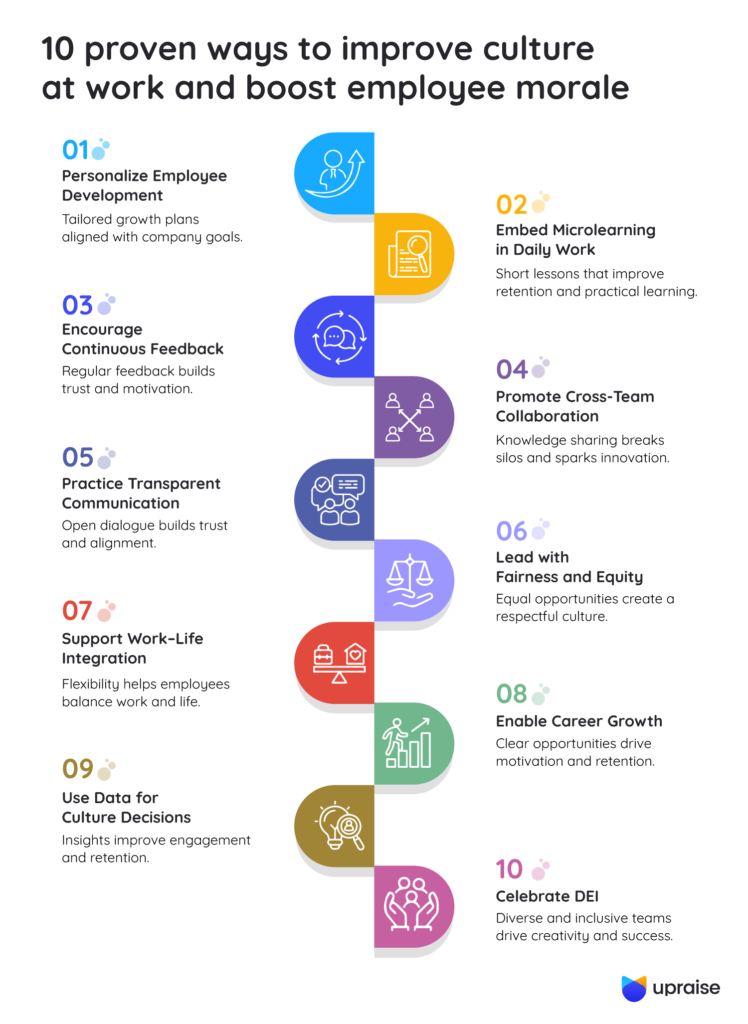
1. Personalize employee development
Each employee has unique goals and distinct learning preferences. That’s the reason personal development plans are more effective than generic programs. These tools enable individuals to discover what motivates them and provide a means to track their progress. Gallup’s research indicates that companies focusing on customized development experience greater engagement and an almost 18% increase in profit.
With platforms such as UpRaise for Employee Success, you can create personalized growth trajectories, align them with organizational objectives, and track actual progress over time.
2. Make microlearning part of daily work
Microlearning breaks training into short, practical modules that employees can complete between tasks, maintaining focus. Using tools like UpRaise for Employee Garrison, you can integrate these lessons into everyday workflows. With the help of microlearning, employees can absorb information quickly, apply it immediately, and retain it effectively.
3. Foster continuous feedback and recognition
Individuals seek to understand their performance on a regular basis, not just annually. With ongoing feedback, employee development accelerates. This, in turn, fosters trust among teams and their managers. Acknowledgment, even for minor achievements, drives motivation more than anything else.
One company reported a sixfold increase in recognition after introducing continuous feedback and OKRs through UpRaise. That small shift led to increased motivation, improved collaboration, and enhanced performance across teams.
4. Create cross-functional collaboration
When you encourage teams to collaborate through shared projects, peer learning, or mentorship programs, a shift occurs. Silos begin to break down, fresh ideas surface, and knowledge flows more freely. Working across functions not only builds empathy but also is known to spark innovation. When you enable this, your employees will start to see how their work contributes to the larger company mission.
5. Prioritize transparent communication
The most effective approach for establishing trust is honesty. Organizations where leaders share transparently and explicitly regarding company objectives, choices, or even challenges, the emphasis shifts from “how to achieve tasks” to “why to achieve tasks.”
The SHRM Global Workplace Culture 2023 report also states that open communication from management is a leading factor in employee satisfaction. Frequent town halls, updates, or manager check-ins have a significant impact on outcomes. The more informed your team feels, the more connected they become.
6. Promote equitable leadership and fair practices
People notice fairness more than most things at work. Equitable leadership, marked by the fair allocation of opportunities, recognition, and constructive feedback, builds lasting trust. Train managers to identify and minimize bias while incorporating equity into daily tasks.
Groups guided by fair leaders typically excel more as team members feel their opinions are valued. Equitable treatment fosters loyalty, which in turn improves company culture.
7. Support work/life integration
Balance varies from person to person. Some individuals require tranquil mornings at home for concentration, whereas others excel with adaptable hours or a hybrid arrangement that offers them a combination of both setups. The key is to give employees sufficient freedom to handle their personal and professional lives without feeling guilt or constant stress.
Merely 32% of individuals are satisfied with their work-life balance. There is a pressing need for companies to reassess their operational frameworks. However, providing flexibility to employees goes beyond a mere policy choice; it conveys a sense of trust to employees. They are more likely to exhibit increased responsibility, enhanced motivation, and improved outcomes.
8. Enable career fulfillment and growth
The feeling that professionals’ efforts are focused on a meaningful purpose is highly motivating for employees. When workers envision a future with your organization, they remain driven and dedicated. Arrange frequent career conversations, offer guidance, and facilitate internal job movement. Motivate leaders to assist employees in matching their individual objectives with company priorities. When career satisfaction is embedded in the culture, engagement naturally follows.
9. Use data-driven decisions for cultural initiatives
With data, you can see which culture programs are actually making a difference. Some innovative analytics tools can help you track and understand trends in engagement, recognition, or retention.
With UpRaise products, you can integrate data tracking into performance and learning workflows, enabling you to make smarter, faster decisions. With more detailed insights, you can create a more tailored and effective culture strategy.
10. Celebrate diversity, equity, and inclusion (DEI)
When they feel that they belong, they often bring their best versions to work. Organizations with a focused DEI provide the right platform where every employee feels respected for who they are and what they contribute. Make inclusion part of daily practice, whether in hiring, promotions, or project assignments. A 2024 workforce survey found that companies actively nurturing inclusive cultures experience higher innovation and lower turnover rates. It’s proof that when everyone feels valued, the entire business grows stronger.
Measuring the effectiveness of work culture initiatives
Positive workplace culture must be more than just appealing in theory. You need to determine whether what you’re doing is genuinely effective. To understand that clearly, you require some intelligent methods to gauge it. Begin with standard engagement or pulse surveys. They provide a quick insight into individuals’ sentiments regarding their workplace, management, and opportunities for growth and development.
Then, monitor retention and voluntary turnover rates. When exceptional employees leave more quickly than you can find replacements, it indicates that a deeper issue requires your focus. At times, it’s salary or workload, but frequently it’s the environment and the way individuals are treated on a daily basis. You can also examine the frequency of feedback movement throughout your organization.
Utilizing tools such as the UpRaise People App for Jira enables you to track patterns of recognition and the frequency of feedback. Examining skill enhancement and professional advancement is also essential. Monitoring progress data helps indicate whether employees believe they are developing or merely going through the motions.
Lastly, evaluate your outcomes against standards. Compare your cultural health indicators with external benchmarks such as the SHRM Global Workplace Culture Report. This provides an accurate view of your organization’s current position and where to concentrate efforts moving forward.
Ultimately, assessing culture isn’t merely about fulfilling requirements. It’s about paying attention.
Final word: The long-term benefits of a positive workplace culture
The benefits of elevating company culture extend well beyond engagement metrics. A vibrant culture equips your organization with the resilience to adapt to change, the trust to overcome challenges, and the creativity to remain competitive. The UpRaise suite of apps integrates growth, feedback, and acknowledgment into everyday work routines. These resources simplify the process of monitoring objectives, acknowledging achievements, and ensuring your culture progresses in a positive direction. By utilizing the appropriate intentions and resources, you can transform your workplace culture into a significant asset for your organization.
FAQs
Q1: How can companies improve culture at work effectively?
You can achieve this by engaging with your team, inquiring about their motivations, and then implementing their relevant suggestions. Genuine change emerges from small, routine actions that foster trust, such as transparent communication, equitable acknowledgment, and clear opportunities for growth and development. Gradually, these steady routines establish an environment where individuals truly desire to stay and grow.
Q2: How does improving company culture boost employee satisfaction?
In a positive workplace culture, employees are fully committed to their work. They exchange ideas more easily, take on project tasks, and celebrate accomplishments together. A positive work environment enhances job satisfaction and cultivates a sense of pride and purpose among employees.
Q3: What strategies can enhance workplace culture in 2025?
Incorporate learning into everyday activities to enable people to continue growing without experiencing burnout. Promote collaboration and the sharing of information among teams from different departments. Provide ongoing feedback throughout the year rather than restricting it to annual evaluations. Most importantly, offer employees flexibility and a sense of connection.
Q4: How do work culture improvements impact employee retention?
When individuals feel valued and encouraged, they are more likely to stay. A setting centered on transparent growth gives them motivation to engage for the long term. Recognition, fairness, and open communication significantly influence that choice. Gradually, these consistent strategies foster trust, reduce turnover, and improve overall team effectiveness.

