


Let’s say you’re in a meeting, and halfway through your presentation, you notice disinterested looks around the room. You share an idea, but it feels like your words are getting lost. Or your emails and work messages leave your team confused instead of inspired. These everyday scenarios highlight the importance of clear communication in the workplace. Communication skills are about more than just being articulate. They’re about choosing the right way to share your thoughts and ideas.
Communication is at the core of any business, whether it is a one-person-owned grocery store or a large multinational software development firm. Failure to clearly communicate your thoughts and ideas is a recipe for disaster.
This article will help you consider what are the types of communication skills you have at your disposal, when to use each one and a few tips about doing so more efficiently.
What is the importance of effective communication in the workplace?
Each workplace context demands a different style. When you choose a communication method that is appropriate for a situation, you are halfway to ensuring your message will be received as intended. This reduces misunderstandings, builds trust and encourages a positive work environment. Let’s consider the following scenarios:
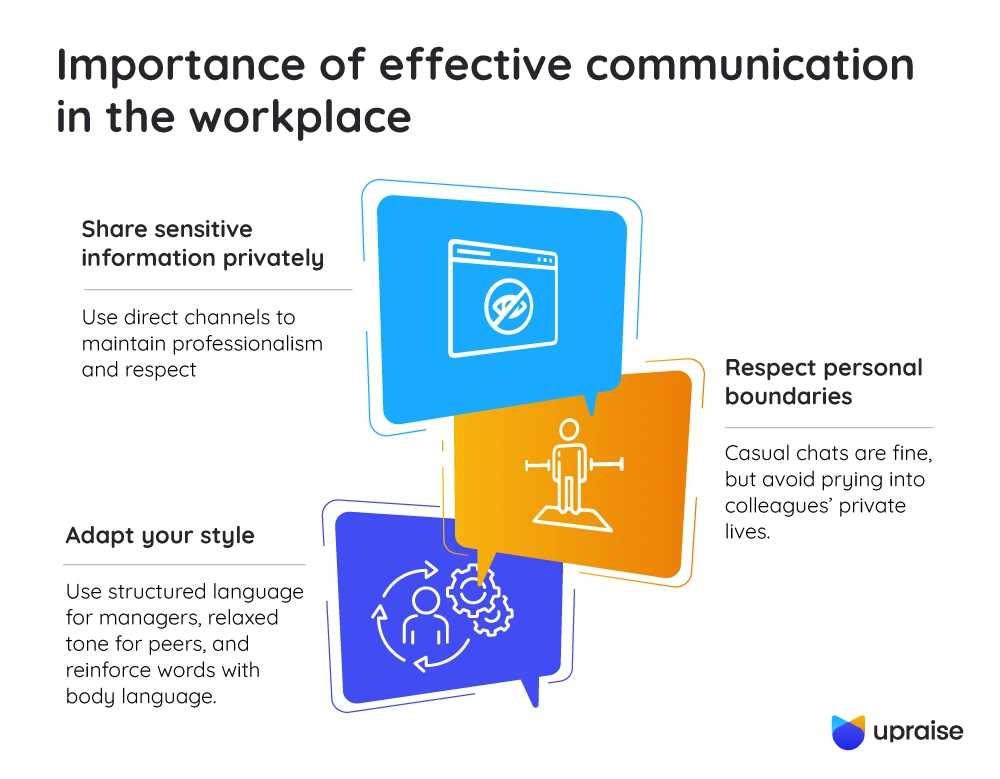
Sharing sensitive information
Delivering sensitive information through a private channel shows respect and professionalism. Sharing it in a group chat, however, would be unprofessional.
Checking on a colleague and discussing personal details
Informal topics often need an informal approach. Setting boundaries and not inquiring about your co-workers’ private lives is also important. If you must do so, the proper way would be to have a friendly face-to-face conversation rather than via formal email.
Communicating with colleagues
Your communication style may change depending on who you’re talking to. A manager discussing goals with a team may use clear, structured language, while a quick brainstorming session with peers can be more relaxed and spontaneous. Even body language plays a role. For example, a nod or smile in a meeting can support your words, making your message clearer.
The core of effective communication is getting your intended message across. Let us start with the fundamentals – the different types of communication methods.
What are the 5 types of communication?
Effective communication is the backbone of any successful workplace, but did you know it comes in multiple forms? If you’re wondering, what are the types of communication, they include verbal, nonverbal, written, visual, and listening communication. Understanding these types can help improve collaboration, clarity, and productivity in any professional setting. Let’s find out how.

#1 Verbal communication
Some of the company events that come to mind for verbal communication methods:
- Water cooler conversation with your friend/s at work
- One-on-one meeting with your manager
- Product demo to a customer
Effective verbal communication (or oral communication) is often an exercise in clarity. The quicker (and clearer) you convey your message, the better. And that is one of the most difficult things. When it comes to speaking – many get emotional, speak unprepared, lack thought structure. Some just shy away
Follow these ‘ground rules’ for effective verbal communication:
- Avoid the use of extraneous filler words (‘yeah’, ‘so’, ‘um’, ‘you know’, ‘basically’)
- Stress and emphasize action words (‘need’, ‘now’, ‘do’)
- Speak clearly and with confidence: people always respond well to confident speech
- Watch your word choice: appropriateness is always important
- Take care of your tone of voice and try to match it with the verbal message you are conveying
Improving verbal communication
The company or its managers can boost verbal communication skills in the workplace with the following:
- So-called ‘cubicle farms’ are miserable for employee productivity, morale and well-being. Try to facilitate local interaction as much as possible. Yes, water cooler talk is not a bad thing. Encourage employees to understand the need to communicate with each other! Consider rearranging desks in different types and patterns, to stimulate a more open environment. Likewise, remind the team to take short breaks whenever needed. It pays off.
- Having established teams, team leaders and established procedures is vital. Pinpointing accountabilities increases the chances of targeted communication between the team members. This will help in streamlining the means of communication channels.
- Keep that office door open! Encourage employees, regardless of position, to offer their opinions on relevant decisions. It’s not easy, but fostering a culture of openness and feedback is incredibly useful.
#2 Non-verbal communication
Think
- Body language when giving feedback
- Reaction when an idea you are opposed to is being adopted
- Behavior in times of tight deadlines and tense projects
Contrary to common belief, the vast majority of communication is nonverbal. The spoken word gets most of the glory, but non-verbal cues like facial expressions are even more important and mastering them invariably leads to good communication skills.
People partake in nonverbal communication in the following ways:
- Body language: posture, body position, facial expressions and stance
- Physical behavior: hand movements, distance
- Eye contact
Honesty and sincerity are best expressed nonverbally. Think of nonverbal communication as the necessary companion to verbal communication. The more your facial and nonverbal indicators sync up with your verbal message, the better understood you’ll be.
Improving non-verbal communication
Consider the following, especially during in-person meetings:
- Understand the image you present to your employees. A closed door and overly formal communication style intimidates some employees. Take the time to craft a personal image that fosters a sense of openness and approachability.
- First impressions may not be permanent, but they are close enough. A friendly, welcoming attitude and facial expressions that exude calmness go a long way towards improving nonverbal communication.
- The more sincerity is shown in communication in the workplace, the better. Your employees respond well to the trustworthiness and sincerity conveyed in eye contact.
#3 Written communication
Written communications are not just words; they are everywhere in any business.
Think
- Emails
- Internal memos
- Notes
Written communication methods are not without their unique nuances and rules. For example, you’ll want to ensure that you use:
- Correct grammar, spelling and sentence structure.
- Fewer words whenever possible.
- Convey your point clearly (and quickly!).
Of course, written communication comes with its own dangers. Interpreting sarcasm or subtle jokes in written forms, memos or emails is not easy. Additionally, written communication may be the most difficult way to convey meaning. Unlike verbal/nonverbal communication, you don’t have the luxury of body language, eye contact and tone to relay your message.
Improving written communication
Written communication can be steadily improved with a little practice and deliberation. Consider the following:
- An extra-wordy memo or lengthy internal letter typically results in a collective groan. Keep your written forms of communication short, concise and to the point.
- Mistakes in spelling or grammar show a lack of care, attention, or ability. This is a good rule to follow, even in informal communication.
- Imagine a note in the break room asking people to clean up after themselves. An overly formal communication note may come off as needling when a funny picture or joke would suffice.
#4 Visual communication
Visual communication is all about presenting complex information in a stimulating way. Common examples include:
- Presentations and brochures
- Organization charts
- Training videos
- Charts, graphs and comparison slides
- Infographics
As a general rule, visual communication acts as a supplement to verbal, nonverbal and written forms of communication. The right visual at the right time can work wonders when it comes to conveying your message.
Communicating with visuals comes with its unique advantages. Visuals are stimulating and provide a supplementary way for people to absorb information. After all, a graph with pretty colors beats plain text every time. Research shows that ‘mixed modality’ learning (presenting information through different mediums) is effective. People comprehend information better when shown information in different types.
Improving visual communication
Improving visual communication is mostly a matter of when and where. Knowing the right time and place for visual communication is half the battle. Consider the following:
- Use visual aids. No meeting is complete without PowerPoint presentations, but take the time to spice it up. Reading off a list of bullet points containing business statistics is not particularly enlightening. Body language and tone of voice also play an important role, so being relaxed and communicating clearly can help in getting started on a positive note.
- Is there one defining statistic or piece of information that your employees need to keep in mind? Consider a central display (digital or otherwise) that keeps track of important information. If applicable, set a ‘daily goal’ that voices details of your employee incentive program.
- Avoid any sort of potentially sensitive or offensive visual content when designing visual aids. Always err on the side of caution (it saves HR a lot of paperwork if the worst happens).
#5 Listening communication
Listening is a critical component of workplace communication. ‘Active listening’ involves engaging with the speaker and working to understand them. True listening is a proactive experience, not a passive one.
Like other forms of communication, listening has a few rules. Consider the following:
- Don’t interrupt. Wait for the right time to speak.
- Focus is everything. The person speaking is just as important as you.
- Think of clarifying questions. They help keep your mind engaged with the speaker.
- Rephrase everything in your language. No individual or group of people think or speak in the same way. Take a moment to rephrase the speaker’s main points in your language.
- Maintaining the right amount of eye contact is necessary as overly staring can become intimidating. Also, it provides an opportunity to assess the body language which can help in furthering the conversation.
Improving listening communication
Improving listening in the workplace takes both a cultural and behavioral shift. Consider the following:
- Eliminate distractions. Nothing is worse than speaking to a person who is only partially invested in having a productive conversation. When an employee comes to you, eliminate distractions as much as possible. Give them your undivided attention and your employees will notice.
- Show concern and offer assistance. Ask clarifying questions when appropriate (‘How much…’, ‘What do you mean by…’) and show concern for the issue discussed. It’s important to validate your employee’s opinions whenever possible.
The role of emotional well-being in workplace communication
As much as you may want the adage of “leave it at the door” to ring true, the reality is far different. Positive and negative emotions play a major role in workplace communication. For better or worse, people are emotional creatures. It’s best to work with, not against, human nature.
Consider some of the following:
- Mistakes occur not through intentional acts, but rather through error. Recognize misunderstandings when they arise and work to correct them – from inappropriate communications (in person or on the phone) to unacceptable behaviors.
- Don’t take it personally. It’s all too easy to take criticism the wrong way, but focusing only on relevant parts and having an honest conversation with the critic can show avenues of growth.
- Empathy is everything. Self-awareness helps and so does imagining oneself in the employees’ shoes. What changes?
Improving emotional well-being
To improve emotional well-being in the workplace, consider the following:
- Role models. You, your team leaders and anyone in a position of authority should embody the values you want to inspire and treat everyone at the same hierarchical level equally.
- Embrace emotions. Encourage employees to speak their minds about what they feel.
- Ask feedback-oriented questions (‘What do you feel about…’). Urge employees to speak their minds so that they don’t phone in their appearances.
- Stress management is also important. Employees can begin to break down under prolonged periods of stress. Do your best to promote healthy work habits. The more you’re aware of your employees’ emotional and stress levels, the more productive they’ll be.
Methods of communication in the workplace
Workplace communication has changed since Covid, as more and more companies are adopting a hybrid work culture. The days when a sticky note on a desk or a morning memo was the main form of communication are long gone. Now it’s all about finding the right mix of tools, communication channels and techniques that keep everyone on the same page. Even if that means that page is a shared Google Doc.
The classic coffee chat vs. Zoom room hustle
Of course, there’s still a place for in-person meetings; after all, they have the charm of freshly brewed coffee. Video calls have, however, taken center stage, especially considering the convenience that remote work provides for teams distributed across time zones.
But here’s a pro tip– Don’t just do video calls. Mix it up with quick Slack updates or even emojis, such as “💡” for ideas or ✅ for approvals.
Email’s not dead, but it’s definitely not the only form of communication available to you. If your inbox looks like a digital junkyard, you’re not alone, we’ve all been there. You can balance it by using tools like Teams, Slack, or Asana to streamline communication.
The mobile revolution
More and more office employees’ communication is happening over the phone in the last decade or so. This is because employers are now promoting the use of mobile applications. As per one of the latest studies, more than 80% of the workforce are using their phones for work-related communications.
Using mobile applications like WhatsApp, Microsoft Teams, or even SMS, you can ensure that you don’t miss any messages and your office colleagues can reach out to you easily.
Exploring other forms of communication
Have you ever heard this, “Actions speak louder than words”?
In the workplace, they truly do. Let’s dive into the unsung heroes of communication – the ones that go beyond just “talking the talk.”
Nonverbal communication
For a minute, imagine that you’re in a meeting, and your boss raises an eyebrow. That one gesture screams, “Explain yourself!” without a single word being spoken. Body language, eye contact and even the tone of your voice can convey as much as, if not more than, words. Master this silent superpowe,r and you’ll be communicating like a pro.
Digital symbols
Remember the last time someone dropped a 🔥 emoji in the group chat?
Digital symbols like emojis are the modern-day equivalent of a pat on the back – or, sometimes, a friendly nudge. They add personality to flat text and help convey emotions that words alone can’t capture.
Symbolic communication
Ever seen a team member’s mug that says, “I survived another meeting that could’ve been an email”?
That’s symbolic communication at its finest. Even if it’s a quirky poster in the breakroom or a color-coded workflow chart, these visual cues can motivate all employees and inform them in a snap.
Bottom line: Communicate efficiently. Quality over quantity.
The more efficiently you and your team communicate, the better the results. Your communication style is the foundation of your workplace success. When you choose the right method for each situation, you prevent misunderstandings, build stronger relationships and foster a more collaborative environment.
Remember these main takeaways:
- Use formal channels for sensitive topics and casual ones for everyday updates.
- Avoid unnecessary jargon and focus on getting your point across.
- Your body language and tone can reinforce or contradict your words.
Now, take a moment to reflect on your communication habits. Identify one area where you can improve – perhaps by streamlining your emails, practicing active listening, or incorporating more visual aids during presentations. Start with small changes and test whether they are effective.
FAQs
1. What are the 5 types of communication?
Here are the most recognized form of communication in the workplace:
- Verbal: The bread and butter of communication. Think meetings, calls and casual chats.
- Nonverbal: Your body says more than you think – gestures, posture and even the occasional eye roll.
- Written: Emails, reports and sticky notes reminding you about deadlines.
- Visual: Infographics, charts and those PowerPoint slides you spent hours perfecting.
- Electronic: Texts, Slack messages and emojis galore.
2. What are the different categories of communication?
There’s more to communication than just direction:
- Formal: Think boardroom presentations and official memos.
- Informal: The watercooler gossip (or its virtual equivalent).
- Upward: Feedback from employees to managers.
- Downward: Instructions from managers to employees.
- Lateral: Peer-to-peer updates.
3. How do effective communication methods impact workplace productivity?
Effective communication can lead to seamless collaboration, fewer misunderstandings and finishing of projects on time, without any hiccups. A study from McKinsey found that improving workplace communication can boost productivity by up to 25%!
4. What are some examples of other forms of communication in the workplace?
- Body Language: A thumbs-up during a meeting signals approval.
- Digital Emojis: A quick “😂” can diffuse tension in an email.
- Collaborative Tools: Shared Trello boards or Google Sheets where actions speak louder than words.
5. Why is understanding the types of communication important for workplace success?
Without knowing the proper form of communication, you can end up overstepping and making someone feel annoyed. Knowing whether to use an email or a call, how to interpret the silence of a colleague and a host of other factors can ensure understanding, avoid conflict and make sure everyone is rowing in the same direction.

