


According to the World Economic Forum, almost 39% of the current employee skill sets will be outdated by 2030. Hiring skilled employees is essential; however, it’s only the first step. Organizations must ensure continuous learning to keep their workforce relevant.
This is exactly what a learning organization aims for. The term ‘learning organization’ indicates an organization facilitating employee learning to transform and develop itself regularly. In a learning organization, employees are encouraged to develop a more interconnected way of thinking.
It is similar to developing a community where employees feel a higher sense of commitment. Such an organization’s work culture results in higher employee engagement levels.
This article explores what makes up a learning organization, its characteristics, obstacles, and the role of behavior in creating a learning organization.
How does organizational culture shape learning and growth?
The culture prevalent within an organization significantly impacts employee growth and learning opportunities. By imbibing a positive organizational culture, an organization facilitates growth and innovation.
Here is how the culture of an organization impacts the learning and growth environment:
- Encourages knowledge sharing: Employees feel comfortable sharing insights in an environment of open communication. This contributes to personal as well as collective organizational growth. Promoting knowledge-sharing platforms and team meetings encourages a positive work culture in an organization.
- Promotes psychological safety: An open organization encourages employees to experiment, innovate, and even make mistakes. This openness to experimentation and psychological safety drives growth and learning.
- Builds learning opportunities: An inclusive organizational culture builds learning opportunities for all employees, irrespective of their roles or levels. This fosters an environment of equality and promotes a unified workforce.
Thus, an organization’s culture plays a significant role in encouraging employee growth and development. It provides them with a psychologically safe environment to express ideas, take risks, and learn from mistakes without fear of judgment.
Role of behavior in an organization’s learning journey
Behavior in an organization plays a key role in its learning journey, as it shapes the willingness to embrace change, collaborate, and continuously grow. Let’s explore how behavior shapes the learning culture:
- Individual behavior: Employee attitudes toward learning, such as their willingness, curiosity, and adaptability, are crucial for organizational growth. Employees who constantly seek newer ways to add to their knowledge and skills motivate others to do so.
- Collective behavior: The overall group’s behavior toward learning also shapes the collective learning journey. It encourages open communication and collaboration and creates a learning-friendly environment, making learning not an isolated effort but a seamless journey.
Individual and group behavior contributes to an organization’s learning journey by creating a learning-friendly, growth-driven environment.
Behavior in an organization: Key factors that prevent a learning culture
Implementing a learning organization can be challenging due to the need for a cultural shift and sustained commitment. Management needs to take steps to bring about a significant change in the organization’s work culture and employee mindset.
Here are the common obstacles that organizations face while creating a learning culture:
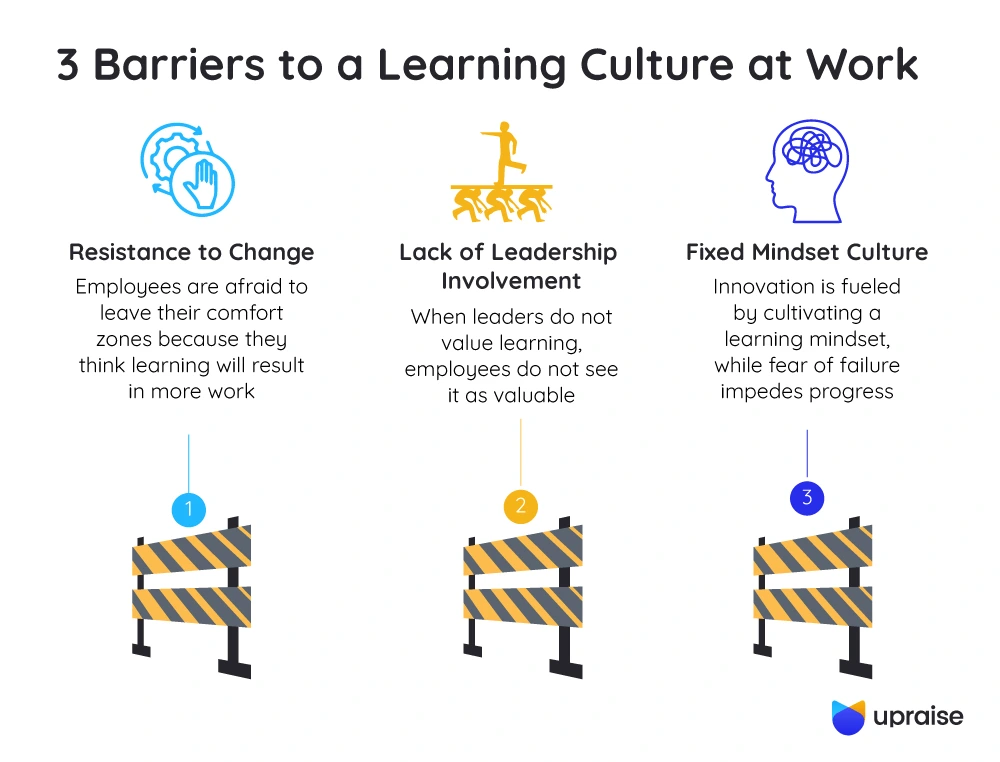
1. Resistance to change
Humans are naturally resistant to change. Anything that gets us out of our comfort zone is typically viewed as a threat or discomfort. Employees need to remain on their toes in their endeavor to keep learning.
Often, a culture of learning is confused with that of training. Training is a part of learning, and the two terms cannot be used interchangeably.
Some key stakeholders, such as C-level execs, managers, and employees, do not buy into the premise of a learning culture. A few associate learning with extra time that could otherwise be used to perform daily tasks and achieve their goals.
Such stakeholders must be enlightened about the impact a culture of learning can have on their businesses.
2. Lack of leadership involvement
Leaders of an organization play an integral role in molding organization work culture and context. C-level executives can set a benchmark through their conduct and activities, allowing the pattern to permeate downward in the organization.
Employees tend to emulate the behavior of their leaders. Thus, employees can learn how to conduct themselves in different situations even without officially conducting any learning and development sessions.
Leaders who ‘practice before they preach’ prioritize staying connected with their employees and providing help when needed.
Conversely, if top management resists learning, it will be reflected in their behavior and actions. Employees may find that learning does not have the promised value since their superiors do not support it.
Such employees refrain from seeking advice from their seniors since the practice is simply not a part of their work culture. Isolation makes it difficult for an employee to learn from others.
3. Fixed vs. growth mindset
In a fixed mindset dominant culture, individuals aim to project themselves as smarter than they actually are. They tend to avoid failure. Employees are entirely focused on performing satisfactorily rather than dedicating a part of their time to developing their skills.
Encouraging a growth mindset in the workplace makes employees understand why it is important to seek challenges and opportunities for development. They learn to understand that failure is not a sign of defeat.
It is crucial to address these obstacles to create a positive growth environment and encourage employees to learn and make the transition smooth.
Characteristics of a learning organization
A learning organization distinguishes itself through its ability to adapt and thrive continuously. A learning organization must:
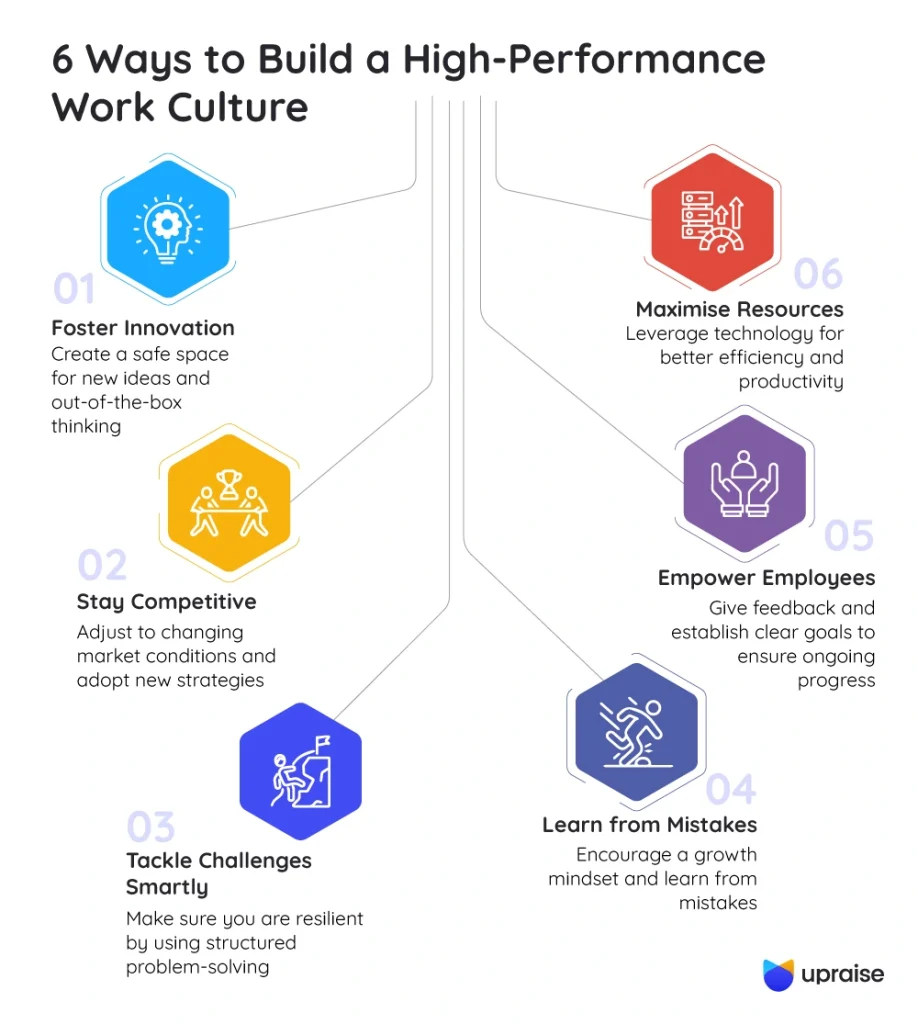
- Encourage innovation and creativity: Create an environment where employees feel safe to discuss new ideas and encourage them to think out of the box.
- Maintain a competitive approach to growth: Stay ahead by continuously evolving strategies, adopting new technologies, and adapting to market shifts.
- Handle pressures systematically: Address challenges with structured problem-solving, ensuring resilience and stability.
- Better utilize resources: Leverage technology and allocate available resources effectively to maximize productivity.
- Strive to improve performance and productivity levels: Provide employees with clear goals and feedback to help them improve performance.
- Develop a people-oriented organizational work culture: Prioritize employee well-being and employee engagement to build a positive culture.
- Make mistakes and learn from them: Encourage a growth mindset across the organization and teach employees to learn from their past mistakes.
By working on these areas, you can transform the organizational culture and make it conducive to employee growth and development.
Conclusion
An organization with a positive learning culture encourages employees to enhance their skills, face challenges, and move toward continuous growth. It provides psychological safety for employees to grow and promotes open knowledge sharing to create a conducive environment for learning.
Adopting a positive learning behavior in an organization can be challenging; however, encouraging adaptability, innovation, and creativity can help you overcome these obstacles. Providing collaboration avenues such as group meetings and events promotes a collective positive work environment.
FAQs
What is the role of behavior in an organization’s culture?
An individual’s behavior toward growth and learning, such as their willingness and adaptability, encourages their peers also continuously to improve and grow.
How does organizational culture influence learning and development?
A positive organizational culture influences learning and development by encouraging knowledge sharing, promoting psychological safety, and building learning opportunities.
What are the key elements of a positive organizational work culture?
Key elements of a positive organizational work culture include adaptability, efficient resource utilization, innovation, creativity, and a people-oriented culture.
Why is it difficult to create a culture of learning in an organization?
Resistance to change, resource limitations, and misaligned goals are challenges that make creating a culture conducive to learning in an organization challenging.
How can leaders foster a learning culture within an organization?
Leaders can cultivate a learning culture by leading through example, offering incentives to employees, and creating a psychologically safe environment.

