


Work, as we know it, has changed irreversibly. Employees today prioritize both personal and professional fulfillment while organizations rewire their processes to improve engagement. However, in this transformation, managers must be careful not to confuse output vs outcome.
Consider this scenario: A company invests in an employee training program to enhance leadership skills. The output? 600 employees complete the training. The outcome? Improved leadership within teams leads to higher productivity and better decision-making.
To understand this distinction better, let’s break it down.
What is an output?
An output refers to the immediate, tangible result of an activity or process. It includes services, products, or deliverables produced as part of a project.
Examples:
- A tech company develops a mobile banking app. The output? The app is designed, tested, and launched.
- A retail business executes a consumer loyalty program. The output? A new mobile app that tracks loyalty points.
- A marketing team creates 15 blog posts and 60 videos for a campaign. The output? The content is published online.
What is an outcome?
An outcome is the measurable impact or benefit derived from outputs. It reflects real-world changes brought about by an organization’s efforts.
Examples:
- After launching a banking app, customer transactions increase while in-branch visits decrease.
- A loyalty program boosts customer retention by 20%, leading to higher sales and revenue.
- A marketing campaign increases website traffic by 55% and drives a 40% rise in product sales.
Difference between output and outcome
Differences between outcome vs output play a key role in setting effective goals and performance measures.
| Aspect | Output | Outcome | Example |
|---|---|---|---|
| Definition | Immediate result of an action or process | Measurable impact of that result | A company launches a new mobile app. The app itself is an output, but increased user engagement and revenue growth are the outcomes. |
| Timeframe | Short-term | Long-term | A company produces 100 training modules in six months (output), but employees demonstrating better skills over the next year is the outcome. |
| Measurement | Easy to quantify (e.g., number of tasks completed) | Harder to measure (e.g., business impact) | A sales team makes 1,000 calls (output), but a mere 5% increase in conversions determines if the outcome is considered successful. |
| Focus | What is produced? | What is achieved? | A restaurant launches a new menu (output), but increased customer satisfaction and repeat visits are the outcomes. |
| Control | Direct control of teams | Influenced by external factors | A marketing team publishes 30 social media posts (output), but audience engagement depends on market trends and consumer behavior (outcome). |
| Indicates | Task completion | Business success | A software company releases a product update (output), but customer retention and satisfaction determine the outcome. |
| Evaluation criteria | Volume and speed of output | Effectiveness and quality of impact | A logistics company reduces delivery time (output), but improved customer satisfaction and retention define the outcome. |
| Sustainability | May not always lead to long-term success | Ensures continuous business growth | A company hires 50 new employees (output), but the actual outcome is whether those hires improve productivity and revenue. |
| Strategic Importance | Helps execute tasks efficiently | Aligns efforts with business goals | A university adds 10 new courses (output), but increase in student enrollments and graduation rates is the outcome. |
By focusing on outcomes instead of just outputs, organizations can ensure their efforts drive real success.
Why is it important to distinguish between outputs and outcomes?
Understanding the difference between output vs outcome is essential for measuring the true impact of your efforts, not just what you produce, but what it actually achieves.
Organizations often focus on output-driven metrics, such as the number of tasks completed. However, outcomes provide a better measure of success, as they reveal whether those tasks drive meaningful change or not.
For instance, focusing solely on the number of sales calls (output) may lead a sales manager to overlook key factors that truly measure business growth. A better approach is to focus on customer conversions or revenue increase (outcome).
How can organizations measure outcomes instead of just outputs?
Measuring outcomes instead of outputs requires redefining success. It requires looking beyond the ‘output vs. outcome’ debate to track long-term impact, behavior change, or strategic goals achieved.
Organizations can track outcomes using these methods:
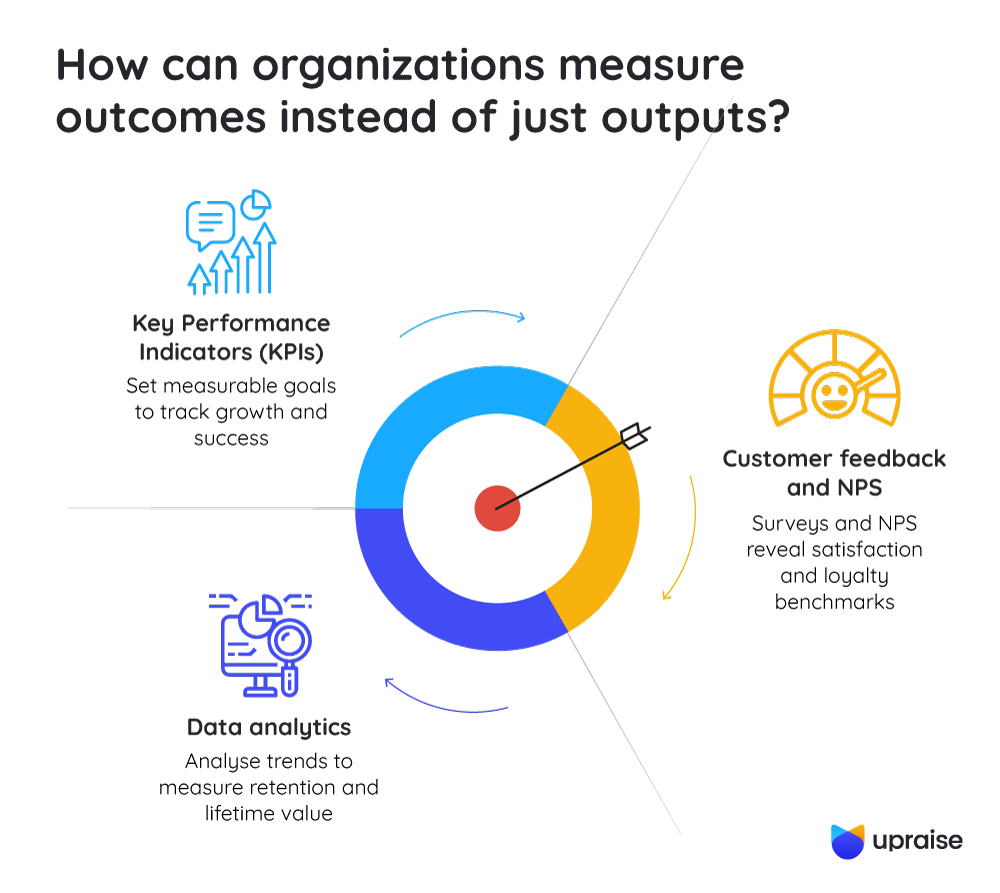
- Key Performance Indicators (KPIs): Set measurable targets for business impact, such as revenue growth or customer retention rates.
- Customer feedback and NPS: Use surveys and Net Promoter Score (NPS) to gauge satisfaction and sentiment.
- Data analytics: Track behavioral trends and long-term impact through analytics tools.
- Before-and-after comparisons: Assess performance improvements after implementing a change.
Role of outputs and outcomes in achieving organizational goals
Understanding the role of outputs and outcomes is crucial for achieving organizational goals, while outputs reflect the work done, outcomes demonstrate the actual progress toward strategic objectives.
Both outputs and outcomes are essential for business success:
- Outputs lay the foundation by ensuring tasks are completed.
- Outcomes confirm whether those tasks contribute to strategic objectives.
For instance, rolling out a new customer support chatbot (output) is meaningless unless it enhances user experience, reduces response time, and improves satisfaction scores (outcome).
Adopting an outcome-driven approach
To successfully shift from an output-based mindset to an outcome-driven approach, organizations should:
Establish clear objectives
- Define long-term goals that align with the company’s mission and vision.
- Instead of setting goals based on task completion (e.g., “publish 50 blog posts”), focus on measurable impact (e.g., “increase organic traffic by 30% in six months”).
- Communicate objectives clearly across all levels to ensure alignment.
Cascade goals across teams
- Break down organizational objectives into department and individual goals.
- Ensure employees understand how their work contributes to the bigger picture.
- Example: If the company’s goal is to improve customer satisfaction, the customer support team might aim to reduce response times, while the product team enhances usability.
Use OKR framework
- Objectives and Key Results (OKRs) help measure real impact.
- Objectives define what you want to achieve, while Key Results track progress toward that goal.
- Example:
- Objective: Improve customer retention.
- Key Results:
- Increase repeat purchases by 25% in Q2.
- Improve Net Promoter Score (NPS) from 60 to 75.
Invest in continuous learning
- Encourage employees to develop problem-solving and strategic thinking skills rather than just task execution.
- Offer training programs that focus on business impact, such as data-driven decision-making, customer insights, and leadership development.
- Create an environment where employees feel empowered to innovate and take ownership of outcomes.
Separate performance measurement from compensation
- Performance evaluations should focus on growth and improvement rather than just rewards and punishments.
- Employees should feel comfortable giving and receiving feedback without fearing pay cuts.
- Example: Instead of only rewarding employees for meeting quotas, recognize those who contribute to long-term improvements in processes or customer satisfaction.
Outcomes drive the business forward
Outcomes drive the business forward. Focusing on outcome rather than just output helps organizations drive meaningful success. In the output vs outcome equation, output indicates task completion, while outcome reveals the actual impact on business goals.
By shifting to an outcome-driven approach, companies can ensure that their efforts lead to measurable improvements in customer satisfaction, efficiency, and revenue growth.
The key takeaway? Outputs are important, but true progress comes from understanding and optimizing for outcomes. Leaders and teams must align their strategies with long-term goals to ensure their work creates real value.
FAQs
What is the difference between output and outcome?
Output refers to the tangible deliverables of a process, while outcome is the impact or results achieved from those outputs.
Why is it important to distinguish between outputs and outcomes?
Understanding this distinction ensures that organizations prioritize meaningful success rather than just task completion.
What are examples of outputs vs. outcomes in business?
Outputs include reports, training sessions, and marketing content, while outcomes reflect customer engagement, sales growth, or process improvements.
How can organizations measure outcomes instead of just outputs?
Organizations can track outcomes using KPIs, customer feedback, and performance analytics.
What is the role of outputs and outcomes in achieving organizational goals?
Outputs contribute to achieving outcomes, which ultimately determine business success. By focusing on outcomes, organizations ensure that their efforts lead to sustainable growth and real impact.

