


Picture this: It’s the end of the quarter and employees are eagerly awaiting performance feedback. However, the performance appraisal system churns out inequitable evaluations, leaving employees confused and discouraged. According to an employee engagement survey, 85% of the people reported disengagement at work due to an unfair employee appraisal system.
Performance appraisal system refers to the periodic evaluation of an employee’s performance on the job compared to the required standards and objectives of the company as a whole. An efficient performance appraisal system offers much more to employees and the company in the form of benefits.
Let’s understand why setting an effective performance appraisal system is crucial for employees and the organization.
This article explores the role of HR in developing and managing the ways of performance appraisal systems. It also discusses the various types of appraisals along with the best practices to implement the HR appraisal system for your organization.
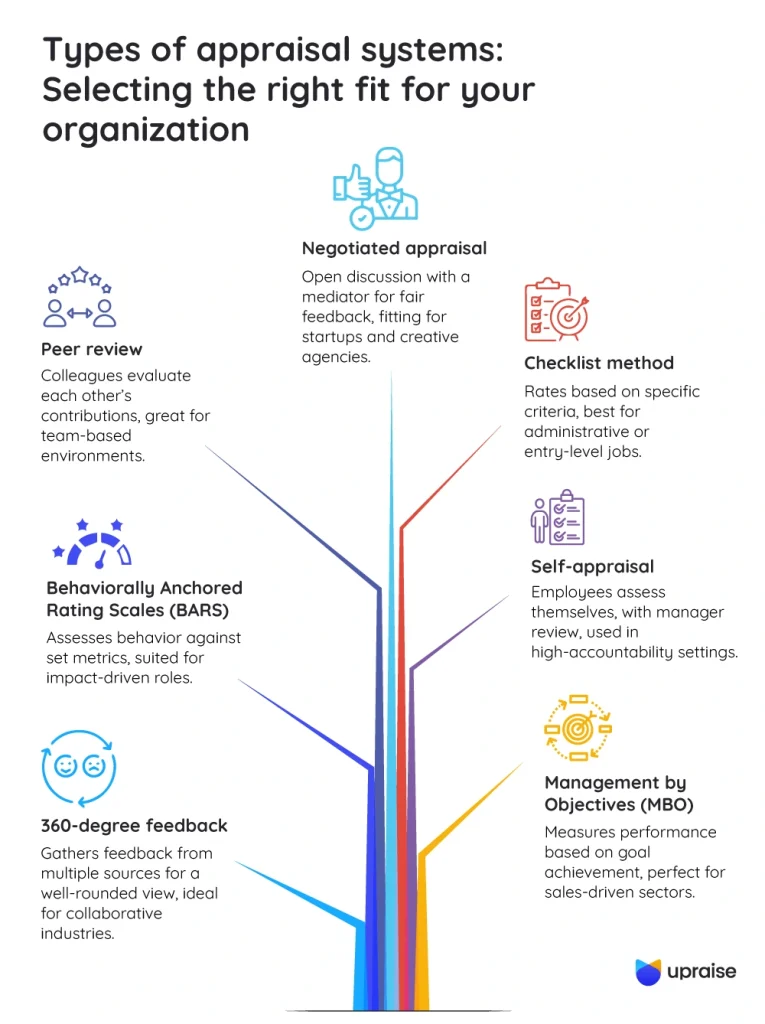
Types of appraisal systems: Selecting the right fit for your organization
In 2012, Marissa Mayer, the CEO of Yahoo, implemented the stack ranking system, where employees were rated on a bell curve. This created a toxic and competitive work culture, resulting in high turnover.
Selecting an inappropriate employee appraisal system can make or break an organization. It is important to understand the options available to avoid such pitfalls.
Let us discuss some popular performance appraisal systems with their unique features and benefits.
360-degree feedback
Under the 360-degree feedback system, an organization collects information about an employee from multiple viewpoints. For example, it may approach team leaders’ peers, supervisors, clients, and subordinates to evaluate their performance.
Google, Deloitte, and Accenture use this form of feedback. According to a study, companies using the 360-degree feedback system experience 12% improvement in employee engagement and leadership development.
Who can adopt this appraisal system?
- Tech or service-based industries where collaboration and teamwork are highly prioritized.
- Managers and team leaders who oversee organizations at the upper levels of the employee hierarchy
Management by Objectives (MBO)
Under this method, an individual’s performance is evaluated in terms of their contribution toward organizational goals.
A retail company may set a target of a 15% monthly sales increase to the manager. The progress would be evaluated based on the outcome.
Who can adopt this appraisal style?
- Sales-oriented, project-based, and goal-driven organizations such as retail companies, financial institutions, and startups
- Sales or customer acquisition teams who can easily measure performance against objectives
Behaviorally Anchored Rating Scales (BARS)
BARS provides a more detailed and specific framework for the staff appraisal system. Employee behavior is compared against the required metrics by the organization.
For instance, a customer service center may rate its employees based on how efficiently they handle complaints or how accurately they provide information to customers.
Who can adopt this appraisal style?
- Roles where one’s behavior or action can significantly impact the organization’s objectives
Self-appraisal
Under this system, employees assess their own performance, achievements, and areas of improvement against set goals. However, the manager reviews each self-assessment for a comprehensive discussion.
The self-appraisal of a project manager may look something like this:
“I managed three projects successfully this year, but I need to focus on better resource allocation to avoid delays.”
This method is typically part of a 360-degree performance appraisal system.
Who can adopt this appraisal style?
- Organizations with high accountability, such as startups or creative industries
- Roles requiring personal goal setting, such as sales or consulting
Peer review
Peer reviews are conducted to determine how well the team members collaborate with each other and contribute toward a project.
For example, a design studio can ask its team members to evaluate each other based on their creativity, adherence to deadlines, and teamwork. This method provides a clearer insight into an individual’s contribution and establishes a supportive team culture.
Who can adopt this appraisal style?
- Collaborative work environments such as tech companies and software development
- Roles that rely on peer collaboration and collective project success
The checklist method
Checklist is one of the ways of performance appraisal, wherein the performance is evaluated based on specific criteria such as punctuality, communication skills, and task completion. However, this method is considered outdated, as it does not represent the full scope of an employee’s contribution.
A company may compensate an employee based on punctuality or the number of calls they receive. However, it may miss out on other important aspects such as the employee’s ability to resolve complex customer issues or demonstration of empathy during calls.
Who can adopt this appraisal style?
- Administrative or entry-level jobs where tasks are easily measurable
- Manufacturing firms and logistics companies that entail repetition of tasks
Negotiated appraisal
Under this system, the appraisal is evaluated in the presence of a mediator. This facilitates an open discussion and offers a fair chance to both parties to share their views.
For example, a manager may point out an employee’s failure to meet sprint deadlines during a review. However, the employee gets the opportunity to clarify the reason behind their impaired performance for a fair evaluation.
Outcome
- The manager may alter the employee’s workload
- Open discussion between the manager and the employee
- Recognition of employee’s contribution to teamwork
- Feedback to the employee on skill improvement
Who can adopt this appraisal style?
- Startups, creative agencies, and tech companies where open communication and fairness are paid utmost importance
- Project managers and sales managers for whom both qualitative and quantitative performance aspects are important
Six steps in structuring an effective performance appraisal system
An effective structure is essential to maximize the benefits of an appraisal system. However, it doesn’t have to be a complex process. Once you decide on the appraisal system to implement, follow these six steps for structuring it for the best results:
Step 1: Train managers
Train your line managers on conducting fair performance appraisals with constructive feedback that can help employees grow.
Step 2: Use holistic methodologies
Instead of adopting limitative and objective methods, use a 360-degree performance appraisal system to obtain a holistic view of employee performance.
Step 3: Conduct regular reviews
Instead of annual or quarterly reviews, keep communication channels open to employees throughout the year.
Step 4: Streamline the performance appraisal process
Streamline the periodic performance reviews by setting fixed date and time for appraisal meetings between employees and managers.
Step 5: Use the right software
Use performance appraisal software such as UpRaise’s app for employee success that provides you with real-time coaching and feedback.
Step 6: Develop supportive programs
Besides the performance appraisal system, consider adopting other supportive programs, such as weekly rewards, to boost employee morale.
A highly effective staff appraisal system may not be enough for an organization’s success. It must align with organizational goals. This is where the HR appraisal system plays a key role.
Let’s explore how a well-designed staff appraisal system can align employee performance with organizational objectives.
HR appraisal systems: Aligning performance with organizational goals
The HR appraisal process ensures employees contribute to organizational goals rather than working in isolation.
Let’s explore how an HR appraisal system is structured:

Designing the performance appraisal process
Large corporations such as IBM use a structured HR appraisal system that aligns with corporate objectives.
The performance appraisal process allows you to set annual review cycles that include self-assessments, peer reviews, and manager evaluations. This ensures that each employee’s performance aligns with the company’s goals.
Training managers and employees
The HR department often conducts training sessions for both managers and employees. This involves teaching how to provide constructive feedback and set SMART (Specific, Measurable, Achievable, Relevant, Time-bound) goals. The goal is to ensure all participants understand the process for an effective and fair appraisal process.
Ensuring fairness and consistency
HRs use standardized evaluation criteria and hold calibration meetings to ensure consistency in appraisals.
For instance, managers from different departments may discuss performance ratings to ensure consistent evaluations across the board. This practice reduces bias and promotes fairness, leading to more reliable performance assessments.
Facilitating performance discussions
HR at a tech startup may provide templates and discussion guides to managers to help them conduct productive performance review meetings. These guides may include tips on how to discuss strengths, areas for improvement, and career development plans.
Conclusion
An effective performance appraisal system sets the base for growth, both for employees and the organization. Selection of the right appraisal method is important in this endeavor. Whether it’s 360-degree feedback, MBO, BARS, or peer reviews, it’s important to ensure fair and accurate evaluations.
HR plays a key role in designing, training, and maintaining a system that aligns individual performance with company goals. A fair and consistent evaluation process facilitates employee and organizational growth.
This is where tools such as UpRaise’s App for Employee Success can help track OKR goals, empower continuous feedback, and conduct periodic performance reviews within Jira.
Ultimately, a well-structured performance appraisal system is the key to strong teamwork, improved productivity, and long-term organizational success.
FAQs
What is a performance appraisal system?
Performance appraisal system is a set of procedures that organizations adopt to evaluate the performance of its employees.
What are the types of appraisal systems?
Popular types of appraisal methods include:
- 360-degree feedback
- Self-assessment
- Peer reviews
- Management by Objectives (MBO)
- Behaviorally Anchored Rating Scales (BARS)
- Negotiation appraisal
- Checklist
What is the process of performance appraisal?
The performance appraisal process involves setting clear performance standards and communicating them thoroughly to the employees. Employee performance is then evaluated against set standards, with feedback provided for improvement.
How does an appraisal system benefit employees and organizations?
A fair appraisal system helps employees track and improve their performance over time. This also benefits the organization by driving more business and increasing profit.
What are the best practices for implementing an effective appraisal system?
The best practices for designing and deploying a performance appraisal include:
- Setting clear performance standards
- Training managers for constructive feedback
- Conducting regular and fair evaluations for timely performance evaluations
- Usage of performance management tools to track progress and derive data-driven insights

