


It’s that time of year for annual performance reviews. Imagine evaluating an employee who’s been with the company for two years. They’re consistently punctual and rarely take sick days, but last quarter, their project deadlines slipped, and work quality declined.
Despite these issues, their punctuality and dedication sway you to rate them more favorably than warranted. This is a classic example of a psychological bias—the halo effect—where one positive trait overshadows areas needing improvement.
Psychological biases can cloud judgment and compromise the fairness of performance reviews. This article explores how these biases influence evaluations and introduces competency-based performance reviews as an ideal solution. Managers can conduct more balanced, objective, and data-driven reviews by focusing on specific competencies rather than general impressions.
We’ll also highlight how UpRaise supports this approach, helping managers conduct unbiased evaluations that reflect an employee’s contributions to the organization.
What is a competency-based performance review?
A competency-based performance review evaluates employees on their outcomes and the skills, behaviors, and personality traits—collectively referred to as competencies—that contribute to those outcomes. These reviews focus on identifying how employees achieve their goals, emphasizing the alignment between their competencies and organizational objectives.
The primary goal is to assess and develop skills that enhance job performance, help employees grow in their roles, and drive organizational success. By analyzing behavior patterns and performance over time, managers can pinpoint existing strengths and identify areas for further development.
Types of competencies
Competencies are typically categorized as follows:
| Type | Description | Example |
|---|---|---|
| Organizational | Reflect the mission, vision, and core values of the organization, shaping its culture and work ethos. | Customer-driven, risk-taking, or innovative approaches. |
| Core | Unique capabilities or technical expertise that distinguish the organization from competitors. | Specialized strategies or proprietary technologies. |
| Technical | Job-specific skills required for performing technical or performance-driven tasks. | Designing systems software or relationship management. |
| Behavioral | Individual performance traits such as adaptability, teamwork, or leadership skills. | Talent development or problem-solving. |
| Functional | Competencies linked to high performance in specific roles or operational tasks. | Backing up a database or managing a production line. |
| Management | Attributes and behaviors that demonstrate leadership and management potential. | Decision-making, conflict resolution, or strategic planning. |
Understanding and evaluating competencies is a critical part of performance management, but it’s not without challenges. Managers’ assessments can sometimes be influenced by psychological biases—unconscious tendencies that impact how they perceive employee performance. Let’s explore the most common biases and their effects on performance reviews.
What are psychological biases?
Psychological biases are systematic patterns of deviation in judgment or perception that influence how people make decisions, form opinions, and evaluate situations. Often unconscious, these biases can lead individuals to rely on subjective impressions over objective facts.
Such biases can skew evaluations in performance reviews, resulting in feedback that may not accurately reflect an employee’s true performance. Let’s delve into the most common types of biases and their effects on the review process.
Types of biases in performance review
Understanding the types of biases that can influence performance reviews is the first step toward minimizing their impact. Here are some of the most common biases managers should watch out for.
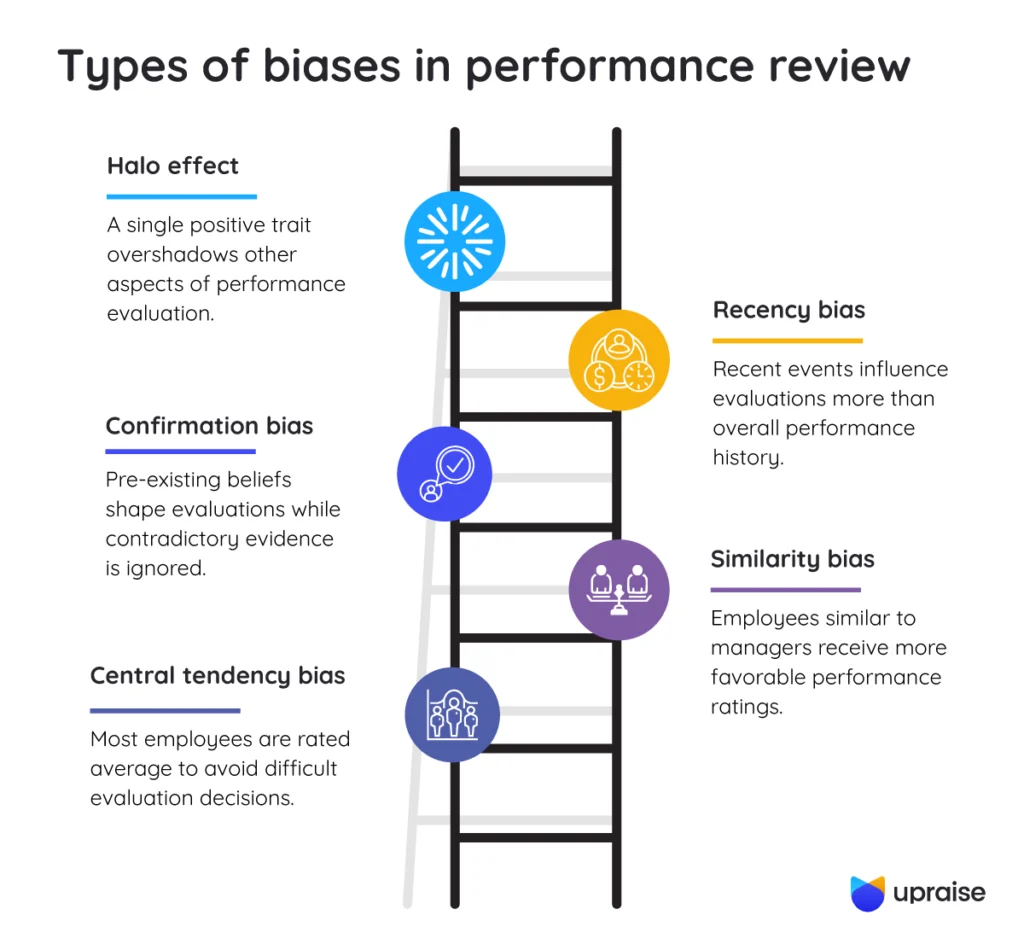
1. Halo effect
The halo effect happens when one positive trait hides everything else about an employee’s performance.
For example, if someone always meets deadlines, they might get high ratings in all areas, even if their teamwork or work quality isn’t great.
2. Recency bias
Recency bias occurs when managers focus on recent events rather than evaluating performance over the entire review period. This often occurs because recent achievements or mistakes are easier to recall. However, managers often do not realize that this performance evaluation bias leads to an inaccurate portrayal of overall performance.
For example, an employee who excelled in the past month might receive a high rating despite underperforming for most of the year.
3. Confirmation bias
Confirmation bias involves seeking information supporting pre-existing beliefs while ignoring evidence contradicting them.
For example, a manager who believes an employee is disorganized might focus only on instances that confirm this perception while overlooking recent improvements.
4. Similarity bias
Similarity bias happens when managers give better ratings to employees who are like them in some way.
For example, a manager might rate an employee higher just because they both attended the same university or enjoyed the same hobbies, even if their performance isn’t outstanding.
5. Central tendency bias
Central tendency bias happens when managers rate most employees as “average” to avoid tough decisions.
For example, on a five-point scale, a manager might give everyone a “3,” even if some employees perform exceptionally well and others need improvement.
Now, let’s understand how these biases affect employees and organizations.
Impact of biases on performance reviews
Whether you’re an employee or a manager, you should have a fair knowledge of how bias impacts individual and organizational performance. Let’s break it down.
For employees
When reviews are unfair, employees often face:
- Unfair compensation: a smaller raise or bonus than they truly deserve
- Missed promotions: biased reviews holding back top performers to grow in their career
- Erosion of trust: lack of trust in management and the review process
- Reduced productivity: struggling to stay productive individually and in a team due to constant demotivation
For organizations
Performance evaluation bias doesn’t just hurt employees; it also impacts organizations to experience:
- Misaligned goals: when biases influence reviews, demotivated teams fail to work in a union and miss their goals
- Poor talent management decisions: biased reviews weaken the organization’s ability to build high-performing teams and hamper long-term success
- It undermines the credibility of the performance review system: employees lose faith in the unfair system, and the organization finds it hard to inculcate a culture of accountability and growth in the workplace.
Performance biases stem from individual psychology. You can’t just factory-reset leaders to avoid this trait in one go. However, you can surely follow some proven strategies to create fairer evaluations.
Strategies to mitigate bias in competency review
There is no single formula for curbing performance bias. So, we have selected five proven strategies that work for organizations regardless of their size and niche. Try them all to see what works best for your organization and team.
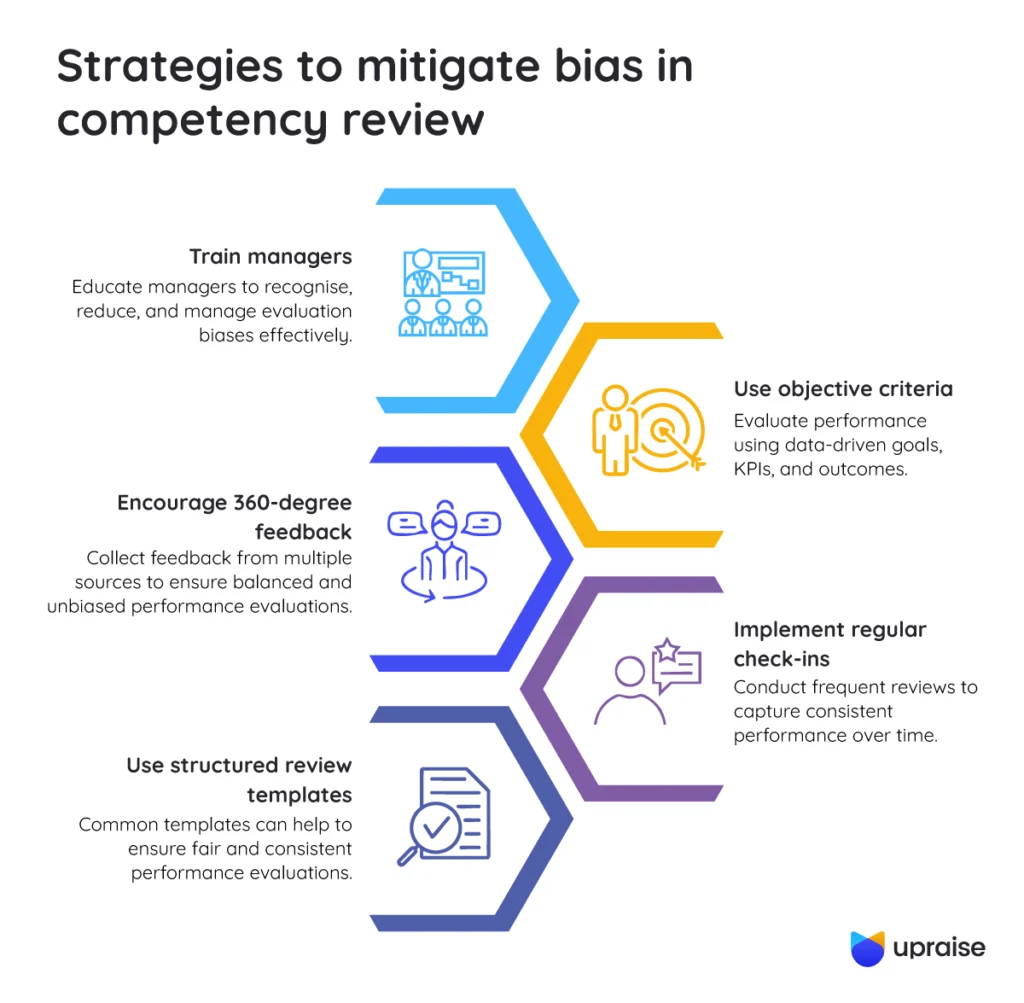
1. Train managers
Managers influence employee reviews nearly 67% of the time, making it crucial for them to identify and manage biases. Bias-awareness workshops can help address common pitfalls like recency or similarity bias.
For instance, a manager might unknowingly rate employees with similar backgrounds higher. A two-day workshop can encourage evaluation based on performance data rather than personal preferences.
2. Use objective criteria
Evaluating performance through measurable goals and outcomes, such as OKRs (Objectives and Key Results) and KPIs (Key Performance Indicators), reduces subjectivity.
Example: A software team aims to reduce update delivery time by 20% by quarter-end. During reviews, managers can assess:
- Did the developer contribute to this goal?
- Did they meet task deadlines and maintain code quality?
Tracking specific KPIs, like maintaining 98% code accuracy or resolving 15 tickets weekly, ensures recognition of consistent performers—even those who work quietly behind the scenes.
3. Encourage 360-degree feedback
Incorporating feedback from peers, subordinates, and clients offers a balanced perspective.
Example: A manager may see an employee as reserved during meetings, but peers might highlight their exceptional collaboration and problem-solving skills behind the scenes.
4. Implement regular check-ins
Annual reviews often prey on recency bias, focusing only on recent performance. Regular check-ins, monthly or quarterly, capture year-long achievements.
For example, if a developer resolves major bugs in the first quarter, frequent check-ins ensure this contribution is acknowledged, avoiding oversight during year-end reviews.
5. Use structured review templates
Standardized templates promote consistency and fairness, tailored to evaluate specific skills like teamwork and problem-solving.
Example for developers:
- Collaboration: Worked effectively with QA and design teams.
- Problem-solving: Reduced system downtime by 30%.
Such templates ensure consistent evaluations across roles, such as QA engineers or designers.
By implementing these strategies, organizations can create fair, unbiased reviews. A performance-tracking tool can further simplify this process, saving time and effort while ensuring accuracy.
How UpRaise helps reduce bias in performance reviews
UpRaise empowers organizations- especially leaders- to ensure a balanced and unbiased competency review with various tools and solutions. Promoting fairness and objectivity in evaluations becomes easy with the following:
Tools for objective goal tracking and performance monitoring
UpRaise offers a range of apps to manage your OKRs in terms of:
- Objective levels: manage OKR levels at a company/team/individual level
- Weightage: set default weightage for KR and alignments (e.g., 0 for no importance and 10 for high importance)
- Default visibility: choose whether to display OKRs to all users or to some users by default
- Default views: choose which objectives (company/team/individual) OKR you want to show by default
- Manage views: view and manage OKR views created by users in UpRaise

360-degree feedback modules to gather diverse perspectives
UpRaise offers a 360-degree review template that helps leaders easily gather responses from themselves, their managers, peers, and direct reports. The best part is that the tool can collect feedback and keep participants anonymous to encourage more participation at the organizational level.

UpRaise anonymous 360-degree feedback system
Dashboards with data-driven insights for evaluations
UpRaise tools come with highly intuitive dashboards to help even new users easily read performance analytics for quick evaluations. For instance, you can dissolve and expand OKR scores at multiple levels inside the dashboard, from team leaders to individual members.
Ready to reduce bias in your performance reviews? Explore UpRaise tools to make reviews fair, transparent, and effective.
Conclusion
Psychological biases can hinder fair performance evaluations, impacting employees and organizations alike. Leaders must recognize these biases and adopt strategies like OKRs, KPIs, 360-degree feedback, and regular check-ins to ensure balanced and objective reviews.
Incorporating competency-based performance reviews offers a strategic approach to overcoming these biases by focusing on specific, measurable competencies and behaviors. This method ensures that evaluations are grounded in concrete data and aligned with organizational goals rather than subjective impressions or sporadic achievements..
UpRaise supports this endeavor by providing platforms for objective goal tracking, performance monitoring, and gathering 360-degree feedback. Now, it’s easy to conduct evaluations that are fair and conducive to continuous improvement and development.
Empower your team and drive success today!

