


Consider this: Team A and Team B are working on launching the same product. Team A struggles because of micromanagement, while Team B delivers results through empowered leadership. What differentiates these two teams? Their management concepts and management styles. In a constantly evolving workplace, proven management concepts and styles can be the key to unlocking team potential and achieving business goals.
This guide explores different management ideas managers can implement to ensure their team’s functioning. It simplifies choosing a relevant management style or concept for you and your team.
What are management concepts and management styles?
Management styles refer to how managers interact with their team members, make decisions and exercise authority. They focus on how management is practiced. The application varies based on the manager’s personality, team dynamics, and organizational culture.
Management concepts are theoretical frameworks or principles that guide how organizations are structured, achieve goals, and manage resources. They focus on the philosophy behind management and are applied to design management practices and policies.
Key Difference
| Aspect | Management Styles | Management Concepts |
|---|---|---|
| Definition | Describes how management is implemented, focusing on practical execution. | Provides the overarching ideas or philosophies (the why and what) that influence the choice of management styles. |
| Purpose | Guides the day-to-day actions and interactions of managers with their teams. | Shapes the underlying beliefs and principles that inform management decisions and strategies. |
| Relationship | Often derives from or is influenced by specific management concepts. | Influences the development and adoption of various management styles. |
| Example | A manager using a participative style actively involves team members in decision-making processes. | This style may be based on principles from Theory Y or the democratic leadership concept, emphasizing trust, collaboration, and team empowerment. |
Why do effective management concepts and styles matter?
Both management concepts and management styles play a critical role in shaping team dynamics and achieving organizational goals. Here’s how they contribute to the success of teams and organizations:
Impact on teams and organizations
- Boosts team morale: A thoughtful combination of effective management concepts and styles creates a positive team environment. For example, adopting a democratic management style encourages employees to participate actively, enhancing their morale and motivation during daily tasks.
- Syncs efforts with organizational objectives: Clear management concepts, such as Management by Objectives (MBO), combined with styles like transformational leadership, ensure team efforts align with broader organizational goals. This synergy drives smoother progress toward common objectives.
- Encourages innovation and collaboration: A participative management style fosters open communication and collaboration among team members. Paired with concepts like Lean Management, it reduces inefficiencies and opens avenues for innovation by promoting shared ownership of ideas.
Key trends in management
- Focus on collaborative approaches: Modern management emphasizes teamwork over rigid hierarchies. For instance, management styles like coaching or servant leadership promote team collaboration, while concepts like Agile Management streamline workflows for cohesive effort.
- Employee-centered growth: Today’s management strategies prioritize employee development and adaptability. Styles like transformational leadership encourage individual growth, aligning with concepts like Theory Y, which assumes employees thrive when motivated and trusted.
Both management concepts and management styles have become essential for fostering innovation, improving team alignment, and driving employee satisfaction. By blending the right theoretical principles with practical leadership approaches, teams can unlock their full potential while staying aligned with organizational goals.
Top 9 management styles that work
Effective management requires choosing the right style to suit your team and organizational goals. Here’s a detailed overview of nine prominent management styles:
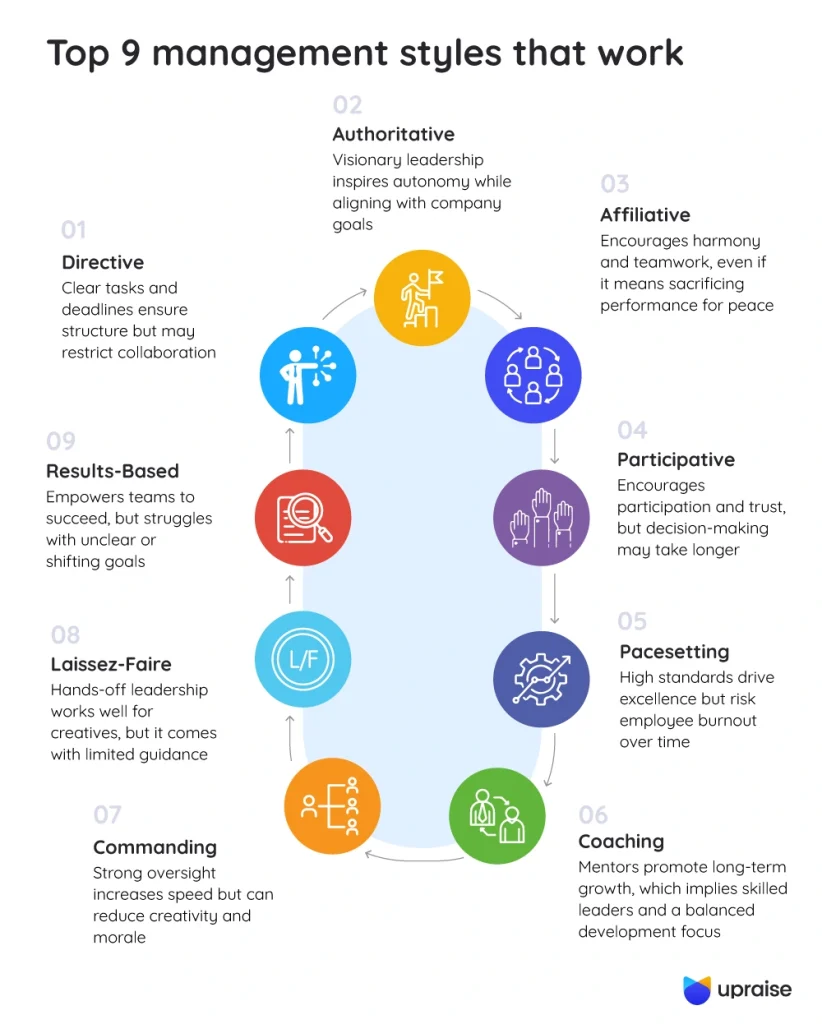
- Directive: This style involves a hands-on manager who sets clear tasks, deadlines, and guidelines. Ideal for high-stakes situations or when employees need firm direction, it ensures clarity and structure. However, it can reduce collaboration and may feel restrictive for highly skilled teams.
- Authoritative: Authoritative managers rely on their expertise and vision to guide teams toward long-term goals. This style allows employees to work independently within the framework of company objectives, boosting focus and motivation. However, it’s less effective for teams needing hands-on guidance.
- Affiliative: Focused on harmony and relationships, this style creates a positive work environment by fostering collaboration and resolving conflicts. While it keeps morale high, it can sometimes prioritize happiness over performance, leading to complacency.
- Participative: Also known as consultative management, this style values employee input in decision-making. By fostering open communication and teamwork, it builds trust and motivation. However, decision-making can be slow due to the time to consider diverse opinions.
- Pacesetting: Pacesetting managers lead by example, setting high standards for themselves and their teams. This approach is perfect for achieving quick results with highly skilled teams but can lead to burnout if maintained for too long.
- Coaching: This style focuses on mentoring employees for long-term professional growth. It helps build strong bonds and nurtures talent, but it requires skilled managers and can create competition among employees for development opportunities.
- Commanding: This style involves hands-on control and direct oversight and is often used in situations requiring immediate action. While it can deliver quick results, it risks demotivating employees and stifling creativity.
- Laissez-Faire: In this hands-off approach, managers set goals and let employees determine how to achieve them. It’s ideal for creative and self-motivated teams but can lead to poor performance without sufficient oversight.
- Results-Based: Focused on measurable outcomes, this style empowers employees to meet clearly defined goals. It promotes engagement and efficiency but may falter when external factors impact results, or goals are unclear.
By understanding these management styles and their unique strengths and challenges, leaders can adapt their approach to support their teams better and achieve organizational success.
Top 5 management concepts that work
Management concepts are the backbone of effective leadership, helping teams stay aligned, motivated, and productive. Let’s explore five impactful concepts that can transform the way teams operate and achieve goals.
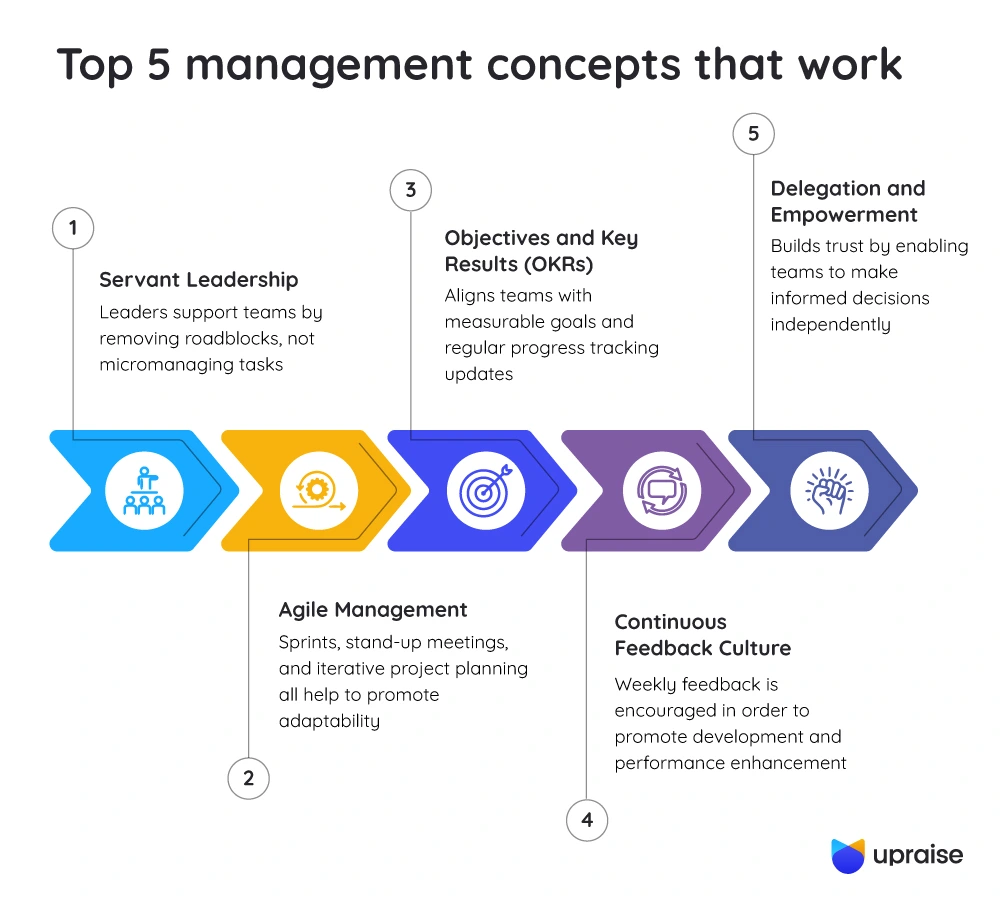
- Servant leadership: This management concept centers around the idea that most effective leadership is aimed at serving the team instead of taking charge.
An example of this practice is encouraging open communication with the team to understand and address their roadblocks instead of micromanaging.
- Agile management: At the core of agile management is flexibility and a non-hierarchical work environment. It focuses on iterative progress, working in short phases and adaptability.
For example, teams with agile management will break the project into smaller parts and conduct daily stand-ups and sprint planning to reflect and make changes.
- Objectives and Key Results (OKRs): OKRs focus on setting collaborative goals with your team and setting measurable results for each to track progress and align the team.
An example of a team working with OKR management style involves setting quarterly objectives, tracking the key results and measuring team progress.
- Continuous feedback culture: This management idea focuses on continuous improvement by providing regular, actionable feedback. It improves overall team performance and boosts team morale.
For instance, instead of providing employees with an annual review, a continuous feedback culture encourages bi-weekly feedback check-ins.
- Delegation and empowerment: This management approach centers around the idea that delegation comes with responsibility. It focuses on building trust by enabling decision-making to empower the team.
One such practice is encouraging team leads to design and execute project plans independently instead of managing the team.
These management concepts simplify balancing employee well-being and overall organizational objectives. They ensure you stay on track with your goals while fostering a positive organizational environment.
How do you choose the right management concepts or styles?
Selecting the appropriate management concepts and styles is critical for fostering an efficient, motivated, and cohesive team. The right choice depends on your team’s unique needs and organizational objectives. Here’s how to make the decision:
- Assess team needs: Understand your team’s dynamics, challenges, and strengths. For example, if your team thrives on structure, a directive style paired with clear concepts like goal-setting might be ideal.
- Align with organizational goals: Ensure the management styles and concepts you choose reflect your company’s vision and values. An authoritative style might work for achieving long-term objectives, while a participative approach could align with fostering innovation.
- Experiment and iterate: Try different styles and concepts on a smaller scale to gauge their impact. For instance, experiment with affiliative or coaching styles alongside collaboration-focused concepts to see what resonates most.
By combining management concepts with the right styles, you can create a tailored approach that supports both your team’s needs and organizational goals.
How UpRaise supports modern management concepts and styles
UpRaise suite of apps assists teams in adopting modern management practices. It provides you with a range of apps to set targets, track progress and even keep employees aligned with organizational goals. Here are some of the UpRaise features that prove beneficial in team management:
- Goal setting and OKRs: UpRaise OKR platform is natively set for Jira to let you set, track and achieve OKRs in Jira. The enterprise-grade flexibility it provides assists you in growing employee success as the adoption increases.
You can also automatically track the progress of team members in real-time. This lets you assess the team’s progress with your overall business objectives. Lastly, you can use this data to generate reports, reflect and enhance. This not only promotes transparency but also enhances accountability.
- Continuous feedback modules: UpRaise apps enable you to parse data as well as coach your team within Jira. It eliminates the need to operate a separate system for providing feedback by integrating this feature within Jira with you.
You can also provide employee-specific and task-specific feedback to ensure seamless, continuous feedback. The best part is you can use either formal ratings or even informal feedback based on your requirements.
- Dashboards for progress tracking: UpRaise apps provide an intuitive dashboard to track team performance and contributions of individual members. This lets you identify bottlenecks as they occur and take corrective actions. With a visual presentation of varied metrics, teams can easily assess performance trends. It also provides a bird’s eye view into the team functioning at all times; the management is aware of the status of tasks and the functioning of the team.
With goal-setting features, real-time feedback, and dashboards for progress tracking, UpRaise equips business teams with all they need to manage their teams. It makes implementing modern management ideas simpler to ensure that the management makes the most of their teams and accomplishes their goals.
Case Study: How UpRaise streamlined OKRs for a Canadian pension firm
Here is a practical example of a company that benefitted from using UpRaise. A pension fund in Canada wanted to implement OKR, but they faced an obstacle. They had two independently running business departments that also needed to be synced sometimes. Finding an OKR tool that catered to this unique challenge was difficult.
This is where UpRaise for Employee Success made implementing OKR possible for them with its Business Units feature. This feature allows businesses to separate independent business functions through configuration changes.
The tool has an iterative development structure that caters to businesses of all sizes and requirements. This is why it has been the trusted choice of more than 500 organizations over the past six years.
Conclusion
The better the management concepts and styles in place, the easier it becomes to lead your team effectively and achieve outcomes with clarity. By combining proven concepts with management styles that align with your team dynamics, you can foster collaboration, drive results, and focus on continuous improvement.
Choose the management concepts and styles that best align with your team’s needs and organizational goals. Assess your team’s challenges, experiment with different approaches—such as directive, participative, or coaching styles—and reflect on the outcomes to find the perfect blend for your team.
UpRaise simplifies the process of adopting modern management practices and styles. Get started today to empower your teams and unlock their full potential!

