


How do you write an employee self-evaluation that feels genuine and confident?
The core challenge of sharing your wins and growth areas is to do it without sounding boastful or unsure while engaging in accurate self-reflection. This is important because it shapes how you’re seen by employers and where you go next.
According to a study, companies that embrace continuous performance feedback are 39% better at attracting talent and achieve 44% higher retention rates than those that don’t. That tells you how much value both employees and managers can gain from honest reflection.
In this post, you’ll discover how to write a self‑evaluation that hits the mark, starting with some employee performance evaluation examples. We’ll also provide you with tips so you can rate, review, and assess your skills without being awkward or embarrassed.
What is an employee self-evaluation?
An employee self-evaluation is a short write-up where you reflect on your own work. What went well, what didn’t, and what you’ve learned. It’s a part of most review cycles, but instead of your manager leading the conversation, you go first.
Self-evaluations are unique to every employee. It’s a way to speak for yourself. You get to bring up the tasks you handled, the roadblocks you faced, and how you’ve grown over the last sprint or quarter. An honest self-evaluation is much more than patting yourself on the back; it shows how aware you are of your role in the company and what you are expecting from yourself in the next sprint or quarter.
Why self-evaluations matter for employees
Most of us move from one sprint to the next without stopping to look back. That’s where self-evaluations give you space to pause and think about what you have accomplished.
- You get to speak for yourself: Instead of waiting for someone else to notice your work, a self-evaluation lets you explain what you’ve done and why it mattered.
- It helps you reflect on growth: Looking back on past sprints or feedback loops helps you see how far you’ve come and what you’ve improved, and still gives you room for improvement. In Agile environments, self-evaluations also align personal growth with the team’s iterative goals.
- Brings quiet wins to the surface: Maybe you helped unblock a teammate, improved how something works, or kept things calm during a tricky client conversation. These moments count even if they didn’t make it into a report. A self-evaluation is the right place to call them out.
- Leads to better conversations: When you’ve already looked at your own performance, discussions with your manager feel more like a two-way conversation and not a surprise review.
Steps to write an effective employee self-evaluation
Writing a self-evaluation during performance review cycles in Agile teams can feel like another task on your sprint board. But a strong employee performance evaluation connects your individual contributions to broader team goals and gives your manager real insight into how you think and solve problems.
Follow these steps to write an effective employee self-evaluation:
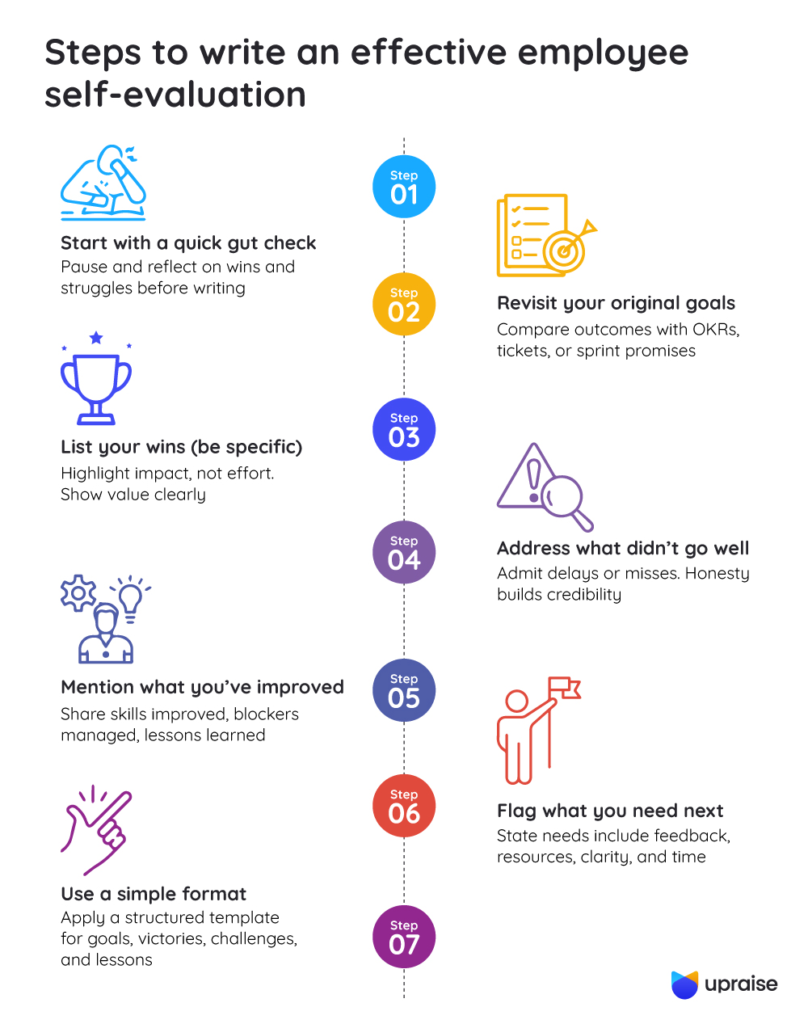
Step 1: Start with a quick gut check
Before you type a single word, pause. Think about the past sprint or quarter. What felt good? What dragged you down? This helps ground your tone and keep things honest.
Step 2: Revisit your original goals
Look back at your OKRs, Jira tickets, or sprint commitments. Did you meet your targets? What changed midway? This gives your self-evaluation real context and shows you’re tracking more than just tasks.
Step 3: List your wins (be specific)
Talk about outcomes, not just effort. For instance, “Improved story mapping for the roadmap planning session” says more than “attended planning meeting.” A good employee performance evaluation example clearly shows impact, not just involvement.
Step 4: Address what didn’t go well
Missed something? Say so. If a release got delayed or feedback didn’t land the way you hoped, own it. Managers don’t expect perfection—they appreciate reflection.
Step 5: Mention what you’ve improved
Growth matters. Maybe you started writing cleaner user stories, got better at estimating timelines, or learned how to manage blockers earlier in the sprint. These are all worth calling out.
Step 6: Flag what you need next
Whether it’s support, feedback, clearer specs, or more time for code reviews, spell it out. This helps shape your next sprint and builds trust with your team lead.
Step 7: Use a simple format
If writing from scratch feels overwhelming, try using an employee evaluation template. Break it into sections like:
- Goals and results
- Wins worth mentioning
- Challenges faced
- Lessons learned
- Support is needed moving forward
Common mistakes in self-evaluations
Even experienced professionals trip up on self-evaluations. Here are a few common mistakes that can weaken a good self-evaluation:
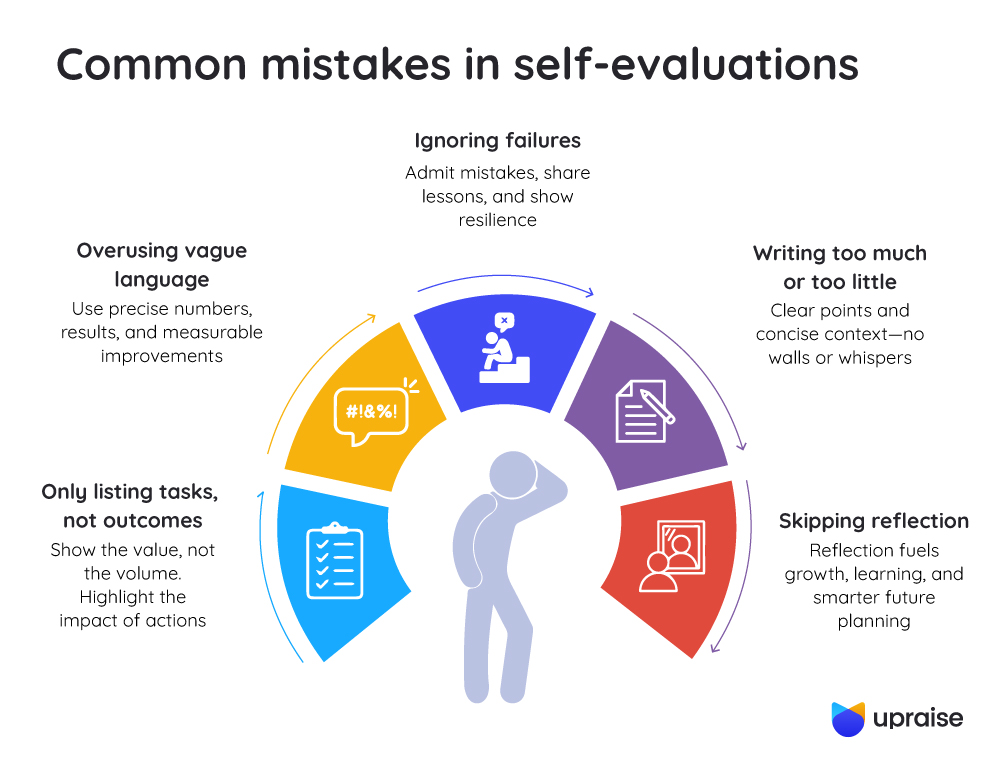
1. Only listing tasks, not outcomes
Saying “completed five user stories” sounds like progress, but without explaining the outcome or value, it doesn’t say much. Instead, connect it to impact: Did it improve delivery speed? Reduce bugs? Support a product launch?
2. Overusing vague language
Phrases like “helped the team” or “supported development” don’t give your manager much to go on with. Be specific. If you refactored a legacy module to improve load time by 30%, say that.
3. Ignoring failures
It’s okay to admit you underestimated a sprint or struggled with stakeholder feedback, as long as you talk about how you handled it.
4. Writing too much or too little
A wall of text is hard to read. But so is a two-sentence review. A good employee performance evaluation example hits the balance: clear points, short context, and just enough detail to show your thinking.
5. Skipping reflection
Skipping reflection can weaken team retrospectives and block continuous improvement. Just saying “met sprint goals” isn’t enough. Take a moment to reflect on the following: did you learn something new, change how you plan, or adapt to feedback?
Avoiding these mistakes makes your self-evaluation easier and useful for both you and your manager.
Examples of employee self-evaluation phrases
Use these ready-to-edit phrases when you’re stuck finding the right words. Each one is direct and grounded, but make sure to edit these to give a personal touch.
1. Performance and results
- “Consistently delivered sprint goals on time and contributed to a 15% reduction in backlog items.”
- “Improved estimation accuracy by reviewing story points after each retrospective.”
- “Met all key OKRs for the quarter, including resolving 40+ customer issues within SLA.”
2. Collaboration and teamwork
- “Proactively supported teammates during high-pressure sprint weeks without letting my own tasks slip.”
- “Facilitated smoother handoffs between dev and QA by initiating shared checklists.”
- “Actively participated in daily stand-ups and retros to improve team coordination.”
3. Learning and growth
- “Took ownership of learning React for the new module, resulting in faster feature delivery.”
- “Acted on peer feedback by improving my pull request summaries for clarity.”
- “Began mentoring a junior teammate and helped them close their first user story independently.”
4. Problem-solving and initiative
- “Identified a recurring blocker in sprint planning and proposed a fix that’s now part of our routine.”
- “Refactored outdated code that had been slowing down deployment pipelines.”
- “Spotted a gap in our sprint review documentation and created a template now used by the team.”
Feel free to tailor these based on your own workflow. Slip them into any employee evaluation template, and it will sound like a real person talking about their achievements and failures.
How to set goals during a self-evaluation
Goals in a self-evaluation are a way for you to decide what matters next, whether that’s improving something you struggled with, building on what worked, or picking up a new skill you’ve been avoiding.
You don’t need to write a five-year plan. One or two clear goals that tie into your day-to-day work are enough.
Use these tips while setting goals:
- Make it relevant to your role: Focus on something you actually deal with in your sprints. For example, “Reduce rollovers by improving story point estimates” is more grounded than “Improve productivity.”
- Turn habits into goals: Not everything needs to be outcome-based. You can set a habit like “Review PRs within 24 hours” or “Check in with the QA team before closing tickets.”
- Use recent roadblocks as clues: If you missed deadlines because of unclear stories, your goal could be “Clarify user stories with the PM before sprint planning.” Keep it practical.
- Include one goal for growth: This could be something like “Learn how to write better unit tests” or “Join a sprint demo I’m not presenting in, just to learn how others pitch.”
- Structure it using a simple employee evaluation template: Templates help you keep your goals short and focused. Add 1–3 goals at maximum; anything more will either be ignored or forgotten.
Conclusion
A strong employee self-evaluation is a clear and honest reflection of how you work, where you’ve grown, and what you want next. We broke down why writing a self-evaluation matters, how to avoid common mistakes, and how to set goals that actually connect with your day-to-day work. We also shared ready-to-use employee performance evaluation examples and tips to help you write one that feels real and not robotic.
Try a few of the self-evaluation phrases we shared. See what feels true to your experience.
FAQs
Q. How do I start writing my self-evaluation?
Start by reviewing your goals from the past sprint, quarter, or review period. Think about what you’ve accomplished, where you faced challenges, and how your work contributed to the team’s progress.
Q. What should I include in my employee self-evaluation?
Include key achievements, challenges you overcame, lessons learned, and goals for the future. Use specific examples that show impact, like improved processes, collaboration wins, or measurable results from your work.
Q. How do I assess my performance in a self-evaluation?
Look at the goals you set and how well you met them. Use data where possible, like story points completed, project milestones, or customer feedback, to support your assessment, and reflect honestly on both strengths and areas for improvement.
Q. Why is a self-evaluation important for my career growth?
It gives you a chance to actively shape how your performance is understood, rather than leaving it entirely in your manager’s hands. A well-written self-evaluation shows you’re self-aware, focused, and ready for growth, which can open up new opportunities over time.

